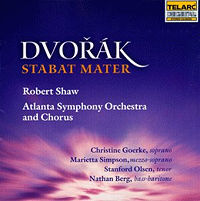
DVORÁK: Stabat Mater
Christine Goerke, soprano; Marietta Simpson, mezzo-soprano; Stanford Olsen, tenor; Nathan Berg, bass-baritone; Atlanta Symphony Orchestra & Chorus, Robert Shaw
Telarc 2CD-80506 (2 CDs). 1999. Robert Woods, prod.; Michael Bishop, eng. DDD. TT: 85:49
Performance ****
Sonics ***** In the best "can-do" American tradition, Robert Shaw wasn't just a great choral conductor but a ceaselessly useful one. Upon forming the Robert Shaw Chorale, he took the Mozart Requiem on tour to the hinterlands. Upon building the Atlanta Symphony Orchestra into a significant regional ensemble, he didn't clutter up the recording market with more Also sprach Zarathustras that the world didn't need. He recorded what he did distinctively—the choral classics in his beautifully blended, translucent sound—though always with his eyes to the horizon, particularly when grateful American composers began writing music for the voice again. Though Shaw's manner became so specific that the chronological extremes of his repertoire—J.S. Bach at one end, John Adams at the other—didn't fare terribly well, he was always keen to give mainstream exposure to composers who needed it. So it is only appropriate that his final recording, made in January just weeks before his death, was Dvorák's neglected Stabat Mater.
In the interview recorded by National Public Radio that's heard at the end of the second CD, the octogenarian conductor expresses astonishment that this 1880 piece had been so neglected. Shaw himself hadn't known about it until recent years, which seems strange considering that there have been at least four major recordings, several of them excellent. But for those who don't care for the relatively strident Eastern European style of vocal production, Shaw's might as well be the first recording. The piece itself is curious: Though the choral/orchestral medium demands a large, public expression, Dvorák often sets the ancient, 10-part text—about the Virgin Mary grieving at the foot of the cross for her dying son—with relatively humble, folklike melodies, equally simple rhythms, and relatively unadventurous harmonic textures. Not all passages of the text inspired him, and, by the standard of his great masterworks, the Stabat Mater seems to have had Dvorák operating at between 40% and 70% of his full strength.
Of course, even barren Dvorák is at least ingratiating, particularly when rendered in Shaw's luminous choral sound, which has always been caught so well by Telarc's fulsome, unfussy sonics. Whenever there are interesting bits of counterpoint, Shaw is sure to point them out without undue spotlighting. He brings a nice flow to the question-and-answer-style antiphony in the "Fac me vere tecum flere" passage, and a welcome, Lohengrin-like religiosity to the soprano-tenor duet, "Fac, ut portem Christi mortem." Vocal soloists seem to have been chosen for how well they walk the line between operatic amplitude and the more intimate manner of oratorio singers. The results lack vocal glamour but conspire to make a recording that draws you into the music rather than focusing the ear on surface-level sheen. In typical Shaw fashion, this recording doesn't leave you marveling at the conductor's interpretive ingenuity or originality. You're left enjoying what's there in the music—which is the kind of legacy that any true musician strives for.—David Patrick Stearns
Christine Goerke, soprano; Marietta Simpson, mezzo-soprano; Stanford Olsen, tenor; Nathan Berg, bass-baritone; Atlanta Symphony Orchestra & Chorus, Robert Shaw
Telarc 2CD-80506 (2 CDs). 1999. Robert Woods, prod.; Michael Bishop, eng. DDD. TT: 85:49
Performance ****
Sonics ***** In the best "can-do" American tradition, Robert Shaw wasn't just a great choral conductor but a ceaselessly useful one. Upon forming the Robert Shaw Chorale, he took the Mozart Requiem on tour to the hinterlands. Upon building the Atlanta Symphony Orchestra into a significant regional ensemble, he didn't clutter up the recording market with more Also sprach Zarathustras that the world didn't need. He recorded what he did distinctively—the choral classics in his beautifully blended, translucent sound—though always with his eyes to the horizon, particularly when grateful American composers began writing music for the voice again. Though Shaw's manner became so specific that the chronological extremes of his repertoire—J.S. Bach at one end, John Adams at the other—didn't fare terribly well, he was always keen to give mainstream exposure to composers who needed it. So it is only appropriate that his final recording, made in January just weeks before his death, was Dvorák's neglected Stabat Mater.
 |  |
|