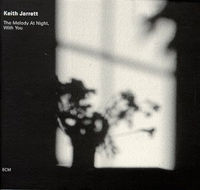
KEITH JARRETT: The Melody at Night, With You
Keith Jarrett, piano
ECM 1675 (CD). 1999. Keith Jarrett, prod., eng.; Manfred Eicher, prod. DDD. TT: 55:18
Performance ****1/2
Sonics ****? It's said that a poem should always risk, but never succumb to, the sentimental—ie, unearned emotion. Practitioners of the art of jazz-standard balladry up that ante: they take as raw material songs that, in words or music or both, almost always are sentimental themselves, and try to make of them something more, even as they leach away excess sweetener. Keith Jarrett has often been accused—mostly falsely, I think—of burgeoning sentimentality, particularly in his improvised solo concerts, but he has never risked that cheapest of emotions as fully as he does in his new solo-piano disc, The Melody at Night, With You.
With Gary Peacock and Jack DeJohnette, Jarrett has already released no less than 16 CDs' worth of selections from the Great American Songbook, including two re-re-recorded here; you'd think he might have little left to say. But the tracks on Melody at Night make music of a sort very different from that of the more ebullient Standards trio. These are deeply intimate, interior, ruminative meditations ("Meditation" is the title of the disc's single Jarrett original) on what seem these songs' very souls, and it's remarkable to hear someone with chops as awesome as Jarrett's so consistently not use them. The one exception, Ellington's "I Got It Bad and That Ain't Good," on which Jarrett rips off some effortlessly long, graceful runs, is virtuosic in a way that sounds, in this context, almost wrong. Which constitutes a testament to the delicacy and power of the mood Jarrett creates here. Those familiar with his catalog will find on Melody at Night an entire disc that shares the special tenderness and quiet of "Over the Rainbow" (La Scala, ECM 1640) and "Hourglass, Part 2" (Staircase, ECM 1090/91). Though he does play harmonic and rhythmic variations on at least some of these well-worn tunes, the overall impression is more one of Jarrett simply playing through each song several times, each time at a level of musicality and spareness more quiet, deep, and profound.
It's hard to imagine even Bill Evans, to whom Jarrett is most often compared, playing this simply or this quietly this well. At his best, guitarist John Fahey also achieves this kind of stillness, whether playing folk, blues, or old Protestant hymns: while seeming to do little more with a song than merely playing its tune and chord progression, Jarrett and Fahey somehow make you hear it as if for the first time. We're used to thinking of songs like Gershwin's "Someone to Watch Over Me" and Heyman-Levant's "Blame It On My Youth," both of which Jarrett covers here, as inexhaustible wells that even improvisers of average talents can essay successfully, and they remain so on this disc. But "My Wild Irish Rose"? "Shenandoah"? Jarrett plays the former as a lullaby, the latter as a hymn. The challenge he's set himself here is one of restraint, and he meets it on every track but the Ellington. This is the paradigmatic example of the "more" that less is so often claimed to be. There's also an exquisite hesitancy here that I've never heard in Jarrett's playing before. He has spoken often of how important it is to be "in the moment" when improvising, but that feeling of hearing him discover, second by second, note by note, what the true nature of each of these songs is, has never been so literally palpable—listening to this record, it seems as if one is inside Jarrett's fingers as they touch the keys, still not sure which ones will be pressed. I sometimes had the eerie feeling that I was a fly on the walls of the rooms in which Jerome Kern or Oscar Levant or George Gershwin gave birth to these songs, their fingers fumbling occasionally, stopping time to linger over a chord, letting it ring while waiting to hear what the next chord or note might be. Remarkable.
The sound, too, is different from any Jarrett has received in his nearly 30 years of recording for ECM. This very close, very dry recording was engineered by Jarrett himself at his home studio, with none of the sumptuously wet reverberation so loved and so well deployed by ECM founder-producer Manfred Eicher. That sort of sound would have been as wrong for this session as would a bravura display of digital pyrotechnics: Jarrett was clearly playing to the room. This is chamber music. Jarrett has dedicated the album to his wife, Rose Anne Jarrett. It does sound like a love letter, teetering constantly on the edge of the sentimental abyss without once falling in. The Melody at Night, With You is Keith Jarrett's smallest, bravest, most elemental recording, one that seems determined to not bowl anyone over—its only virtuoso turns are those of silence. It wasn't until I'd heard it three or four times that I began to realize it just might be the best thing he's done.—Richard Lehnert
Keith Jarrett, piano
ECM 1675 (CD). 1999. Keith Jarrett, prod., eng.; Manfred Eicher, prod. DDD. TT: 55:18
Performance ****1/2
Sonics ****? It's said that a poem should always risk, but never succumb to, the sentimental—ie, unearned emotion. Practitioners of the art of jazz-standard balladry up that ante: they take as raw material songs that, in words or music or both, almost always are sentimental themselves, and try to make of them something more, even as they leach away excess sweetener. Keith Jarrett has often been accused—mostly falsely, I think—of burgeoning sentimentality, particularly in his improvised solo concerts, but he has never risked that cheapest of emotions as fully as he does in his new solo-piano disc, The Melody at Night, With You.
 |  |
|