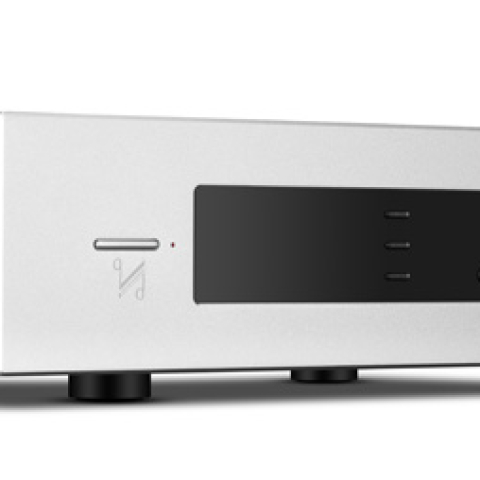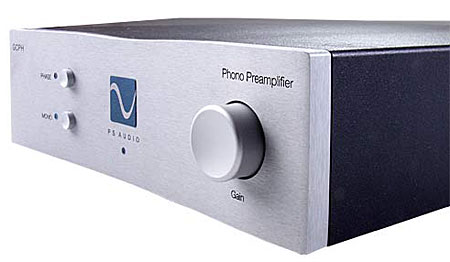
PS Audio's first product, back in 1973, was a standalone phono stage; more recently, their PCA-2 preamp had an optional phono board. The GCC-100 integrated amplifier that I review this month has no room inside for a phono board, so they've gone back to producing a separate phono stage: the GCPH ($995). Like the other products in PS Audio's current line, this one is based on the Gain Cell, one module on the input side connecting to the cartridge, followed by a passive RIAA curve (with a claimed accuracy of 0.1dB over the 40dB range of the curve), and another Gain Cell on the output side.
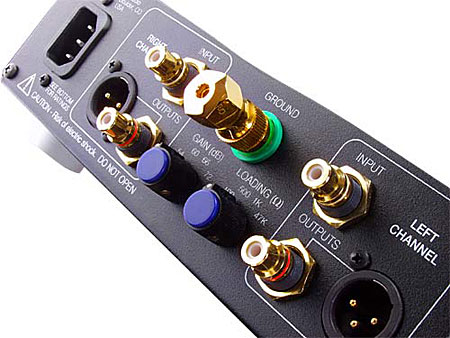
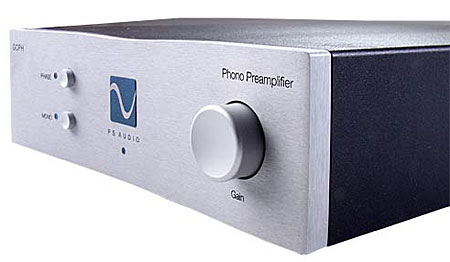 The GCPH runs in a fully differential mode and accommodates moving-coil and moving-magnet cartridges. Controls in the rear set cartridge resistance loading and the gain for the input amplifier. The output of the GCPH is high enough to drive a power amplifier, and the GCPH has a front-panel volume control, so a purist vinyl lover could connect it directly to an amplifier. The GCC-100 has unbalanced RCA as well as balanced XLR outputs; I used the balanced outputs (via a 5m pair of balanced Nordost Quattro Fils interconnects) to drive the GCC-100's balanced input.
Although I was initially told that the GCPH I received was the final version, I was subsequently informed that they've since added two more switches, for mono/stereo and phase reversal. Stereophile's editorial policy is not to review preproduction prototypes, but the added switches should have no effect on the GCPH's sound. In any case, this is more of a preview than a review as such. My reference preamp is a Convergent Audio Technology SL-1 Ultimate, which has a built-in phono stage, and I really don't have the experience with outboard phono stages to be able to put the performance of the GCPH in proper context. Also, my listening to LPs is rather sporadic, and not so much for sound quality as for content: much of my LP collection is sufficiently obscure that it has not been—and is unlikely to be—released on CD, let alone SACD or DVD-Audio.
The GCPH runs in a fully differential mode and accommodates moving-coil and moving-magnet cartridges. Controls in the rear set cartridge resistance loading and the gain for the input amplifier. The output of the GCPH is high enough to drive a power amplifier, and the GCPH has a front-panel volume control, so a purist vinyl lover could connect it directly to an amplifier. The GCC-100 has unbalanced RCA as well as balanced XLR outputs; I used the balanced outputs (via a 5m pair of balanced Nordost Quattro Fils interconnects) to drive the GCC-100's balanced input.
Although I was initially told that the GCPH I received was the final version, I was subsequently informed that they've since added two more switches, for mono/stereo and phase reversal. Stereophile's editorial policy is not to review preproduction prototypes, but the added switches should have no effect on the GCPH's sound. In any case, this is more of a preview than a review as such. My reference preamp is a Convergent Audio Technology SL-1 Ultimate, which has a built-in phono stage, and I really don't have the experience with outboard phono stages to be able to put the performance of the GCPH in proper context. Also, my listening to LPs is rather sporadic, and not so much for sound quality as for content: much of my LP collection is sufficiently obscure that it has not been—and is unlikely to be—released on CD, let alone SACD or DVD-Audio.
 Judged on its own merits, using my fully updated Linn Sondek LP12 turntable with a Linn Ittok tonearm, the GCPH performed very well indeed. The noise level with the low-output AudioQuest 7000nsx cartridge was low enough not to present a problem, and the sound had the same sort of tonal neutrality, combined with high resolution of detail, that characterized the GCC-100.
Perhaps Michael Fremer, whose experience includes using such price-no-object phono stages as the Balanced Audio Technology VK-P10SE ($8000) and the Boulder 2008 ($29,000), could find fault with the performance of the GCPH, but I can't. I would be quite happy to use it in combination with the GCC-100.
Judged on its own merits, using my fully updated Linn Sondek LP12 turntable with a Linn Ittok tonearm, the GCPH performed very well indeed. The noise level with the low-output AudioQuest 7000nsx cartridge was low enough not to present a problem, and the sound had the same sort of tonal neutrality, combined with high resolution of detail, that characterized the GCC-100.
Perhaps Michael Fremer, whose experience includes using such price-no-object phono stages as the Balanced Audio Technology VK-P10SE ($8000) and the Boulder 2008 ($29,000), could find fault with the performance of the GCPH, but I can't. I would be quite happy to use it in combination with the GCC-100.
The GCPH runs in a fully differential mode and accommodates moving-coil and moving-magnet cartridges. Controls in the rear set cartridge resistance loading and the gain for the input amplifier. The output of the GCPH is high enough to drive a power amplifier, and the GCPH has a front-panel volume control, so a purist vinyl lover could connect it directly to an amplifier. The GCC-100 has unbalanced RCA as well as balanced XLR outputs; I used the balanced outputs (via a 5m pair of balanced Nordost Quattro Fils interconnects) to drive the GCC-100's balanced input.
Although I was initially told that the GCPH I received was the final version, I was subsequently informed that they've since added two more switches, for mono/stereo and phase reversal. Stereophile's editorial policy is not to review preproduction prototypes, but the added switches should have no effect on the GCPH's sound. In any case, this is more of a preview than a review as such. My reference preamp is a Convergent Audio Technology SL-1 Ultimate, which has a built-in phono stage, and I really don't have the experience with outboard phono stages to be able to put the performance of the GCPH in proper context. Also, my listening to LPs is rather sporadic, and not so much for sound quality as for content: much of my LP collection is sufficiently obscure that it has not been—and is unlikely to be—released on CD, let alone SACD or DVD-Audio.
Judged on its own merits, using my fully updated Linn Sondek LP12 turntable with a Linn Ittok tonearm, the GCPH performed very well indeed. The noise level with the low-output AudioQuest 7000nsx cartridge was low enough not to present a problem, and the sound had the same sort of tonal neutrality, combined with high resolution of detail, that characterized the GCC-100.
Perhaps Michael Fremer, whose experience includes using such price-no-object phono stages as the Balanced Audio Technology VK-P10SE ($8000) and the Boulder 2008 ($29,000), could find fault with the performance of the GCPH, but I can't. I would be quite happy to use it in combination with the GCC-100.