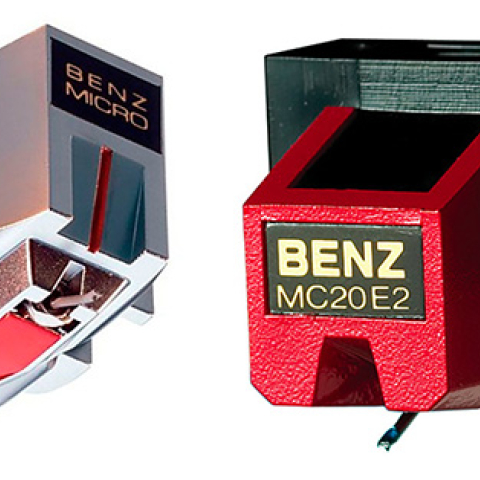
The ceiling remains, but the floor has changed: Benz-Micro continues to offer a selection of rather expensive phono cartridges, including their well-established LP Ebony ($4700) and Ruby 3 ($3000) models. But in recent years, my attention has been drawn by the succession of budget Benzes: first, the Gliders ($795), then the ACEs ($550), and now the MC20E2-L ($199).
 Actually, this particular Benz has been here before, but never with such a low output: The enduring MC20EII ($199) puts out a generous 2.5mV. But those who think of sub-millivolt cartridges as purer, quicker, and altogether better than their louder counterparts, and who don't mind having an extra gain stage between their phonographs and their preamps, will greet the MC20E2-L as an especially welcome newcomer.
And why not? Until recently, and apart from the long-legged Denon 103 and Signet OC9, virtually every inexpensive moving-coil cartridge has also been a high-output moving-coil cartridge. It's reasonable for the industry to try to attract new consumers to the genre by sparing them the expense of a transformer or pre-preamp; but in 2007, with sales of LPs and playback gear on a continuing upswing, one assumes there are a number of record lovers who are interested in buying a first—or perhaps even a spare—moving-coil cartridge, yet who have all the gain they need.
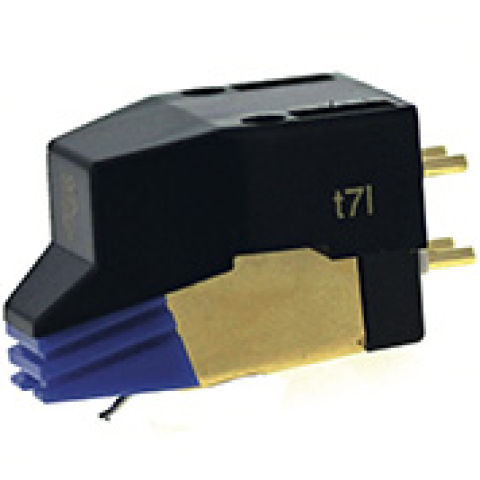
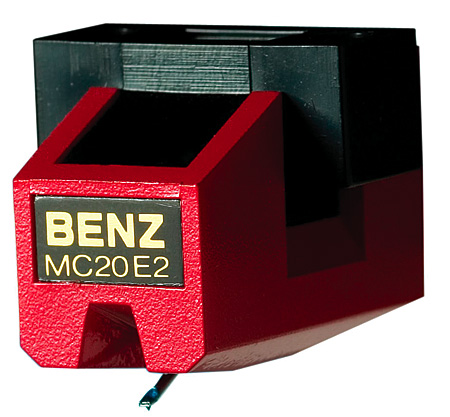
The MC20E2-L doesn't resemble much of anything else in the current Benz-Micro line. If anything, it bears a striking if coincidental resemblance to the Ortofon X-MC high-output cartridges of the late 1980s, if somewhat more plasticky and a good deal more pink. The newest Benz weighs a scant 3.26gm without its stylus guard, and I was surprised to discover that it could be made even smaller and lighter by pulling its black plastic mounting block away from the rest of the body, into which it's otherwise snugly pressed.
The Benz uses a V-shaped coil former rather than the more common cross, with just a single coil per channel, wound generously with exceedingly fine copper wire: At 32 ohms, the MC20E2-L is a source of somewhat higher impedance than most low-output cartridges. The damper is shiny black rubber, and the cantilever is a good old-fashioned aluminum tube, flattened and creased at its business end. A square-shank diamond with an elliptical tip is punched into place from above, and secured with what appears to be a tiny drop of Loc-Tite or similar adhesive. In my sample, the alignment of the coil and pole-piece was acceptably good, while the centering of the cantilever and alignment of the stylus were excellent: Apparently, the most painstaking work was applied to those aspects of construction that directly affect record and stylus wear—the best approach to making a budget phono cartridge.
Installation and setup
Actually, this particular Benz has been here before, but never with such a low output: The enduring MC20EII ($199) puts out a generous 2.5mV. But those who think of sub-millivolt cartridges as purer, quicker, and altogether better than their louder counterparts, and who don't mind having an extra gain stage between their phonographs and their preamps, will greet the MC20E2-L as an especially welcome newcomer.
And why not? Until recently, and apart from the long-legged Denon 103 and Signet OC9, virtually every inexpensive moving-coil cartridge has also been a high-output moving-coil cartridge. It's reasonable for the industry to try to attract new consumers to the genre by sparing them the expense of a transformer or pre-preamp; but in 2007, with sales of LPs and playback gear on a continuing upswing, one assumes there are a number of record lovers who are interested in buying a first—or perhaps even a spare—moving-coil cartridge, yet who have all the gain they need.
The MC20E2-L doesn't resemble much of anything else in the current Benz-Micro line. If anything, it bears a striking if coincidental resemblance to the Ortofon X-MC high-output cartridges of the late 1980s, if somewhat more plasticky and a good deal more pink. The newest Benz weighs a scant 3.26gm without its stylus guard, and I was surprised to discover that it could be made even smaller and lighter by pulling its black plastic mounting block away from the rest of the body, into which it's otherwise snugly pressed.
The Benz uses a V-shaped coil former rather than the more common cross, with just a single coil per channel, wound generously with exceedingly fine copper wire: At 32 ohms, the MC20E2-L is a source of somewhat higher impedance than most low-output cartridges. The damper is shiny black rubber, and the cantilever is a good old-fashioned aluminum tube, flattened and creased at its business end. A square-shank diamond with an elliptical tip is punched into place from above, and secured with what appears to be a tiny drop of Loc-Tite or similar adhesive. In my sample, the alignment of the coil and pole-piece was acceptably good, while the centering of the cantilever and alignment of the stylus were excellent: Apparently, the most painstaking work was applied to those aspects of construction that directly affect record and stylus wear—the best approach to making a budget phono cartridge.
Installation and setup
I wound up trying the Benz MC20E2-L in three different tonearms, at least two of which are germane to this price point: the Naim Aro ($3050), the current basic version of the Well-Tempered Arm ($1007), and the perennially recommendable Rega RB300 ($395).
Owners of the Naim, which is not adjustable for overhang, will be pleased to know that the Benz's stylus-to-mounting-hole distance is extremely close to the "Linn standard" around which their favorite arm was designed: In my sample of the Aro, the MC20E2-L exhibited only a bit too much (about 1mm) overhang, which could surely be adjusted out with extra care during turntable setup. While I'm on the subject of the Aro, I'll also mention that the Benz performed best with that arm's azimuth weight at its innermost position (ie, closest to the unipivot bearing), and that it responded well to having the bias weight at its next-to-highest setting. The best downforce was 2gm on the nose, which was also true with the Well Tempered Arm; for its part, the Rega did the job at a hair under 2gm. (All tracking forces were measured with a Technics SH-50P1 electronic stylus-pressure gauge.)
All of the above can be thought of as medium-mass tonearms, the first two falling squarely on the low side of medium. And here's the thing: Given its medium-low compliance, one might expect the MC20E2-L to perform slightly better in a tonearm that's on the high side of medium—a concern that, if anything, is sharpened by the cartridge body's own extremely low mass. The solution is a 3gm spacer that's supplied with the MC20E2-L, intended to be used between it and the headshell.
I tried it both ways, and was left with no doubt that the spacer is mandatory. Without the spacer, using the Benz in my Naim Aro tonearm, the cartridge-arm combination exhibited undesirably high resonant frequencies, according to the test record (HFN 001) created by UK magazine Hi-Fi News & Record Review: 13Hz in the lateral plane, and an eyebrow-raising 16Hz in the vertical plane. With the 3gm spacer in place, those numbers dropped to an almost ideal 11Hz and 12Hz, respectively.
Shoppers who wish to use the Benz MC20E2-L in a Rega RB300 or variant should note that the 3gm spacer is approximately 0.05" thick; if you use it, as you probably should, you'll also want to shim the arm itself by a similar amount, to maintain acceptable arm height and thus vertical tracking angle.
Having done all of the above and more in recent weeks, I can assure you: None of it is very difficult. In any event, cartridge loading was even more straightforward: The Benz MC20E2-L spent all of its time playing through step-up transformers, and most of that time playing through the standard transformers in the Shindo Masseto preamplifier (see July's "Listening" p.39).
Listening
I don't recall whether Musical Surroundings, Benz-Micro's US distributor, had run in the MC20E2-L before shipping it to me, but its sound didn't change very drastically during its time here. If anything, the cartridge exhibited slightly better tracking behavior toward the end of its stay—but that may have had more to do with increasing ambient temperatures than anything else. (The Benz arrived in late April and went back home in mid-June, and so coped with daytime temps ranging from the 40s to the 80s.)
Actually, this particular Benz has been here before, but never with such a low output: The enduring MC20EII ($199) puts out a generous 2.5mV. But those who think of sub-millivolt cartridges as purer, quicker, and altogether better than their louder counterparts, and who don't mind having an extra gain stage between their phonographs and their preamps, will greet the MC20E2-L as an especially welcome newcomer.
And why not? Until recently, and apart from the long-legged Denon 103 and Signet OC9, virtually every inexpensive moving-coil cartridge has also been a high-output moving-coil cartridge. It's reasonable for the industry to try to attract new consumers to the genre by sparing them the expense of a transformer or pre-preamp; but in 2007, with sales of LPs and playback gear on a continuing upswing, one assumes there are a number of record lovers who are interested in buying a first—or perhaps even a spare—moving-coil cartridge, yet who have all the gain they need.
I wound up trying the Benz MC20E2-L in three different tonearms, at least two of which are germane to this price point: the Naim Aro ($3050), the current basic version of the Well-Tempered Arm ($1007), and the perennially recommendable Rega RB300 ($395).
I don't recall whether Musical Surroundings, Benz-Micro's US distributor, had run in the MC20E2-L before shipping it to me, but its sound didn't change very drastically during its time here. If anything, the cartridge exhibited slightly better tracking behavior toward the end of its stay—but that may have had more to do with increasing ambient temperatures than anything else. (The Benz arrived in late April and went back home in mid-June, and so coped with daytime temps ranging from the 40s to the 80s.)