If you think I burned out cartridge-wise at the end of my and JE's It's A Mad Mad Mad Mad World cartridge survey at the beginning of the year (Vol.18 Nos.1 & 2), you're wrong. If you think I ought to burn out and give it a rest, you'll be disappointed. If you think analog doesn't matter anymore, you have my semi-sincere condolences. But if you think, as I do, that analog is enjoying a resurgence of epic proportions (twilight or no), and that LP playback has reached a new zenith of musical wonder, then hang on—here I go again!
 As mentioned in the Survey wrap-up, my high-rez, high-mileage van den Hul Grasshopper III Gold gave up the ghost at the end of a long and distinguished career of delivering the musical goods. This just as the Survey began, so a 'Hopper III slash Symphonic Line RG-8 comparison was not to be. A.J. van den Hul (or Pope Stylus, as he's known in Germany) replaced my tired old 'Hopper III with a brand-new-for-'95 Grasshopper IV Gold sometime after the Survey; the lurid details follow.
Technology & the new look
As mentioned in the Survey wrap-up, my high-rez, high-mileage van den Hul Grasshopper III Gold gave up the ghost at the end of a long and distinguished career of delivering the musical goods. This just as the Survey began, so a 'Hopper III slash Symphonic Line RG-8 comparison was not to be. A.J. van den Hul (or Pope Stylus, as he's known in Germany) replaced my tired old 'Hopper III with a brand-new-for-'95 Grasshopper IV Gold sometime after the Survey; the lurid details follow.
Technology & the new look
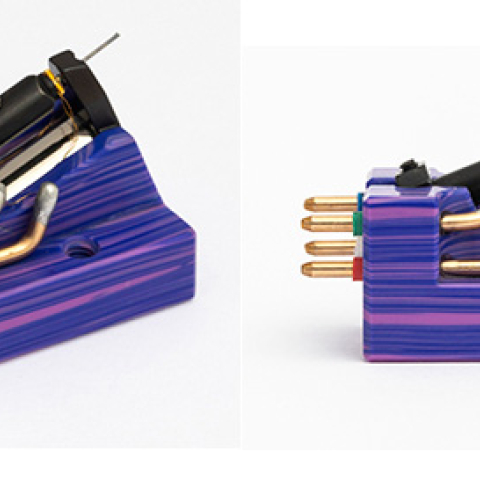
During a pressurized 30 minutes at the 1995 WCES, I talked with A.J. van den Hul about the new Grasshopper IV while a cast of thousands crowded in to see him. He was extremely pleasant, and put off with chunks of Dutch chocolate the milling throng clamoring for his attention. As an interviewing guest, I was offered a few pieces, too! Here's what I learned between bites. The Grasshopper IV uses only a special soft, monocrystal, 24k, enamel-insulated gold wire of the highest purity for its coil, which means significantly, according to A.J., that many electrons are available for conductivity, very few for binding the atoms together. As gold is chemically inert, there's no physical degradation: "You get the same sound on the first day as on the last day, so to speak. It doesn't change because of mechanical or chemical properties of the environment," the Stylus Pope explained. The IV's output pins are wired to the coil assembly with color-coded, nylon-insulated, monocrystal silver Litz wire.
The Grasshopper IV makes use of what A.J. called a Weisz-complex–free armature. Upon seeing my questioning demeanor, A.J. elucidated. Herr Weisz was a German who discovered that ferromagnetic materials don't change their magnetic polarity per atom, but rather in groups. The higher the number of groups in this so-called "step-function," the higher the noise level created. A.J. claims his implementation of these concepts results in "an almost step-function–free armature resulting in an enhanced sense of resolution and spaciousness due to the much lower noise floor. This noise floor is partly modulation noise and partly surface noise, so when you eliminate the modulation noise, extremely-low-level information is no longer masked, and that means the senses of spaciousness and resolution improve quite a lot."
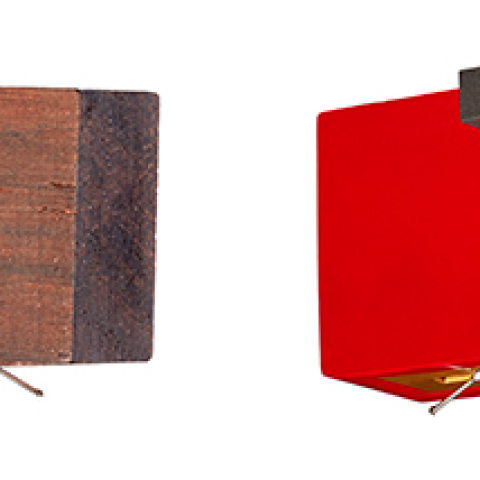
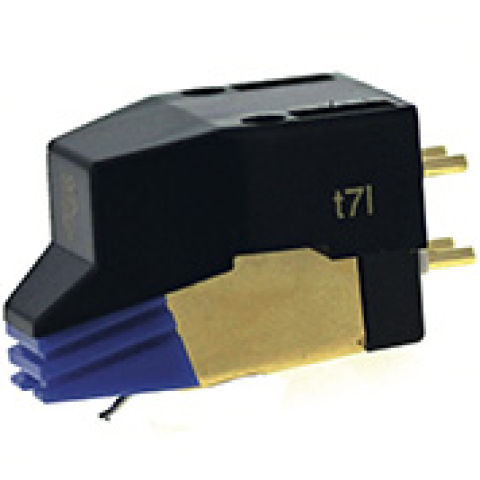
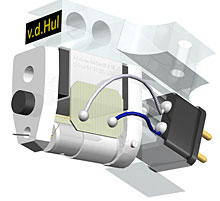
The Grasshopper IV is comparatively svelte at 8.2 grams, compared with the Symphonic Line RG-8's massive 18gm. The IV's polycarbonate body has a completely different look from that of the 'Hopper III and the Symphonic Line—its shape has been fashioned expressly to reduce mechanical resonances. A.J.: "The polycarbonate works as a buffer between minor vibrations of the motor and the tuning of sensitive tonearms, giving a quieter, lower coloration presentation, with higher purity and resolution."
The Grasshopper IV is made with a square armature to improve the output voltage and dynamics—the Grasshopper III and RG-8 use cross-shaped armatures. "With the cross shape you have less iron, and less output per number of turns. This square armature actually doubles the volume of iron. The more iron involved, the higher the output—resolution of low-level signals is getting better because it still falls in the limits of what can be achieved with a cross or pure air coil. It's a special iron we use that's also Weisz-complex–free—so no step-function again.
"The soft iron at the rear and front pole is a minimum of 3mm thick—very few other cartridges use this thickness. This thicker material reduces crosstalk, resulting in less magnetic interaction mixed in with the signal." A.J. also employs Eddy Current Dampers around the magnet and the pole piece, reducing signal-degrading crosstalk. "When you modulate one channel, it also magnetically modulates the other channel—it's the same motor you're using for both," he explained.
When I asked him about the Alnico magnet (an iron alloy with aluminum and nickel) used in the Grasshopper IV (and RG-8), he told me: "We have done a lot of testing and listening, and we have found this very fine Alnico magnet, which we chose purely for its sonical characteristics. Although costly, we feel this is the best to use." The Alnico magnet leads to a very satisfactory 0.55mV output.
I was pleasantly surprised to learn that each cartridge is custom-built: "It's not that we build a standard series with some variations," explained A.J. "Each Grasshopper IV is built special-order, depending on the tonearm, load impedance, or particular type of music the owner wants to play. For instance, classical music needs lots of space, but jazz more dynamics. We do this with careful adjustment of the two types of rubber in the suspension, and by reducing or widening the gap between the front and rear poles. It's very personalized."
I like the concept. The fellow building these cartridges is the same one repairing and adjusting them. And it's not just any fellow—it's the Stylus Pope himself, fulfilling his longterm commitment to analog. Typically, distributor Joyce Fleming at Vanguard learns from the dealer or purchaser the details of their system and musical tastes, and communicates this to A.J. before the cartridge is built. When I asked A.J. how mine was tuned, he informed me it was set for..."Average."
I was crestfallen. Being European and politic (with a well-developed sense of humor), he quickly explained that, since he understood I was interested in all kinds of music—small ensemble to large orchestral, jazz and classical—the unit I had on hand was biased equally between strong dynamics and large soundstage dimensions. You don't especially require the personalized build approach, but at this level of play, why not enjoy the luxury of it?
Twist & shout!
I'd been perplexed in the past by A.J.'s concerns regarding the Grasshoppers and the Forsell linear-tracking air-bearing arm—a combo I've always enjoyed. He believes the undamped sideways motion of any undamped linear arm contributes to Early vdH Demise Syndrome. In any case, I came to "see" what A.J. was talking about.
One day, I carefully observed the RG-8 as I set it down on an LP. The cartridge's bulky mass scooted to the beginning of play, pulled forward by the lead-in groove to the signal-bearing portion of the spiral. This rapid sprint was suddenly checked as the lead-in spiral "flattened out" and signal began. The energy the cartridge developed rushing toward signal start is quite considerable given the (previous) van den Hul/Symphonic Line's massive body, coupled with the total mass of the tonearm/slider assembly. When the stylus shortstopped and dug into the signal, the cartridge/arm combo overshot and corrected a time or two as it stabilized. I could see the torsional forces on the cartridge's compliance, and it wasn't a pretty sight. In the microworld of LPs, that's a whole lotta twistin' goin' on!
What to do? Simple. If you use any undamped linear-bearing arm, avoid the lead-in groove completely and set your van den Hul down at the beginning of play. Okay, you miss the first beat or two, but you'll miss it anyway as you scurry back to your listening chair! 'Nuff said? No problem. From my experience with the Grasshopper IV, I'd definitely say the entire scenario applied more to the Grasshopper IIIs and RG-8s.
The newly minted Grasshopper IV has more rubber on the road, so to speak, and doesn't get torsional whiplash every time it digs into the signal. In fact, A.J. told me: "The suspension rubber of the Grasshopper IV is more adapted to practical life. The contact surface between the armature and suspension rubber is bigger, what means a lower possibility that it will run out of position." While the Grasshopper IV does give the impression of greater robustness than the Grasshopper III, I still wouldn't take bets on its ability to survive outright mishandling.
Mounting, setup, & play tip sheet
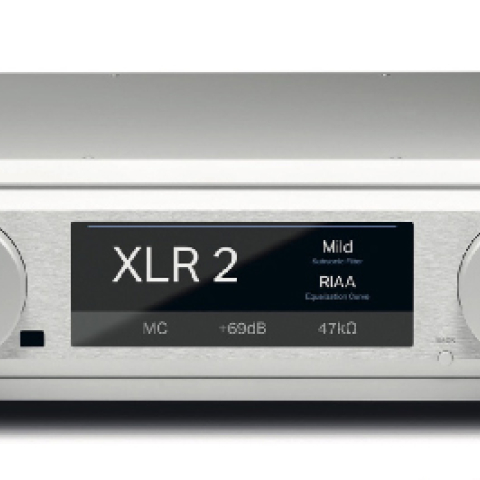
Mounting the Grasshopper IV was a breeze—the polycarbonate is threaded for easy installation with nonmagnetic Allen-head bolts. As I had suspected, it measured significantly better in the crosstalk department than the 'Hopper III or the Symphonic Line RG-8, using the Audio-Technica AT6020 Phono Cartridge Analyzer. (The immediate sense of a huge and super-wide soundstage bore this out neatly.) Its relatively brawny output meant it could be led loose right into the CAT's MM phono inputs. A.J. had told me that the minimum load impedance supported is 200 ohms. "But it sounds very fine at 47k! That's mainly for classical, and 200 ohms for jazz. Anything between—personal choice." Interesting idea tailoring loading to type of music, although you've still got to factor in the preamp's characteristics. (Mostly, although I played around with this, I preferred the CAT at a wide-open 47k ohms load.)
As mentioned in the Survey wrap-up, my high-rez, high-mileage van den Hul Grasshopper III Gold gave up the ghost at the end of a long and distinguished career of delivering the musical goods. This just as the Survey began, so a 'Hopper III slash Symphonic Line RG-8 comparison was not to be. A.J. van den Hul (or Pope Stylus, as he's known in Germany) replaced my tired old 'Hopper III with a brand-new-for-'95 Grasshopper IV Gold sometime after the Survey; the lurid details follow.
Technology & the new look
During a pressurized 30 minutes at the 1995 WCES, I talked with A.J. van den Hul about the new Grasshopper IV while a cast of thousands crowded in to see him. He was extremely pleasant, and put off with chunks of Dutch chocolate the milling throng clamoring for his attention. As an interviewing guest, I was offered a few pieces, too! Here's what I learned between bites. The Grasshopper IV uses only a special soft, monocrystal, 24k, enamel-insulated gold wire of the highest purity for its coil, which means significantly, according to A.J., that many electrons are available for conductivity, very few for binding the atoms together. As gold is chemically inert, there's no physical degradation: "You get the same sound on the first day as on the last day, so to speak. It doesn't change because of mechanical or chemical properties of the environment," the Stylus Pope explained. The IV's output pins are wired to the coil assembly with color-coded, nylon-insulated, monocrystal silver Litz wire.
I'd been perplexed in the past by A.J.'s concerns regarding the Grasshoppers and the Forsell linear-tracking air-bearing arm—a combo I've always enjoyed. He believes the undamped sideways motion of any undamped linear arm contributes to Early vdH Demise Syndrome. In any case, I came to "see" what A.J. was talking about.
Mounting the Grasshopper IV was a breeze—the polycarbonate is threaded for easy installation with nonmagnetic Allen-head bolts. As I had suspected, it measured significantly better in the crosstalk department than the 'Hopper III or the Symphonic Line RG-8, using the Audio-Technica AT6020 Phono Cartridge Analyzer. (The immediate sense of a huge and super-wide soundstage bore this out neatly.) Its relatively brawny output meant it could be led loose right into the CAT's MM phono inputs. A.J. had told me that the minimum load impedance supported is 200 ohms. "But it sounds very fine at 47k! That's mainly for classical, and 200 ohms for jazz. Anything between—personal choice." Interesting idea tailoring loading to type of music, although you've still got to factor in the preamp's characteristics. (Mostly, although I played around with this, I preferred the CAT at a wide-open 47k ohms load.)