I see a pattern taking shape: Roy Gandy's Rega Research offered their first CD player in 1996, which was 13 years after the medium was introduced to the public. Now, in 2006, some 50 years after Joe Grado designed and sold the first moving-coil phono cartridges, Rega has released one of those. The year 2016 may see the first Rega fluoroscope, or perhaps wire recorder. And it'll be a good one, I'm sure.
 It seems that Rega would be the last company on earth to do anything just because everyone else does; thus it comes as no real surprise that Rega would decline to make a moving-coil (MC) cartridge unless and until they had a very good reason to do so. That time has arrived: The Rega Apheta ($1695) is clearly, unambiguously, and purposefully different from everything that's come before it.
Description
It seems that Rega would be the last company on earth to do anything just because everyone else does; thus it comes as no real surprise that Rega would decline to make a moving-coil (MC) cartridge unless and until they had a very good reason to do so. That time has arrived: The Rega Apheta ($1695) is clearly, unambiguously, and purposefully different from everything that's come before it.
Description
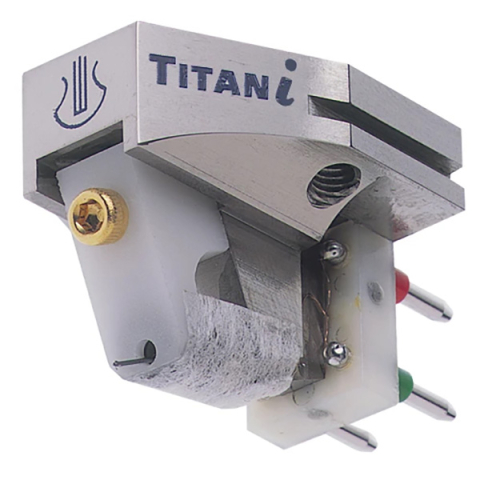
In my thoughts on the Brinkmann EMT Titanium in the August issue, I made a big deal of the fact that an MC cartridge is a simple thing, and that the designer has only a few variables to play with in his or her quest for a certain level of performance. Specifically, as I wrote then, an MC cartridge has a "stylus, cantilever, rubber grommet, tensioning wire, coils, magnet, output pins," and "maybe a body." That doesn't seem like a lot—but it is enough to account for a good variety of often pleasant-sounding designs, many of which are so purely handmade that they reflect the very personalities of their designers.
What I didn't imagine: A clever designer might find a way of omitting one of those variables altogether, for an even simpler and more direct transducer. That's how Rega approached the challenge. Determining that the art of MC cartridge design had changed precious little in 50 years (quite true), they took stock of the progress that's been made in all of the pertinent fields: magnetics, precision machining, synthetic elastomers, those sorts of things. Then they felt compelled to ask: Who needs that tensioning wire, anyway?
Not Rega. Not when rare-earth magnets are available that can be made small and powerful and finely focused. Not when there are modern elastomers that can resist deteriorating and remain pliant over time. Not when the art of machining has progressed to where the physical proximity between two parts can be determined and maintained within microns. Not when tensioning wires are known to resonate within the audioband. Get that tensioning wire the hell out of here—and watch us do some real transduction for a change.
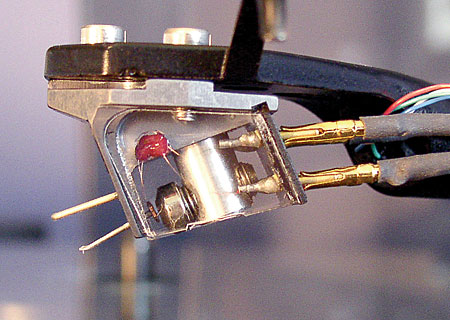
So it was with the Apheta, which, as I write this, Rega began developing in earnest almost three years ago. Aside from the perennially interesting Deccas, the Rega Apheta is the first and only MC cartridge I know of to dispense with a traditional suspension altogether, excepting its fulcrum: The Apheta's long aluminum cantilever passes through a single elastomer grommet in the front surface of its body—and that's all that holds it in place.
At one end of that two-piece (telescoping) cantilever is a nude diamond stylus, ground to a Vital hyperelliptical profile; the other end abuts to a cross-shaped former wound with fine copper wire. The remainder of the Apheta's motor is a neodymium magnet cemented to a threaded mounting apparatus that's adjustable in two planes. (It isn't hard to imagine that the ability to precisely adjust and "focus" the permanent magnet would be uniquely critical in a design such as this. In particular, any future retipping of the cartridge—and any reconditioning of its minimal suspension—would be unthinkable without also being able to adjust the rest of the system.)
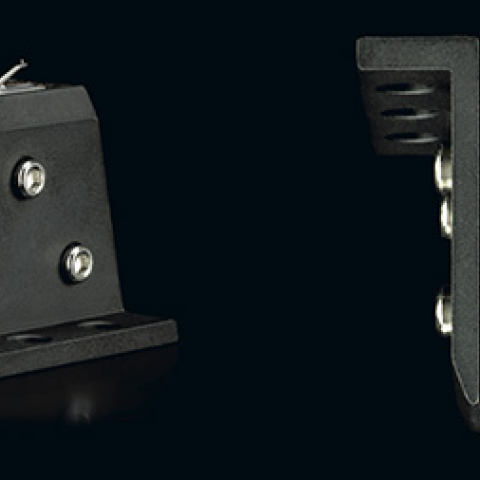
The magnet assembly is sturdily bolted to an open-sided body that's beautifully machined from aluminum alloy, and formed in such a way that the user's headshell makes tight, intimate contact with a stable ridge, as in other recent designs. A thin sheet of clear plastic is glued in place to protect those open sides, and while a stylus guard in the traditional sense isn't supplied, a stiff wire yoke is fastened to the front, just above the cantilever. That piece, which suggests a curb feeler (do they have those in England?), is intended to protect the cantilever against that most common disaster: being bashed against the edge of the record or platter while the arm is being lowered. Threaded holes are provided for three cartridge bolts—but the holes are in accordance with Rega's own proprietary pattern, and not the pattern used for tonearms made by Linn and Naim. The two main bolts, of course, use the industry standard spacing of 0.5", while the frontmost bolt can be added with any contemporary Rega tonearm.
Installation and setup
A Rega tonearm is also where the styling of the Apheta is best appreciated. I didn't notice at first, when I saw the new cartridge in its machined aluminum case—itself supplied in a dashing pinstriped carton that led me to wonder if Rega had finally run out of brown cardboard—but its body is shaped to match the lines of Rega's tonearms. The pairing looked purposeful, almost like a one-piece casting.
Indeed, given that the Rega Apheta's three bolts line up with the openings machined into every Rega headshell, achieving perfect alignment in an all-Rega player is a snap. But keep in mind that Rega's cartridge-alignment scheme is based not on Baerwald geometry (whom I had to look up, even after all these years), but on Gandywald: The template provided with Rega's turntables and tonearms is intended to place one of the two geometrically feasible zero-distortion, or "null," points much closer to the inner grooves, where pinch distortion runs rampant, than other alignment schemes.
Ever the enthusiast, I tried both approaches when I used the Apheta in a Rega RB1000 tonearm; I achieved Baerwald alignment with the aid of a Dennessen Soundtraktor (vale, Frank), removing the front bolt and scooting the cartridge a goodly way forward. I also used the Apheta in a Rega RB300 tonearm and in my long-term favorite, the Naim Aro. In the latter, of course, changes in alignment are impossible, and I was forced to make do with an excessive amount of overhang.
Used in the Rega tonearms, the Apheta cartridge exhibited the best vertical alignment when I used no spacers between the arm base and mounting surface. In all three arms, the best tracking force seemed to be just a frog's whisker over 1.8gm (which my listening tests confirmed, as you'll see below): Thanks to both the Apheta's body design and its lack of a traditional motor suspension, I was able to observe the motor as I lowered the stylus onto a record, seeing quite clearly and unambiguously if and when the coil former and the magnet were in proper alignment. In fact, I enjoyed watching how very small changes in downforce had a significant effect on the juxtaposition of those parts. And you thought I had a life.
While Rega hasn't published any compliance specs on their new cartridge, my experience suggested that the Apheta can be thought of as a pickup of medium-high compliance. According to the very useful Hi-Fi News & Record Review Test Record (LP, HFN 001), the combination of a Rega Apheta cartridge and Rega RB300 tonearm exhibited a resonant frequency of 8Hz laterally and 9Hz vertically; used with my Naim Aro tonearm, the numbers were a respective 9Hz and 10Hz—perfectly acceptable performance in all cases.
Listening
It's too early in this product's history, and my experience with it is too limited, to say that the Rega Apheta will always perform better into an active device than into a voltage-gain transformer, but that's certainly how it sounded to me: The Apheta sounded better driving the perennially recommendable Linn Linto phono preamp (input impedance: 150 ohms) than the EAR 834P, either with the latter's own transformer stage or my external Tamura TKS-83. With the Linn, for instance, piano chords sounded much more real: more forceful than with the trannies, but not at all hard or glassy. As predicted, the Apheta's performance was indeed sensitive to changes in tracking force—more so than with most other cartridges. Right was right, and everything else was very wrong. In both the Rega and Naim tonearms, 1.80–1.85gm did the job; any lower or higher unfocused the music and fuzzied the sound.
It seems that Rega would be the last company on earth to do anything just because everyone else does; thus it comes as no real surprise that Rega would decline to make a moving-coil (MC) cartridge unless and until they had a very good reason to do so. That time has arrived: The Rega Apheta ($1695) is clearly, unambiguously, and purposefully different from everything that's come before it.
Description
In my thoughts on the Brinkmann EMT Titanium in the August issue, I made a big deal of the fact that an MC cartridge is a simple thing, and that the designer has only a few variables to play with in his or her quest for a certain level of performance. Specifically, as I wrote then, an MC cartridge has a "stylus, cantilever, rubber grommet, tensioning wire, coils, magnet, output pins," and "maybe a body." That doesn't seem like a lot—but it is enough to account for a good variety of often pleasant-sounding designs, many of which are so purely handmade that they reflect the very personalities of their designers.
A Rega tonearm is also where the styling of the Apheta is best appreciated. I didn't notice at first, when I saw the new cartridge in its machined aluminum case—itself supplied in a dashing pinstriped carton that led me to wonder if Rega had finally run out of brown cardboard—but its body is shaped to match the lines of Rega's tonearms. The pairing looked purposeful, almost like a one-piece casting.
It's too early in this product's history, and my experience with it is too limited, to say that the Rega Apheta will always perform better into an active device than into a voltage-gain transformer, but that's certainly how it sounded to me: The Apheta sounded better driving the perennially recommendable Linn Linto phono preamp (input impedance: 150 ohms) than the EAR 834P, either with the latter's own transformer stage or my external Tamura TKS-83. With the Linn, for instance, piano chords sounded much more real: more forceful than with the trannies, but not at all hard or glassy. As predicted, the Apheta's performance was indeed sensitive to changes in tracking force—more so than with most other cartridges. Right was right, and everything else was very wrong. In both the Rega and Naim tonearms, 1.80–1.85gm did the job; any lower or higher unfocused the music and fuzzied the sound.