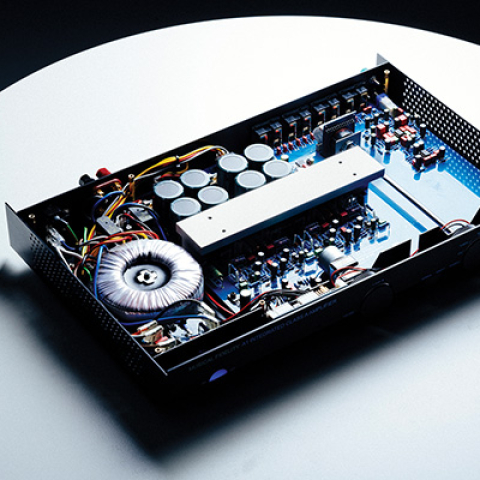
The $395 NAIT, rated at 20Wpc, is a good-sounding little amp. It's very open and spacious-sounding, but, like the $250 Rotel RA-820BX, sometimes sounds a little hard in the upper registers. The real problem with the NAIT, however, is its lack of features. There is no Aux or CD input. If you have a tuner, a tape deck, and a CD player, you're out luck. Of course, you wouldn't need, or even want, a CD player in a Linn/Naim system. (I wonder if Julian Vereker, of Naim, will change his mind about CD now that Linn is producing their own electronics. A Naim high-end CD player might make great competition for Mission and Meridian.) There are also no tone controls on the NAIT, and no moving-coil input. [The phono input is MM-only.—Ed.] The Naim looks very cheaply made, inside and out—like it took $40 worth of parts and $40 worth of labor to build (footnote 1). The unit turns on and off with a fairly loud pop, and has a strange balance control.
All Naim dealers are Linn dealers, too—at least for the time being. You're therefore likely to hear the standard Linn sales pitch: put most of your money into a Linn turntable, equip it with a Linn Basik Plus arm and Basik cartridge, run it into a Naim NAIT driving a pair of Linn Index speakers (and forget about FM, tape, and of course, CD). Summary: spend 48% of your money on the turntable, the other 52% on arm, cartridge, amp, and speakers. Madness? Absolutely! The Linn table is among the best and the Naim NAIT is quite good for what it is, hut such a system is entirely out of balance. The problem with the NAIT isn't sound quality, but lack of features. Overall, it doesn't seem very good value for the money (especially with units like the Rotel available for significantly less).—Sam Tellig
Footnote 1: That's probably about right. With a 5:1 cost-to-retail ratio (which is sometimes worse on imported gear), that $80 translates to a $400 retail. What's amazing is the companies who seem to do so much more for $400.—Sam Tellig
Footnote 1: That's probably about right. With a 5:1 cost-to-retail ratio (which is sometimes worse on imported gear), that $80 translates to a $400 retail. What's amazing is the companies who seem to do so much more for $400.—Sam Tellig