I was the member of the family on whom the others could depend for technical assistance: mending eyeglass frames, fixing the radio, replacing the lightbulb in the oven, getting the car to idle smoothly. No job too big or too small. House calls a specialty.
 That began to change when the world became more dependent on consumer electronics—except for perfectionist audio, of course—and as consumer electronics became more and more dependent on microprocessors. "How do I reset the time on my VCR?" I don't know. "How do I turn off the flash on my camera?" I don't know. "Where are all the songs I downloaded last night?" I don't know.
Slowly but surely, it dawned on my family that I'm an idiot, for the simple reason that I no longer seem to know very much. I chafed at that conclusion, for the simple reason that I shouldn't be expected to know what I can't be expected to know—at least until I've had a chance to read the instructions.
I retreated to my little world of belt-driven record players and loudspeakers stuffed with jute: things I know about. But the world came knocking again, anxious to show what a fraud I really am. There it was, in black and white, on p.8 of the owner's manual that arrived with the Simaudio Moon Evolution i-7 ($6000), which has replaced the Moon i-5 as the Canadian manufacturer's top integrated amplifier: "The Moon i-7 integrated amplifier includes powerful software..."
Uh-oh.
"What follows are step-by-step examples of how to configure an input..."
I felt like a small, frightened woodland animal. But my fears proved ill-founded: The instructions were clear and easy to follow. Within 15 minutes, I'd given every one of the inputs a custom label, some of which were childishly amusing.
It wasn't hard at all. So I carried on...
Description
That began to change when the world became more dependent on consumer electronics—except for perfectionist audio, of course—and as consumer electronics became more and more dependent on microprocessors. "How do I reset the time on my VCR?" I don't know. "How do I turn off the flash on my camera?" I don't know. "Where are all the songs I downloaded last night?" I don't know.
Slowly but surely, it dawned on my family that I'm an idiot, for the simple reason that I no longer seem to know very much. I chafed at that conclusion, for the simple reason that I shouldn't be expected to know what I can't be expected to know—at least until I've had a chance to read the instructions.
I retreated to my little world of belt-driven record players and loudspeakers stuffed with jute: things I know about. But the world came knocking again, anxious to show what a fraud I really am. There it was, in black and white, on p.8 of the owner's manual that arrived with the Simaudio Moon Evolution i-7 ($6000), which has replaced the Moon i-5 as the Canadian manufacturer's top integrated amplifier: "The Moon i-7 integrated amplifier includes powerful software..."
Uh-oh.
"What follows are step-by-step examples of how to configure an input..."
I felt like a small, frightened woodland animal. But my fears proved ill-founded: The instructions were clear and easy to follow. Within 15 minutes, I'd given every one of the inputs a custom label, some of which were childishly amusing.
It wasn't hard at all. So I carried on...
Description
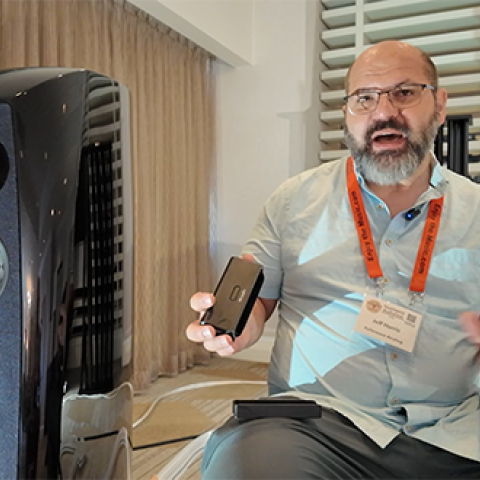
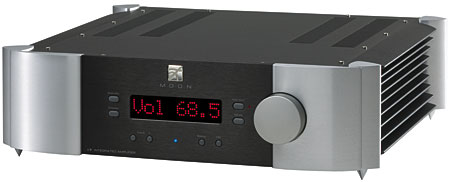
The Moon Evolution i-7 is one of Simaudio's statement products: a good-looking, surprisingly heavy (58 lbs), solid-state integrated amplifier built into an aluminum alloy chassis more or less equal in size to that of the SuperNova CD player, which Wes Phillips wrote about in the January 2007 Stereophile. The i-7 comes with a nice-looking remote handset, built into a molar-shaped alloy enclosure so heavy that, when I accidentally dropped it, it dented the floor. Seriously.
The i-7 is fully balanced, although the single-ended inputs outnumber their balanced counterpart four to one. There's also a tape loop, a pair of auxiliary line-level outputs (their output impedance is a low 50 ohms), special jacks for communicating with other Simaudio products, and a nine-pin RS-232 port: something else I don't know much about.
The front side of the Moon is a marvel of beauty and usefulness. Scattered around a red-lit display are the soft-touch buttons needed to run the amplifier's various setup routines, as well as switches for the monitor loop, mute, standby mode, display lighting, and two buttons for toggling back and forth among the five line-level inputs.
A large knob off to the right actuates an optical encoder, which itself selects among many combinations of metal-film resistors for signal attenuation. (The knob is also used as a selector switch during the setup routine.) This is Simaudio's M-eVol, a resistive-array circuit with 130 discrete steps, intended to avoid the distortions associated with old-fashioned potentiometers. The M-eVol system is also speed-sensitive, which is something no potentiometer can match: In the lowest portion of its overall range, from 0dB to 30dB, loudness is adjusted in 1dB steps; above that, the speed with which the knob is turned determines whether loudness is to be adjusted in steps of 0.5dB (slow turning) or 1dB (quick turning). Incidentally, the mute control works not by clamping input signal to ground, but by instantly switching the M-eVol system to zero—from whence it can, of course, be switched immediately back to the previous setting.
The Moon i-7 lacks a mono-blend or channel-reversal switch. Side-to-side balance is adjustable, but only from the remote—which makes more sense than doing it while standing next to the amp itself, I suppose. In any event, the user can adjust the left-to-right loudness differential in accordance with a hundred small steps; that was certainly enough for me.
To look inside the Moon's well-made chassis was to conclude that the i-7 is in fact a monumentally well-designed, high-tech power supply, with a nice integrated amp along for the ride. From the two wildly overspecified toroidal transformers forward, every bit of the power supply is discretely dual-mono. (Actually, the power supply for the logic circuitry isn't dual-mono, but then, I've always suspected that logic comes only in mono.) Everything looked stiff but sensible, and my search for a flaw in the layout—some weakness that might leave the power supply open to hum, or create ground points of differing potential—was as fruitless as playing chess with a master: Someone else had already thought of everything.
That began to change when the world became more dependent on consumer electronics—except for perfectionist audio, of course—and as consumer electronics became more and more dependent on microprocessors. "How do I reset the time on my VCR?" I don't know. "How do I turn off the flash on my camera?" I don't know. "Where are all the songs I downloaded last night?" I don't know.
Slowly but surely, it dawned on my family that I'm an idiot, for the simple reason that I no longer seem to know very much. I chafed at that conclusion, for the simple reason that I shouldn't be expected to know what I can't be expected to know—at least until I've had a chance to read the instructions.
The Moon Evolution i-7 is one of Simaudio's statement products: a good-looking, surprisingly heavy (58 lbs), solid-state integrated amplifier built into an aluminum alloy chassis more or less equal in size to that of the SuperNova CD player, which Wes Phillips wrote about in the January 2007 Stereophile. The i-7 comes with a nice-looking remote handset, built into a molar-shaped alloy enclosure so heavy that, when I accidentally dropped it, it dented the floor. Seriously.