Although audiophiles may muster little enthusiasm for the home-theater-driven audio marketplace of the 21st century, its prerequisites have inspired manufacturers to cram as wide a range of flexible programming features into as highly resolved a set of performance packages as possible. Thus we're now witnessing a new generation of exceptionally musical electronics with high-end performance targeted at two-channel enthusiasts, but all primped and prepped for integration into an expanded audio-video rig. 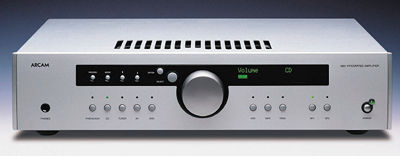 It's just such a systems approach that Arcam used in their attempt to satisfy the need of demanding music-only listeners for high-performance, high-value electronics, while at the same time offering multifunction capabilities to home-theater enthusiasts. It resulted in Arcam's new Digitally integrated Video and Audio (DiVA) series of components, positioned one step below their top line, the Full Metal Jacket (FMJ) series. While some of the DiVA A85 integrated amplifier's system-programming functions might be irrelevant to audiophiles, in the long the A85 is ready when you are, able to evolve as your system grows. But none of that would mean twaddle if the A85's meat-and-potatoes two-channel performance didn't rate favorable comparisons with some of the better solid-state gear I've auditioned in the past few years, from companies such as YBA/Audio Refinement, Musical Fidelity, Simaudio, and NAD. Arcam's current cachet among cost-conscious audiophiles derives in part from the rapturous response of the American market to its groundbreaking Alpha 9 CD player. With dCS's remarkable Ring DAC technology incorporated in an integrated chip, the Alpha 9 offered exceptional resolution, low-level detail, and soundstaging depth at a competitive price. Yet while Arcam is a relatively new name to many consumers on this side of the pond, they are a dominant player on the British and European audio scenes. With the rollout of the sleek, stylish A85 as the flagship of their new DiVA series (along with the system-matched DiVA CD92 CD player, a lineal successor to the Alpha 9), Arcam is poised to raise some audio eyebrows in the US.
"Our whole philosophy has changed a little bit," explains Gary Warzin, CEO of Audiophile Systems Ltd., of Indianapolis, Indiana, Arcam's US distributor. "Arcam's Alpha Series was developed around the early capabilities of CD, and you wanted something that was a bit more polite and forgiving, given the problems early CD players had. So when Arcam designed this new DiVA series, they were looking to design an amplifier capable of giving you the kind of signal/noise ratio and dynamic range you need to handle these emerging new music sources. The A85's circuitry is direct-coupled from input through output, with no series capacitors in the signal path (capacitors are employed only in the power supply). And where older Arcam amps employed MOSFETs, the DiVA A85 uses discrete bipolar output devices. "MOSFETs tended to misbehave in a manner analogous to tubes. Electronically, these new Sanken-type output devices look pretty much like any bipolar output stage, but the real advantage is that the heat sensor is built right into the package, so it can react very quickly to changes in temperature. Arcam engineers were also very clever in the way they employed Side Chain Servos outside of the signal path to remove any of the residual DC you might normally have with a direct-coupled device—but without degrading the signal. The main thing they focused on all the way through was keeping the signal path as simple as possible." This philosophy is reflected in the simple, straightforward, elegant layout of the DiVA A85. Electronic input switching is used to avoid some of the problems mechanical switches can cause, and microprocessor circuits are used for the volume and balance functions and to activate the tone-control circuitry. The front panel is dominated by a large, centrally located Control knob, which functions as a volume control; in tandem with the adjacent Enter and Select buttons (or those on Arcam's CR-389 remote control), Control can also be used to customize amplifier settings via a menu-driven system. For instance, you can set the input trims for each source to compensate for relative variations in output level; you can program volume resolution from Standard through Fine and Reference, with a Graphic or Numeric readout; and Global or Per Source configurations for the tone-control settings. (The default settings affect all sources equally.) The headphone input is always in-circuit, and other front-panel controls correspond to those on the remote.
The rear panel features Trigger Out and Remote In connections for multi-room setups, two horizontal arrays of speaker terminals, a pair of Power-In/Pre-Out inputs, and an adjacent Pre/Power switch, which allows you to run the A85 as a separate preamp or as a power amp. Using Arcam's gain-matched P85 power amp, you can biamp with the A85—a terrific way to make your system sound a whole lot bigger. The Mode, Up, and Down buttons on the front panel and remote are to be used when (and if) optional modules become available.
It's just such a systems approach that Arcam used in their attempt to satisfy the need of demanding music-only listeners for high-performance, high-value electronics, while at the same time offering multifunction capabilities to home-theater enthusiasts. It resulted in Arcam's new Digitally integrated Video and Audio (DiVA) series of components, positioned one step below their top line, the Full Metal Jacket (FMJ) series. While some of the DiVA A85 integrated amplifier's system-programming functions might be irrelevant to audiophiles, in the long the A85 is ready when you are, able to evolve as your system grows. But none of that would mean twaddle if the A85's meat-and-potatoes two-channel performance didn't rate favorable comparisons with some of the better solid-state gear I've auditioned in the past few years, from companies such as YBA/Audio Refinement, Musical Fidelity, Simaudio, and NAD. Arcam's current cachet among cost-conscious audiophiles derives in part from the rapturous response of the American market to its groundbreaking Alpha 9 CD player. With dCS's remarkable Ring DAC technology incorporated in an integrated chip, the Alpha 9 offered exceptional resolution, low-level detail, and soundstaging depth at a competitive price. Yet while Arcam is a relatively new name to many consumers on this side of the pond, they are a dominant player on the British and European audio scenes. With the rollout of the sleek, stylish A85 as the flagship of their new DiVA series (along with the system-matched DiVA CD92 CD player, a lineal successor to the Alpha 9), Arcam is poised to raise some audio eyebrows in the US.
"Our whole philosophy has changed a little bit," explains Gary Warzin, CEO of Audiophile Systems Ltd., of Indianapolis, Indiana, Arcam's US distributor. "Arcam's Alpha Series was developed around the early capabilities of CD, and you wanted something that was a bit more polite and forgiving, given the problems early CD players had. So when Arcam designed this new DiVA series, they were looking to design an amplifier capable of giving you the kind of signal/noise ratio and dynamic range you need to handle these emerging new music sources. The A85's circuitry is direct-coupled from input through output, with no series capacitors in the signal path (capacitors are employed only in the power supply). And where older Arcam amps employed MOSFETs, the DiVA A85 uses discrete bipolar output devices. "MOSFETs tended to misbehave in a manner analogous to tubes. Electronically, these new Sanken-type output devices look pretty much like any bipolar output stage, but the real advantage is that the heat sensor is built right into the package, so it can react very quickly to changes in temperature. Arcam engineers were also very clever in the way they employed Side Chain Servos outside of the signal path to remove any of the residual DC you might normally have with a direct-coupled device—but without degrading the signal. The main thing they focused on all the way through was keeping the signal path as simple as possible." This philosophy is reflected in the simple, straightforward, elegant layout of the DiVA A85. Electronic input switching is used to avoid some of the problems mechanical switches can cause, and microprocessor circuits are used for the volume and balance functions and to activate the tone-control circuitry. The front panel is dominated by a large, centrally located Control knob, which functions as a volume control; in tandem with the adjacent Enter and Select buttons (or those on Arcam's CR-389 remote control), Control can also be used to customize amplifier settings via a menu-driven system. For instance, you can set the input trims for each source to compensate for relative variations in output level; you can program volume resolution from Standard through Fine and Reference, with a Graphic or Numeric readout; and Global or Per Source configurations for the tone-control settings. (The default settings affect all sources equally.) The headphone input is always in-circuit, and other front-panel controls correspond to those on the remote.
The rear panel features Trigger Out and Remote In connections for multi-room setups, two horizontal arrays of speaker terminals, a pair of Power-In/Pre-Out inputs, and an adjacent Pre/Power switch, which allows you to run the A85 as a separate preamp or as a power amp. Using Arcam's gain-matched P85 power amp, you can biamp with the A85—a terrific way to make your system sound a whole lot bigger. The Mode, Up, and Down buttons on the front panel and remote are to be used when (and if) optional modules become available.
It's just such a systems approach that Arcam used in their attempt to satisfy the need of demanding music-only listeners for high-performance, high-value electronics, while at the same time offering multifunction capabilities to home-theater enthusiasts. It resulted in Arcam's new Digitally integrated Video and Audio (DiVA) series of components, positioned one step below their top line, the Full Metal Jacket (FMJ) series. While some of the DiVA A85 integrated amplifier's system-programming functions might be irrelevant to audiophiles, in the long the A85 is ready when you are, able to evolve as your system grows. But none of that would mean twaddle if the A85's meat-and-potatoes two-channel performance didn't rate favorable comparisons with some of the better solid-state gear I've auditioned in the past few years, from companies such as YBA/Audio Refinement, Musical Fidelity, Simaudio, and NAD. Arcam's current cachet among cost-conscious audiophiles derives in part from the rapturous response of the American market to its groundbreaking Alpha 9 CD player. With dCS's remarkable Ring DAC technology incorporated in an integrated chip, the Alpha 9 offered exceptional resolution, low-level detail, and soundstaging depth at a competitive price. Yet while Arcam is a relatively new name to many consumers on this side of the pond, they are a dominant player on the British and European audio scenes. With the rollout of the sleek, stylish A85 as the flagship of their new DiVA series (along with the system-matched DiVA CD92 CD player, a lineal successor to the Alpha 9), Arcam is poised to raise some audio eyebrows in the US.