Lovers of Italian wine, travelers to Italy, and, of course, Italians, may be familiar with this story. It seems that in the year 1111, Henry V was traveling to Rome to be crowned Holy Roman Emperor. A member of his entourage, one Giovanni Defuc, was very fond of wine, and had the practice of sending ahead one of his servants to sample the wine in each place. When the servant found a wine that he particularly liked, he would write "Est!" on the door of the establishment, which was a signal to his master that the wine is (est) good. Having arrived at Montefiascone, the servant found a wine he thought so superb that he wrote on the door of the inn "Est! Est!! Est!!!"
 The point of this story is that you, dear reader, are much like Giovanni Defuc, but with a taste for good sound rather than good wine (not that the two are mutually exclusive), and I am your humble servant, traveling ahead, informing you when I find something special.
Which brings me to the PS Audio GCC-100.
What is it?
The point of this story is that you, dear reader, are much like Giovanni Defuc, but with a taste for good sound rather than good wine (not that the two are mutually exclusive), and I am your humble servant, traveling ahead, informing you when I find something special.
Which brings me to the PS Audio GCC-100.
What is it?
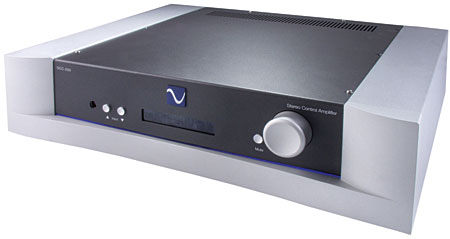
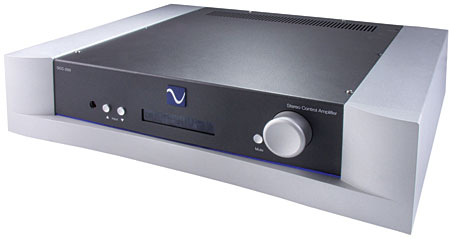
Functionally, the GCC-100 can be classified as an integrated amplifier: it has several line-level inputs (single-ended and balanced), controls for volume, balance, and polarity, and binding posts for speaker cables. However, the GCC-100's owner's manual states that it and other models in the GCC series "are not integrated amplifiers." Instead, PS Audio calls the GCC-100 and its sisters, the GCC-250 and the GCC-500, Control Amplifiers or Variable Gain Power Amplifiers. Unlike a standard integrated amplifier, the GCC-100 has no volume control in the traditional sense; ie, no potentiometer or resistor ladder that shunts part of the signal through ground. Instead, the gain is varied directly by a proprietary analog gain stage called the Gain Cell.
According to PS Audio, the Gain Cell provides the closest approximation of the perfect gain stage, and represents "the single most revolutionary advancement in analog audio since PS Audio was founded in 1973." Certain details of the Gain Cell's operation are left deliberately obscure, and the circuitry itself is in a potted module, "keeping our competitors completely in the dark." The information that PSA has made public about the Gain Cell is that it's a fully balanced design with gain adjustable from –100dB to +30dB, a step resolution of 0.001dB, noise below –100dB, 80dB input common-mode rejection, a frequency response of 1Hz–50kHz, and THD of 0.005%. The input impedance is 47k ohms and the output impedance is 100 ohms. The performance of each Gain Cell unit is tweaked with three trim pots at the factory, providing 0.1dB matching between channels.
The Gain Cell, which is direct-coupled and functions in the current mode, can be used in a fixed-gain mode, in which case, when combined with a suitable output stage, you have a power amplifier (PS Audio's new GCA series); or in a variable-gain mode, in which case you have the GCC-100 (and others in the GCC series). In the GCC-100, the Gain Cell is coupled with a class-D output stage, an evolutionary development of PSA's well-received HCA-2. According to PSA's Paul McGowan, the main difference between the HCA-2 and the GCC-100's output stage is that the HCA-2 was a low-feedback, fixed-frequency-modulator design fed by a conventional unregulated AC power supply, whereas the GCC-100 has a low-distortion, high-feedback, variable-frequency modulator, fed by individually regulated power supplies for each channel. The higher feedback of the G-series amps raises the damping factor, providing better control of the speaker. The HCA-2 had a combination of JFETs and op-amps for its input, which added much more noise and distortion than the GCC-100's Gain Cell.
Setup
The basic setup of the GCC-100 is much the same as for any normal integrated amplifier: Connect the source interconnects and speaker cables (the connectors all seem to be of high quality), plug it in, press the Power button (which is also the PS Audio logo), and, after a two-second delay, you're in business. The source default is Input 1, which is the balanced set, so if you're not using that you have to switch over to the input that you are using.
The owner's manual suggests placing the GCC-100 close to the source equipment, so that you can keep the interconnects short. In my room I have the source equipment near the listening area, a good distance from the speakers, so following PSA's recommendation would have meant having very long speaker cables, which I didn't think desirable—and which, in any case, I didn't have. Instead, I followed my more or less standard practice of using fairly long (5m) interconnects and shorter (3m) speaker cables. The difference was that, rather than having the long interconnects between the preamp and power amp, they were between the digital processor and the input of the GCC-100. The GCC-100 itself was placed on an amplifier stand, between the speakers.
The GCC-100 offers considerable flexibility in setup adjustment and convenience. A Setup mode—which you enter by pressing a specific combination of buttons as described in the manual—lets you adjust the gain offset of and name each input. One of the inputs can be designated "Home Theater Bypass," in which case the volume control is deactivated, the system volume then being controlled by a surround preamplifier-processor.
The front panel has a bright blue numerical display of volume and some other functions; the intensity of this display can be dimmed or the display can be turned off completely. (It comes on again momentarily when the volume or some other control is adjusted.) The front panel also has a horizontal blue light, whose best feature is that it can be dimmed or—my preference—turned off entirely by a switch on the GCC-100's rear. As long as it's plugged in, the GCC-100's Gain Cell is energized even when the unit is not on, so at least for the gain stage the need for warmup is eliminated. (I didn't notice any marked warmup effect.)
The industrial design is clean, stylish, even elegant, and the fit'n'finish would seem appropriate for a component selling for double the price. The volume control is well thought out, with large steps in the lower part of the range and finer steps in the higher part.
The GCC-100 is supplied with a slim credit-card–type remote control, which has buttons for Power, Mute, Volume Up/Down, Balance, Phase (0° or 180°), Input, and Dim. I was not fond of the squishy, nondiscrete feel of these buttons, but liked the fact that the ones controlling Volume were larger than the others, and therefore easier to find in the dark.
PS Audio suggests that the GCC-100 can benefit from the use of aftermarket physical isolation devices, and recommends using high-quality power cables (eg, their own xStream Power) and suitable power-line conditioning equipment (eg, PSA's Power Plant or Ultimate Outlet series, but not simple AC line filters made by others). Which brings me to a caveat about the GCC-100's performance. My comments about its sound quality refer to a unit placed on three Aurios Pro component supports, with a PSA xStream used instead of the supplied power cable, and the entire system, including the GCC-100, plugged into a PSA P500 Power Plant (AutoWave or MultiWave I setting).
Each of these made a significant improvement in the sound of the GCC-100, the biggest improvement being brought about by the Power Plant. Plugged directly into the wall, which is the way I first listened to it, the GCC-100 actually sounded pretty good, but when plugged into the P500 the sound took on an added finesse, with a reduction of some high-frequency fuzziness and better low-level detail. People vary a great deal in how much they value a given improvement in sound quality and what they're willing to pay for that improvement, so I hesitate to call the P500 a mandatory accessory—but you must listen to this combination if you want to know what the GCC-100 is capable of. The GCC-100's class-D output stage resulted in very efficient operation; according to the P500's power indicator, the source components plus GCC-100 drew only about 50W most of the time; one of the less expensive Power Plants (such as the original P300) would have more than enough capacity to power the GCC-100.
The speakers I was using with the GCC-100 were Avantgarde Unos, whose sensitivity of more than 100dB exposes any noise in the electronics. The quietest preamp and power amp I have had in my system so far have been the Balanced Audio Technology VK-3ix and VK-55 that I reviewed last November; although I did not have these on hand for direct comparison, I'd say that the GCC-100 had a bit more noise, though not enough to be heard with music played even at a fairly low level.
The system with the GCC-1 in it did seem more than usually sensitive to cable positioning; to get the least noise, I had to make sure that the interconnects were kept away from the P500 Power Plant (on the floor, potentially in the path of the cables) and AC cables. Of the various cables I had on hand, I got the best sound with Nordost Quattro Fils interconnects (the top-of-the-line Nordost Valhallas sounded a little too clinical) and Nordost Valhalla speaker cables. I also got good results—a bit more mellow, not as transparent—with PS Audio's much less expensive xStream interconnects and speaker cables.
Sound
Many speaker designers, and some designers of audio electronics, talk about a phase or aspect of the development of a new product they refer to as voicing. This is when the basics of the design are in place but there are still aspects to be worked out, dealing with things such as circuit layout, choice of specific component parts, and the tweaking of certain parameters, like the exact amount of feedback. These are usually validated by careful listening tests, the aim being, in the case of electronics, to make sure that the final product passes the signal with the minimum of changes other than a gain in signal strength. A "straight wire with gain" is an admirable ideal, but in the real world there are always some changes other than gain, and the best components are those whose residual changes are such that they serve the music. What this means exactly is a subjective matter, and the choice of the character, or "voice," of the component rests with the designer or design team. The character can be subtle, and in some situations its effects may be obscured by the stronger character of other parts of the system, but it's still there, and is likely to become apparent with prolonged listening. The PS Audio GCC-100's most impressive attribute was its almost total lack of sonic character. It didn't sound exactly like solid-state, and it didn't sound like tubes. It didn't sound dark, but it didn't sound bright, either. It didn't sound forward, and it didn't sound laid-back. What it did have was a sound that, with a wide range of recordings, seemed very much like the sound of musical instruments and voices, and a reproduction of the spatial aspects of recordings that was at times spooky. Perhaps more than any other preamp and amplifier pairing I've had in my system, the GCC-100 provided a definition of sonic neutrality. No part of the frequency range was slighted or overemphasized. The treble was smooth and extended (but see the description of the setup and associated equipment), but it didn't jump out at me.
The cymbals, bells, and other percussive instruments on track 3 of the Chesky Records Jazz Sampler & Audiophile Test Compact Disc, Vol.1 (JD37) had a presence that was variously delicate and dynamically startling. With the best recordings—such as Robert Silverman's cycle of the Beethoven Piano Sonatas (CD, Orpheum Masters KSP 830)—the treble range of the piano rang out with pristine clarity, the distinctive sound of the instrument evident in the overtone structure.
My Avantgarde Unos incorporate powered subwoofers, so one would think that bass performance in this system would be determined mostly by the subwoofer amps and their level and crossover-frequency settings. But the main power amp that drives the subwoofer amp still has a marked effect on the character of the bass response. In this case, the bass was tight and had good extension—in line with what I normally find with well-designed solid-state amplifiers, and without the softness that tends to characterize tube amps. (Although the BAT VK-55, which I reviewed in November is no slouch in this department.)
To check out how the GCC-100 would perform with a less exotic speaker, I hooked it up to a pair of Paradigm Studio/100 v.3s (reviewed by John Atkinson in the January 2005 Stereophile), and there were no surprises: the GCC-100 took the Paradigm's lower sensitivity in stride and maintained good control over the woofers.
The GCC-100's other great strength was resolution and transparency. This was apparent on highly familiar recordings, where I kept hearing details of orchestration, and sometimes artifacts of recording technology, that I hadn't noticed before or that had not been as clearly defined. One of my tests for assessing resolution is a glitch—probably an edit point—at 1:35 into track 10 of Sylvia McNair's superb Sure Thing: The Jerome Kern Songbook (CD, Philips 442 129-2). With some equipment, when she sings the words "that lights," the voice just sounds fuzzy; with the GCC-100 in the system I could hear a distinct if muffled echo of the voice itself, probably indicating an imperfect blending of two different takes. The GCC-100 is definitely in the high-resolution class.
The GCC-100 put in a solid performance in the rhythm/dynamics department as well. With 100W on tap, it had more than enough power to drive the Avantgarde Unos to levels that threatened hearing damage, and allowed the more subtle ebb and flow of the music (microdynamics) to be communicated.
The point of this story is that you, dear reader, are much like Giovanni Defuc, but with a taste for good sound rather than good wine (not that the two are mutually exclusive), and I am your humble servant, traveling ahead, informing you when I find something special.
Which brings me to the PS Audio GCC-100.
What is it?
Functionally, the GCC-100 can be classified as an integrated amplifier: it has several line-level inputs (single-ended and balanced), controls for volume, balance, and polarity, and binding posts for speaker cables. However, the GCC-100's owner's manual states that it and other models in the GCC series "are not integrated amplifiers." Instead, PS Audio calls the GCC-100 and its sisters, the GCC-250 and the GCC-500, Control Amplifiers or Variable Gain Power Amplifiers. Unlike a standard integrated amplifier, the GCC-100 has no volume control in the traditional sense; ie, no potentiometer or resistor ladder that shunts part of the signal through ground. Instead, the gain is varied directly by a proprietary analog gain stage called the Gain Cell.
The basic setup of the GCC-100 is much the same as for any normal integrated amplifier: Connect the source interconnects and speaker cables (the connectors all seem to be of high quality), plug it in, press the Power button (which is also the PS Audio logo), and, after a two-second delay, you're in business. The source default is Input 1, which is the balanced set, so if you're not using that you have to switch over to the input that you are using.
Many speaker designers, and some designers of audio electronics, talk about a phase or aspect of the development of a new product they refer to as voicing. This is when the basics of the design are in place but there are still aspects to be worked out, dealing with things such as circuit layout, choice of specific component parts, and the tweaking of certain parameters, like the exact amount of feedback. These are usually validated by careful listening tests, the aim being, in the case of electronics, to make sure that the final product passes the signal with the minimum of changes other than a gain in signal strength. A "straight wire with gain" is an admirable ideal, but in the real world there are always some changes other than gain, and the best components are those whose residual changes are such that they serve the music. What this means exactly is a subjective matter, and the choice of the character, or "voice," of the component rests with the designer or design team. The character can be subtle, and in some situations its effects may be obscured by the stronger character of other parts of the system, but it's still there, and is likely to become apparent with prolonged listening. The PS Audio GCC-100's most impressive attribute was its almost total lack of sonic character. It didn't sound exactly like solid-state, and it didn't sound like tubes. It didn't sound dark, but it didn't sound bright, either. It didn't sound forward, and it didn't sound laid-back. What it did have was a sound that, with a wide range of recordings, seemed very much like the sound of musical instruments and voices, and a reproduction of the spatial aspects of recordings that was at times spooky. Perhaps more than any other preamp and amplifier pairing I've had in my system, the GCC-100 provided a definition of sonic neutrality. No part of the frequency range was slighted or overemphasized. The treble was smooth and extended (but see the description of the setup and associated equipment), but it didn't jump out at me.