As you read this, are you listening to your stereo? Whatever the music, what you're actually hearing is your public utility's AC as modulated by your power amplifier. No matter how good the gear, the final result can be only as pure as the power feeding your components. Unfortunately, plenty of sonic schmutz usually comes along for the ride.
 The purveyors of line conditioners, power regenerators, isolation transformers, and the like have been bombarding us with that message for years now, and it seems to have taken hold. Though the message comes larded with multiple helpings of BS, its basic truth is no longer in doubt.
Cleaning up the AC is good, but getting off the grid altogether and powering one's stereo system with batteries is even better. In the early 1980s, the inexpensive and surprisingly quiet Marcoff PPA-1 MC head amp, powered by a 9V battery, effectively made the case for many audiophiles. More recent products include Sutherland's PhD phono preamp, powered by 16 Alkaline D cells; and ASR's Basis Exclusive phono preamp (which I reviewed in my October 2003 "Analog Corner" column), tethered to a boat anchor of a rechargeable battery. Battery options are also available for phono preamps from Trigon and Phonomena, among others.
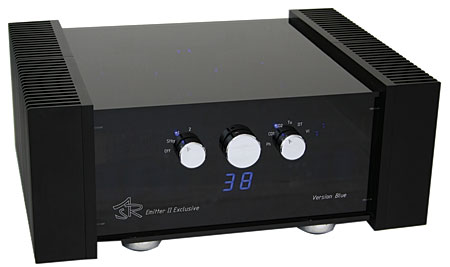
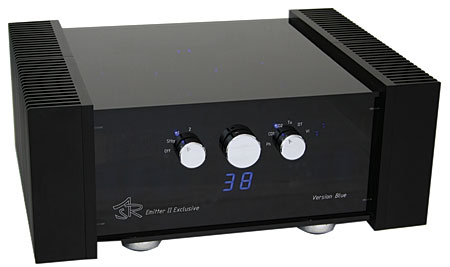
But none of those components requires all that much power. ASR's Emitter II Exclusive is a battery-powered amplifier. Sort of. Its rechargeable battery powers only the amplifier's driver stage, which the designer feels is the most critical. What's more, the battery supply is a plug-in option. Housed in its own heavy case, the battery supply contains six 6V, 12 ampere-hour batteries and a total of 400,000µF of capacitance. Once fully charged, the battery can power the driver stage for approximately 100 hours. The instructions recommend that you turn the Emitter II to Standby overnight after approximately two days of playing in order to limit the discharge level and keep the battery well conditioned. All battery operations, including charging, and auto-switching to AC power when the batteries are low, are controlled by optical digital logic circuits. In practical terms, the ASR's battery power supply was transparent, never requiring my attention. The Emitter II costs $24,900 with the battery supply.
Even minus its battery, the Emitter II is an unusual and intriguing product. It consists of a large, heatsink-capped main chassis and two massive outboard power supplies that connect to the amplifier via fist-sized multipin connectors attached to silver cables the diameter of garden hoses. Designer Friedrich Schäfer doesn't like metal chassis, so, like his Basis Exclusive phono preamp, the Emitter II is made of deeply tinted acrylic (the power supplies and battery pack are encased in metal chassis, however). Because you can peer inside, Schäfer has fitted the Emitter II's circuit boards with a light show's worth of colored LEDs indicating the amp's various states of operation.
A power amplifier with a volume control?
The purveyors of line conditioners, power regenerators, isolation transformers, and the like have been bombarding us with that message for years now, and it seems to have taken hold. Though the message comes larded with multiple helpings of BS, its basic truth is no longer in doubt.
Cleaning up the AC is good, but getting off the grid altogether and powering one's stereo system with batteries is even better. In the early 1980s, the inexpensive and surprisingly quiet Marcoff PPA-1 MC head amp, powered by a 9V battery, effectively made the case for many audiophiles. More recent products include Sutherland's PhD phono preamp, powered by 16 Alkaline D cells; and ASR's Basis Exclusive phono preamp (which I reviewed in my October 2003 "Analog Corner" column), tethered to a boat anchor of a rechargeable battery. Battery options are also available for phono preamps from Trigon and Phonomena, among others.
But none of those components requires all that much power. ASR's Emitter II Exclusive is a battery-powered amplifier. Sort of. Its rechargeable battery powers only the amplifier's driver stage, which the designer feels is the most critical. What's more, the battery supply is a plug-in option. Housed in its own heavy case, the battery supply contains six 6V, 12 ampere-hour batteries and a total of 400,000µF of capacitance. Once fully charged, the battery can power the driver stage for approximately 100 hours. The instructions recommend that you turn the Emitter II to Standby overnight after approximately two days of playing in order to limit the discharge level and keep the battery well conditioned. All battery operations, including charging, and auto-switching to AC power when the batteries are low, are controlled by optical digital logic circuits. In practical terms, the ASR's battery power supply was transparent, never requiring my attention. The Emitter II costs $24,900 with the battery supply.
Even minus its battery, the Emitter II is an unusual and intriguing product. It consists of a large, heatsink-capped main chassis and two massive outboard power supplies that connect to the amplifier via fist-sized multipin connectors attached to silver cables the diameter of garden hoses. Designer Friedrich Schäfer doesn't like metal chassis, so, like his Basis Exclusive phono preamp, the Emitter II is made of deeply tinted acrylic (the power supplies and battery pack are encased in metal chassis, however). Because you can peer inside, Schäfer has fitted the Emitter II's circuit boards with a light show's worth of colored LEDs indicating the amp's various states of operation.
A power amplifier with a volume control?
Friedrich Schäfer made clear to me that he does not regard the Emitter II as an integrated amplifier—although the instruction manual calls it just that, and although it includes a volume control and input switching. Instead, he told me, it's a 250Wpc or 500Wpc (into 8 or 4 ohms, respectively) multi-input power amplifier with relay-based switching facilities and volume control. [This is exactly what Stereophile defines as an integrated amplifier—Ed.] The volume is adjusted via a rotary pulse encoder controlling 32 precision stepped relays. The input signal is attenuated up to volume level "50." At "51", the signal does not pass through the volume control, he assured me. From "52" up to the maximum setting of "76" is gain, but, accompanied by ultralow noise. During our conversation, Schäfer told me that there is approximately 20dB of gain at "51", but the instructions claim that the signal passes through the amplifier "unchanged." Hopefully, John Atkinson's measurements will clear all this up.
 The Emitter II provided for review included five mirror-imaged sets of line-level, unbalanced RCA inputs, one set of balanced inputs (the signal is converted internally to unbalanced), and two RCA Tape Out jacks (other input options are possible). One of the RCA inputs, labeled Direkt, bypasses the switching relays and connects directly to the volume-control relays with silver wire. This input features separate ground paths. Though the Direkt input offers the purest and, potentially, the best-sounding, lowest-noise signal path, it can be used only in a single-source system: Switching to another input will not remove the Direkt input's signal from reaching the amplifier, and two signals will be heard simultaneously.
The Emitter II can be custom-built to offer two sets of speaker terminals, a front- or rear-mounted headphone jack, and a tape monitor switch. The review sample had none of those, which was fine with me.
The building blocks of the Emitter II include a FET op-amp IC input stage, a "very fast" MOSFET driver stage, and five high-power audio MOSFETs per channel in the output, with separate power supplies for each channel. ASR claims that the amplifier operates "mostly" in class-A, and with no capacitors in the signal path, for full direct-coupled operation with offset regulation. Each outboard power supply, containing a pair of massive transformers, produces separate voltages that are individually rectified and pre-buffered, to separately supply the input, driver (if the optional battery supply is not used), output, and microprocessor-control circuits.
All amplifier operations are controlled by microprocessors. In the superb-sounding Basis Exclusive phono preamp, Schäfer used a seemingly unlikely microphone preamp op-amp. Here he's chosen a video op-amp for the input stage. He told me that it sounds better, less "mechanical" than the audio op-amps he tried, thanks in part to low open-loop gain (ie, less negative feedback required).
Setup and use
The Emitter II provided for review included five mirror-imaged sets of line-level, unbalanced RCA inputs, one set of balanced inputs (the signal is converted internally to unbalanced), and two RCA Tape Out jacks (other input options are possible). One of the RCA inputs, labeled Direkt, bypasses the switching relays and connects directly to the volume-control relays with silver wire. This input features separate ground paths. Though the Direkt input offers the purest and, potentially, the best-sounding, lowest-noise signal path, it can be used only in a single-source system: Switching to another input will not remove the Direkt input's signal from reaching the amplifier, and two signals will be heard simultaneously.
The Emitter II can be custom-built to offer two sets of speaker terminals, a front- or rear-mounted headphone jack, and a tape monitor switch. The review sample had none of those, which was fine with me.
The building blocks of the Emitter II include a FET op-amp IC input stage, a "very fast" MOSFET driver stage, and five high-power audio MOSFETs per channel in the output, with separate power supplies for each channel. ASR claims that the amplifier operates "mostly" in class-A, and with no capacitors in the signal path, for full direct-coupled operation with offset regulation. Each outboard power supply, containing a pair of massive transformers, produces separate voltages that are individually rectified and pre-buffered, to separately supply the input, driver (if the optional battery supply is not used), output, and microprocessor-control circuits.
All amplifier operations are controlled by microprocessors. In the superb-sounding Basis Exclusive phono preamp, Schäfer used a seemingly unlikely microphone preamp op-amp. Here he's chosen a video op-amp for the input stage. He told me that it sounds better, less "mechanical" than the audio op-amps he tried, thanks in part to low open-loop gain (ie, less negative feedback required).
Setup and use
The Emitter II's main chassis alone is rather large. Because it can also have two—or, with the battery option, three—large boxes tethered to it, placement can be problematic. The racks fill up quickly. In systems like mine, with sources and preamp located on one sidewall and amplifiers placed between the speakers, the choice is either to run very long lengths of speaker cables, or multiple long lengths of interconnects from source components to amp. The latter proved to be the best option for me, though most buyers will probably place the Emitter II and all source components on racks between the speakers. I also tried the Manley Skipjack, a passive, relay-controlled, programmable switch box that permits, among other things, switching among four inputs. Using it, I needed only a single long run of interconnect from all of my source components to the ASR.
The ASR's big, beefy terminals made speaker connection easy and secure. Though the amplifier incorporates various kinds of protective circuitry, the instructions warn that because the single-speaker-per-channel version features a direct, relay-free connection between the output transistors and the speaker terminals, speaker cables should be checked for "shortcuts" before the unit is turned on. (The informative and laudably complete instructions, translated from the German, need to be rewritten by someone whose primary language is English.)
The Emitter II Exclusive requires three AC jacks: one for each power supply and one for the battery pack (my battery supply arrived precharged). Once everything's connected and plugged in, you switch from Off to position "1" or "2" or Standby, and you're in business. Position 1 turns the amp on and puts it in its Energy Saving mode, which allows a volume range of 0–61dB. Position 2 deactivates Energy Saving and permits 0–76dB output. (I never got above the 55dB position.) From Standby, the Emitter II can be operated using its compact remote control.
When turned on, the Emitter II first goes through an automated checklist, after which it's ready to play music. Pressing the remote's Mode button repeatedly cycles you through a variety of adjustments, indicated by flashing LEDs. You can match input levels, adjust balance, set the volume level at which the amp switches from Energy Saving to full-power mode (anywhere from 01 to 51), control the brightness of the amp's display, and even choose which of the display LEDs light up in a given operating mode. The remote also lets you adjust volume, toggle through inputs, adjust operating mode, and select Mute. The last is a "soft" mute that ramps up and down.
The purveyors of line conditioners, power regenerators, isolation transformers, and the like have been bombarding us with that message for years now, and it seems to have taken hold. Though the message comes larded with multiple helpings of BS, its basic truth is no longer in doubt.
Cleaning up the AC is good, but getting off the grid altogether and powering one's stereo system with batteries is even better. In the early 1980s, the inexpensive and surprisingly quiet Marcoff PPA-1 MC head amp, powered by a 9V battery, effectively made the case for many audiophiles. More recent products include Sutherland's PhD phono preamp, powered by 16 Alkaline D cells; and ASR's Basis Exclusive phono preamp (which I reviewed in my October 2003 "Analog Corner" column), tethered to a boat anchor of a rechargeable battery. Battery options are also available for phono preamps from Trigon and Phonomena, among others.
Friedrich Schäfer made clear to me that he does not regard the Emitter II as an integrated amplifier—although the instruction manual calls it just that, and although it includes a volume control and input switching. Instead, he told me, it's a 250Wpc or 500Wpc (into 8 or 4 ohms, respectively) multi-input power amplifier with relay-based switching facilities and volume control. [This is exactly what Stereophile defines as an integrated amplifier—Ed.] The volume is adjusted via a rotary pulse encoder controlling 32 precision stepped relays. The input signal is attenuated up to volume level "50." At "51", the signal does not pass through the volume control, he assured me. From "52" up to the maximum setting of "76" is gain, but, accompanied by ultralow noise. During our conversation, Schäfer told me that there is approximately 20dB of gain at "51", but the instructions claim that the signal passes through the amplifier "unchanged." Hopefully, John Atkinson's measurements will clear all this up.
The Emitter II provided for review included five mirror-imaged sets of line-level, unbalanced RCA inputs, one set of balanced inputs (the signal is converted internally to unbalanced), and two RCA Tape Out jacks (other input options are possible). One of the RCA inputs, labeled Direkt, bypasses the switching relays and connects directly to the volume-control relays with silver wire. This input features separate ground paths. Though the Direkt input offers the purest and, potentially, the best-sounding, lowest-noise signal path, it can be used only in a single-source system: Switching to another input will not remove the Direkt input's signal from reaching the amplifier, and two signals will be heard simultaneously.
The Emitter II can be custom-built to offer two sets of speaker terminals, a front- or rear-mounted headphone jack, and a tape monitor switch. The review sample had none of those, which was fine with me.
The building blocks of the Emitter II include a FET op-amp IC input stage, a "very fast" MOSFET driver stage, and five high-power audio MOSFETs per channel in the output, with separate power supplies for each channel. ASR claims that the amplifier operates "mostly" in class-A, and with no capacitors in the signal path, for full direct-coupled operation with offset regulation. Each outboard power supply, containing a pair of massive transformers, produces separate voltages that are individually rectified and pre-buffered, to separately supply the input, driver (if the optional battery supply is not used), output, and microprocessor-control circuits.
The Emitter II's main chassis alone is rather large. Because it can also have two—or, with the battery option, three—large boxes tethered to it, placement can be problematic. The racks fill up quickly. In systems like mine, with sources and preamp located on one sidewall and amplifiers placed between the speakers, the choice is either to run very long lengths of speaker cables, or multiple long lengths of interconnects from source components to amp. The latter proved to be the best option for me, though most buyers will probably place the Emitter II and all source components on racks between the speakers. I also tried the Manley Skipjack, a passive, relay-controlled, programmable switch box that permits, among other things, switching among four inputs. Using it, I needed only a single long run of interconnect from all of my source components to the ASR.