Back in 1964, Avery Fisher, founder and president of the Fisher Radio Corporation, wrote a short note for the 500-C Stereophonic FM Multiplex Receiver owner's manual. In that note he said, "a door has opened for you, and your family, on virtually unlimited years of musical enjoyment."
 Little did he know how right he would be. Who could predict that, 40 years later, Avery Fisher's crystal ball had been spot on—that thousands of units of this American audio engineering classic would be the centerpieces of the music and fidelity pastime, of vintage audio?
Forget everything you've read or imagined over the past 20 years—vintage gear does not necessarily sound rolled-off, soft and woolly, or fuzzy. This stuff is as far from windup Victrola sound as HDTV is from 1950s black-and-white TV. It is serious high-end audio, and offers a bouquet of endless multilayered soundscapes, pinpoint and holographic images, startling frequency response, and exceptional pace, rhythm, and drive. It's what we look for in our hobby, and it's been here all along. I've invested many years chasing the best cutting-edge gear our industry offers, yet I've never been more satisfied with music and audio since finding a home in yesteryear with all those dead guys with ears.
Vintage audio offers something for everyone. It's an affordable entry point for those new to the audio hobby. It's ideal for second systems or modest living spaces. Best of all, it gives us gray-haired hi-fi veterans a respite from the spiraling expenses of new gear, and it can offer the intrepid audio explorer sonic performance that I feel can be comparable to that offered by modern gear.
The era of vintage audio, roughly 1965 through 1970, comprised the gilded age of hi-fi and the ripe years of RCA Living Stereo and Mercury Living Presence records. This era of audio embodies the work of such names as Saul Marantz, Hermon Hosmer Scott, Rudy Bozak, James B. Lansing, Paul Klipsch, David Hafler, and Henry Kloss—dead guys with ears. These guys used the absolute best minds available to design and engineer sonic marvels that have stood the test of time as icons in a world now dominated by home theater.
The Fisher 500-C
Little did he know how right he would be. Who could predict that, 40 years later, Avery Fisher's crystal ball had been spot on—that thousands of units of this American audio engineering classic would be the centerpieces of the music and fidelity pastime, of vintage audio?
Forget everything you've read or imagined over the past 20 years—vintage gear does not necessarily sound rolled-off, soft and woolly, or fuzzy. This stuff is as far from windup Victrola sound as HDTV is from 1950s black-and-white TV. It is serious high-end audio, and offers a bouquet of endless multilayered soundscapes, pinpoint and holographic images, startling frequency response, and exceptional pace, rhythm, and drive. It's what we look for in our hobby, and it's been here all along. I've invested many years chasing the best cutting-edge gear our industry offers, yet I've never been more satisfied with music and audio since finding a home in yesteryear with all those dead guys with ears.
Vintage audio offers something for everyone. It's an affordable entry point for those new to the audio hobby. It's ideal for second systems or modest living spaces. Best of all, it gives us gray-haired hi-fi veterans a respite from the spiraling expenses of new gear, and it can offer the intrepid audio explorer sonic performance that I feel can be comparable to that offered by modern gear.
The era of vintage audio, roughly 1965 through 1970, comprised the gilded age of hi-fi and the ripe years of RCA Living Stereo and Mercury Living Presence records. This era of audio embodies the work of such names as Saul Marantz, Hermon Hosmer Scott, Rudy Bozak, James B. Lansing, Paul Klipsch, David Hafler, and Henry Kloss—dead guys with ears. These guys used the absolute best minds available to design and engineer sonic marvels that have stood the test of time as icons in a world now dominated by home theater.
The Fisher 500-C
The Fisher 500-C stereo receiver was the pinnacle of high-fidelity reproduction in 1964. A conservative estimate of the number of 500-Cs built runs to more than 100,000 units. It was a technological tour de force that combined a full-function control center (preamp) with a 35Wpc power amplifier and a stereo multiplex FM tuner that offered the highest sensitivity rating of the time (footnote 1). It's interesting to note that FM tuners from those days continue to offer outstanding performance—witness the $2000-plus resale prices of Marantz 10Bs on the Internet. There is a reason for this, and it's not just nostalgia.
Frequency modulation (FM) (footnote 2) was adopted for stereo broadcasting for its ability to reject spurious signals and noise—such as the sound of your vacuum cleaner, static-electric sparks, or lightning. This rejection ability, plus a wide distance between stations (200kHz vs AM's 9–10kHz) gave FM ample room for more than twice the basic audio bandwidth (20Hz–15kHz) required for stereo broadcasts without impinging on adjacent stations. FM stereo combines the left (L) and right (R) audio channels in a technique called multiplexing, in which an L+R signal is broadcast simultaneously with an L–R signal. A summing-and-difference amp decodes the two signals as discrete left and right channels.
Fisher used the same multiplex decoder in all its tuners and receivers. In fact, many identical parts were shared across Fisher models for cost savings and production efficiency. Today, ultra-rare units such as the Fisher FM1000 Broadcast tuner can be maintained or repaired from beaters and discarded Fisher stereo receivers. Fisher tuners were (and still are) revered for their sound, and were built to such high standards that Fisher maintained tube-based production designs well into the solid-state era.
A Fisher 500-C sold for $369 in 1964. That seems like chump change today, but in 1964, $2368 bought you a brand spanking new Ford Mustang (the 1964 New York Auto Show was the pony car's debut). Collector-condition Mustangs now trade for between $10,000 and $15,000. A mint, low-hours 500-C rarely goes for more than $600.
Where do you find a 500-C? Well, if it weren't for the Internet or a national marketplace (Pierre Omidar's eBay), these trusty old soldiers would be gathering yet more layers of dust in grandma's attic or the neighborhood thrift shop. But they're plentiful and shamefully affordable. Current market prices of functional 500-Cs run from $175 to $600. The top of the range is reserved for cosmetically mint and electronically restored units. But you'll be buying blind and deaf, so caveat emptor.
You can plug in and play original units, but it's best to make three basic updates first—see the "Reviewing & Testing Vintage Audio Components" sidebar. Restoring vintage tube audio equipment is not rocket science; any capable TV/radio shop can do the job. Expect to pay less than $30 in parts, plus two or three hours' shop time to bring a 500-C to basic operating condition. You can get away with playing an original-condition 500-C for a short time, but don't plan to use it as your system centerpiece unless you've done the updates. Some of them are necessary—today's household wall voltages are well above yesterday's 110V, and can shoot as high as 125V.
Setup and features
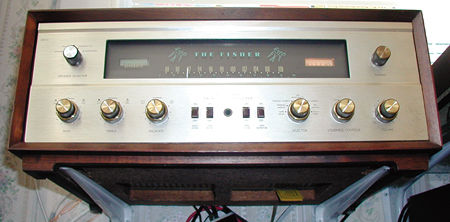
The Fisher 500-C uses a solid-state full-wave rectifier for its front-end circuitry, and half-wave rectification for its B voltage rails, the latter smoothed with RC Pi filters. The output and power transformers, filtering caps, and output tubes are at the rear, the line stage and FM front-end tubes are in the middle, and the faceplate and tuning dial are at the front. The faceplate is brushed aluminum, anodized a soft platinum gold color. It's not half an inch thick and is not machined from solid mil-spec stock—40 years ago, designers had yet to discover the sonic "benefits" of thick faceplates. There are six control knobs on the lower half of the faceplate, and two on the top, one at each end of the ruler dial for the FM band. The knobs are brown plastic with brass endcaps that come unglued over time, fall under the couch, and disappear forever. Don't worry; replacement endcaps are available from the Fisher Radio Corp. through the "Fisher Doctor" (footnote 3).
The FM section has enough options—Auto Stereo, Stereo, De-emphasis, Mono—to make you pause a moment before tuning in to NPR or Air America. I live in Philadelphia; we have only two noncommercial music stations, not one 24/7 classical station.
The 500-C's amplifier section has five front-end inputs: two phono inputs and a tape-head input (all three of these use the phono stage but with different equalization options selected), a monitor input, and an Aux input. The phono/tape-head stage uses one 12AX7 tube per channel for about 20dB of amplification. A Sumiko Blue Point Special high-output MC phono cartridge is a good match gain-wise, but for lower-output MCs, it's best to use a step-up transformer to lower the noise floor.
The 500-C has dual phono inputs, one labeled Phono High for old ceramic cartridges, the other Phono Low for mid- to high-output magnetic cartridges. I place the transformer in line with my low-output moving-coils, test the level, and compare both inputs for noise, dynamic range, and headroom optimization. The 500-C's phono stage is very good, offering wide dynamics, punch, and drive. The soundstage is wide and deep, giving up only a thumbnail of grain to cost-no-object designs.
Footnote 1: The minimum input signal required in an FM receiver to produce a specified output signal of a specified signal/noise ratio. Footnote 2: The FCC authorized stereo FM broadcasting on June 1, 1961. Two stations broadcast in FM stereo on that day: WEFM Chicago and WGFM Schenectady. Footnote 3: If you search online for Fisher Radio Corp. , you'll find Al Pugliese, postal employee by day and Fisher Doctor by night. The Dr. has lots of goodies to help you restore your 500-C, including electronic restoration packages (aka RESTO-PAKs), which come complete with caps and resistors and all sorts of doodads. E-mail: fisherdoc@aol.com. Tel: (718) 948-7489. Fisher Radio Corporation, 27 Daleham Street, Staten Island, NY 10308.
Little did he know how right he would be. Who could predict that, 40 years later, Avery Fisher's crystal ball had been spot on—that thousands of units of this American audio engineering classic would be the centerpieces of the music and fidelity pastime, of vintage audio?
Forget everything you've read or imagined over the past 20 years—vintage gear does not necessarily sound rolled-off, soft and woolly, or fuzzy. This stuff is as far from windup Victrola sound as HDTV is from 1950s black-and-white TV. It is serious high-end audio, and offers a bouquet of endless multilayered soundscapes, pinpoint and holographic images, startling frequency response, and exceptional pace, rhythm, and drive. It's what we look for in our hobby, and it's been here all along. I've invested many years chasing the best cutting-edge gear our industry offers, yet I've never been more satisfied with music and audio since finding a home in yesteryear with all those dead guys with ears.
The Fisher 500-C stereo receiver was the pinnacle of high-fidelity reproduction in 1964. A conservative estimate of the number of 500-Cs built runs to more than 100,000 units. It was a technological tour de force that combined a full-function control center (preamp) with a 35Wpc power amplifier and a stereo multiplex FM tuner that offered the highest sensitivity rating of the time (footnote 1). It's interesting to note that FM tuners from those days continue to offer outstanding performance—witness the $2000-plus resale prices of Marantz 10Bs on the Internet. There is a reason for this, and it's not just nostalgia.
The Fisher 500-C uses a solid-state full-wave rectifier for its front-end circuitry, and half-wave rectification for its B voltage rails, the latter smoothed with RC Pi filters. The output and power transformers, filtering caps, and output tubes are at the rear, the line stage and FM front-end tubes are in the middle, and the faceplate and tuning dial are at the front. The faceplate is brushed aluminum, anodized a soft platinum gold color. It's not half an inch thick and is not machined from solid mil-spec stock—40 years ago, designers had yet to discover the sonic "benefits" of thick faceplates. There are six control knobs on the lower half of the faceplate, and two on the top, one at each end of the ruler dial for the FM band. The knobs are brown plastic with brass endcaps that come unglued over time, fall under the couch, and disappear forever. Don't worry; replacement endcaps are available from the Fisher Radio Corp. through the "Fisher Doctor" (footnote 3).
Footnote 1: The minimum input signal required in an FM receiver to produce a specified output signal of a specified signal/noise ratio. Footnote 2: The FCC authorized stereo FM broadcasting on June 1, 1961. Two stations broadcast in FM stereo on that day: WEFM Chicago and WGFM Schenectady. Footnote 3: If you search online for Fisher Radio Corp. , you'll find Al Pugliese, postal employee by day and Fisher Doctor by night. The Dr. has lots of goodies to help you restore your 500-C, including electronic restoration packages (aka RESTO-PAKs), which come complete with caps and resistors and all sorts of doodads. E-mail: fisherdoc@aol.com. Tel: (718) 948-7489. Fisher Radio Corporation, 27 Daleham Street, Staten Island, NY 10308.