High-quality, low-cost loudspeaker systems are not an everyday blessing. The Rogers LS3/5a has survived for more than a decade precisely because so few US manufacturers sought musical accuracy as distinguished from high output and powerful bass. The economics of loudspeaker manufacture also don't lend themselves to economy. The cost of woodwork is driving the price of speakers up almost as fast as the cost of sheet-metal work is escalating the price of electronics. Both Spica and Dayton Wright, however, have come out with small affordable speakers that should earn the term "blessing" from even the most demanding golden ear. Better yet, they offer a range of desirable tradeoffs. Rather than directly competing with each other, they provide different sets of strengths and weaknesses that allow the buyer to choose between them on the basis of his or her own taste in music and listening patterns. No, you don't get a $5000/pair loudspeaker for $500/pair, and no, they don't make the Mirages, Spendors, LS3/5as, and other good low-cost loudspeakers obsolete. But the Spica TC-50 and Dayton Wright LCM-1 do offer the kind of imaging, phase coherence, and musical integrity that have previously been available only at prices approaching $1000.
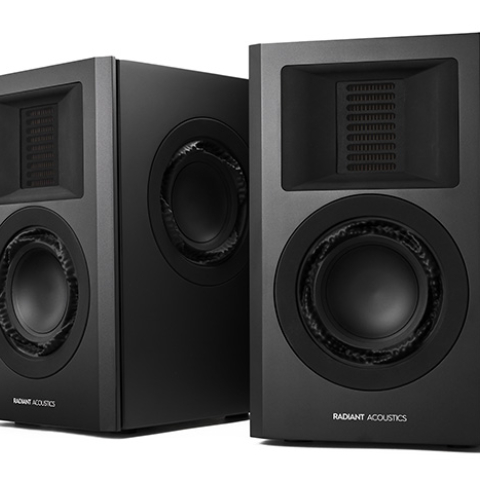
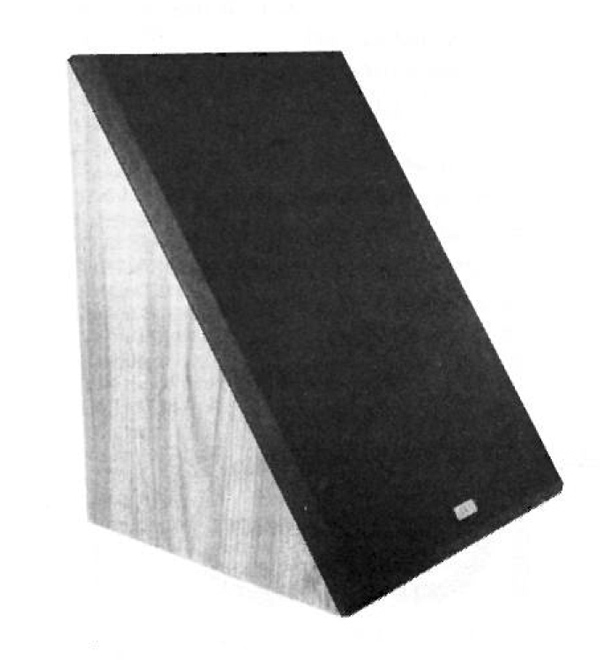
They also are small enough so that few wives (or other partners of various sexes and species) are likely to object. Like Fords they come only in black (footnote 1), and they do require mounting on stands and careful placement, but they are generally quite easy on the eyes unless you go in for the clean Greek lines of heavily carved Ionic mahogany and pre-Raphaelite Islamic inlay. Enough deference to culture! Let's get down to the hardware. Like the Dayton Wright, the TC-50 is a relatively compact speaker, weighing about 20 pounds each and having a sloping front. Also like the Dayton Wright it comes with a basic black grille cloth, although with nice Formica side panels. It is also similar to the Dayton Wright in using a 1" dome tweeter and a 6½" woofer. The woofer is acoustic suspension and the impedance varies from a low of 3.7 ohms to a high of 15 ohms. The impedance curve is smooth in the midrange, but the dip to under 4 ohms rules out poorly designed receivers or integrated amps anything not rated for 4 ohms. It is with relatively inexpensive receivers, by the way, that most TC-50s are sold, according to the manufacturer. Unlike the Dayton Wright, power handling is comparatively limited. Stick with 100 watts or less, and a really good 40-70W amplifier will be far better than a less transparent high-powered unit.
The Spica differs from the Dayton Wright in that it is an attempt to provide the best possible phase and time coherence at the price. As has been discussed previously, this is achieved at the cost of deep bass and extreme highs. The Spica rolls off fairly gently in the bass on a frequency response graph, but have no strong bass below about 70Hz. It falls off steeply after 12-14kHz. Compared to the DWs and other very dynamic speaker systems, the subjective differences between loud and soft are less dramatic on the Spicas. The TC-50 is, however, exceptionally flat in its frequency and phase response in the 300Hz to 5kHz region. The tweeter section of the crossover is first-order Butterworth (6dB/octave rolloffs, footnote 2), and the Spica exhibits very little phase shift in the midrange. This allows it to rival electrostatics in coherence and to outperform most ribbon designs. While it is definitely not as fast as ribbons or electrostatics, it is also not bipolar and avoids the problems of rear wall reflections and consequent delayed arrival of musical information. This is, in fact, the raison d'etre of the Spica TC-50. It is an attempt to provide coherence in the frequency range to which the ear is most sensitive, comparable to that of the most expensive speakers available but at a price below $500/pair. It represents the result of very sophisticated work in Time Delay Spectrometry and Bessel filter design, supported by extensive listening tests. Further, they have exceptionally tight quality control to ensure that they meet specification. Each pair is individually matched within 0.5dB using Time Delay Spectrometry.
This emphasis shows up in the listening. The Spicas are slightly warm in the lower midrange and a bit recessed in the top octave, but they are exceptionally transparent and coherent. They rival the Quad ESL-63 at providing low-level detail and harmonic delicacy from low, to moderately high listening levels. The imaging is outstanding (after several days of speaker adjustment to get it just right), and violin and woodwinds are exceptionally natural. Voice is just slightly warm, and percussion is slightly lacking in impact and bottom, although it is very fast, coherent, and tight. Brass is more detailed and correct, in terms of imaging and revelation of the mechanics of musicianship, than with any speakers in the price range, although it is slightly "toppy" (tilted towards the upper midrange) in timbre.
Footnote 1: This has become not quite true for the Spica; it is now available in oak veneer for $450/pair.—Anthony H. Cordesman
Footnote 2: The woofer section of the crossover is a fourth-order Bessel which felicitously gives flat phase response through the crossover region. The discovery of this was a major achievement for John Bau (Spica's president) and his computer, which will be the subject of a future interview in these pages.—Larry Archibald
Footnote 1: This has become not quite true for the Spica; it is now available in oak veneer for $450/pair.—Anthony H. Cordesman