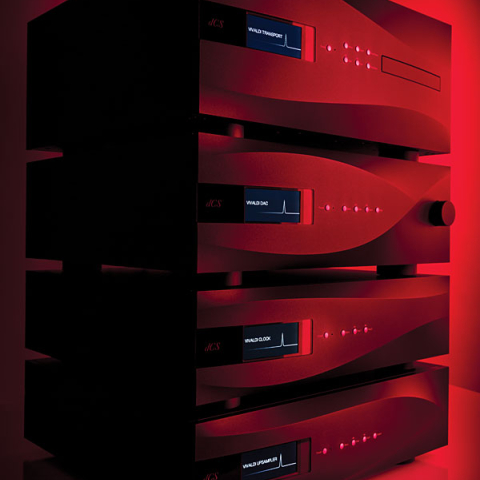
There are components that stick in a reviewer's memory long after they have been crated up and entrusted to the tender mercies of UPS. When I reviewed the Verona Master Clock from English company dCS in March 2005, the sound it allowed the combination of a dCS Verdi transport, Purcell upsampler, and Elgar Plus D/A processor to achieve from SACD was the best I had heard from my system—better, even, than I remember getting from the EMM Labs SACD transport and processor I had borrowed for a weekend a few months earlier. But at what price? The stack of four dCS components adds up to a cool $45k—"Yes, the complete dCS system is hip," I wrote in the conclusion to my review. "But $45k's worth of hip? That's a question I can't answer, I'm afraid, what with school fees and mortgages and taxes." The megabux dCS stack thus had to go back to the distributor at the end of the review period.
 But I still miss it. So when the company announced its P8i one-box SACD player at last May's Home Entertainment Show in New York, which it promised would deliver much of the big rig's sound quality for a somewhat more affordable $13,995, I asked for a review sample as soon as the model was in production.
The P8i...
But I still miss it. So when the company announced its P8i one-box SACD player at last May's Home Entertainment Show in New York, which it promised would deliver much of the big rig's sound quality for a somewhat more affordable $13,995, I asked for a review sample as soon as the model was in production.
The P8i...
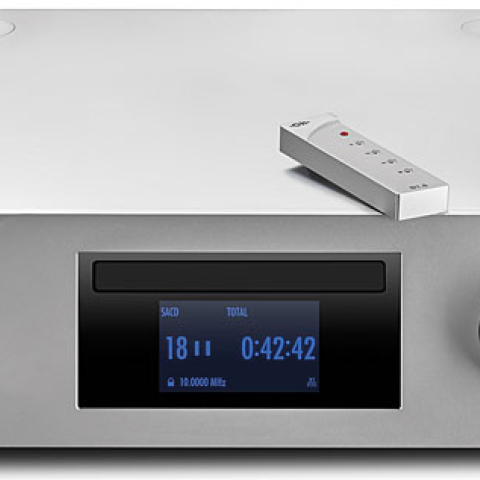
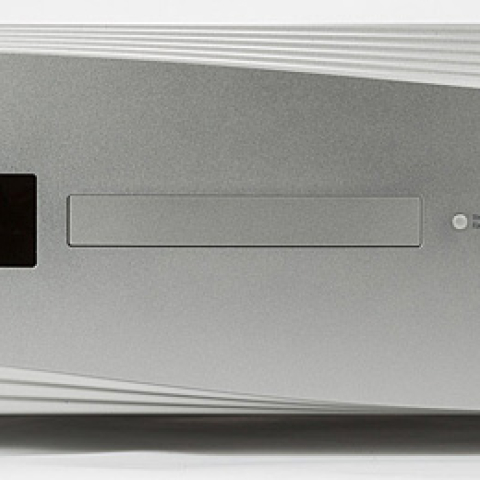
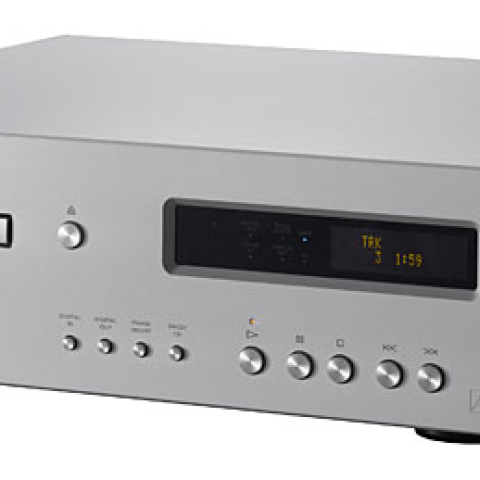
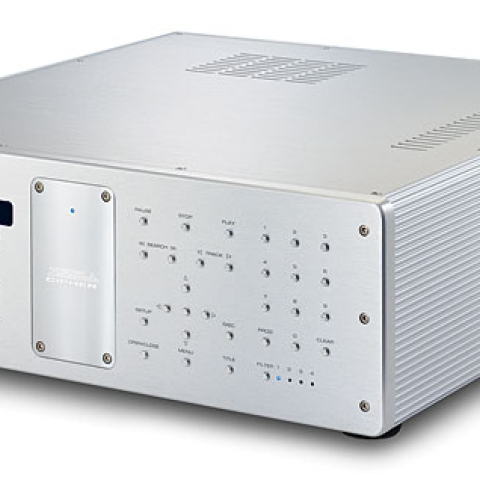
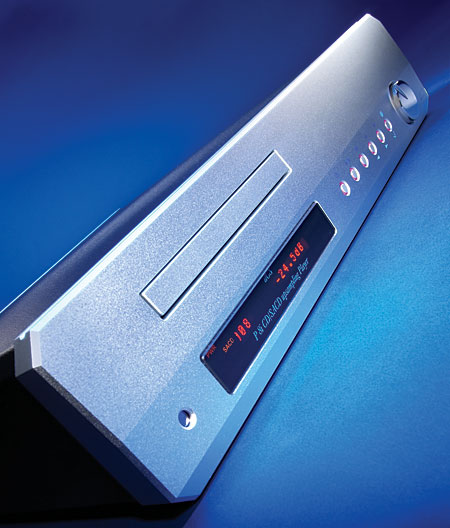
...is the first in a series of less-extreme-priced products from dCS, each housed in a handsome aluminum-faced chassis. (A separate DAC and transport should be available around the time you read these words.) The slot for the disc transport lies above the orange fluorescent display on the left of the front panel. On the right is a chromed knob that controls volume in 0.5dB steps or accesses the menu options. In between are six pushbuttons. These glow green when the P8i is turned on or when the tray is open, red when a CD is played, and violet during SACD play.
The rightmost button selects the setup Menu, the leftmost switches between Standby and Operate, and in between are the usual transport controls; all are duplicated on the chunky metal remote, which also has Volume, Balance, Mute, and numeric track buttons. Absolute signal polarity can be changed with the Menu button, but, peculiarly, not with the remote. Its arrangement of front-panel buttons was my first quibble with the P8i: as the Standby button was closest to the transport, I kept pushing it, rather than the button to its right, when I wanted to eject a disc.
The rear panel has three color-coded recesses, with the AC supply jack, fuse, and master On/Off switch mounted on a red background, the digital and word-clock outputs coded light green, the digital and word-clock inputs pink, and the single-ended and balanced analog outputs blue. The last provided my second quibble: there is very little clearance between the top of the XLR shells and the chassis. If you have fat, stubby fingers like mine, you'll find it hard to depress the latches on the XLR plugs when you want to disconnect them.
I found the P8i susceptible to static—if I didn't discharge myself on my metal component rack before touching one of the player's buttons, I got some unpredictable behavior that on one occasion caused me to reboot the machine in order to extract the disc. Otherwise, operation was without mishap.
Technology
I couldn't disassemble the P8i, so can't report firsthand on its circuitry. However, dCS's white paper says that the player uses the company's Ring DAC, clocked by a high-precision, voltage-controlled crystal oscillator. The Ring DAC is a discrete, 5-bit converter running at a 64x oversampling rate: 2.822MHz for DSD and CD data. For SACD playback, the DSD datastream is fed directly to the DAC; when a CD is played, the "Red Book" data can be upsampled to DSD, this selectable with the Menu button. A choice of four reconstruction filters is provided for CD playback, these again selected by the Menu button. As mandated by the Sony-Philips license, the P8i's digital outputs are switched off when an SACD is playing. The review sample of the P8i was run by v1.05 of the operating software, which doesn't activate the digital inputs. I will write a Follow-Up when the free upgrade is available. A second software upgrade, this one for extra cost, will allow external digital sources to be upsampled to DSD. Sound
My initial auditioning was done with CDs played back using Filter 1. While the presentation was detailed and transparent, CDs that were themselves a little overcooked in the treble sounded a touch relentless. I settled on Filter 4, which gives a slower ultrasonic rolloff, for a sound that best approached what the P8i could do with SACDs. I started out using the dCS set to 6V maximum output, but ended up switching it to 2V both when I used it to feed the Mark Levinson No.326S preamp and when I used it without a preamp.
Digital players with pretensions to performance tend to fall into two camps: those that attempt to smooth over the sound and those that attempt to dig as deep as possible into what is on the disc. The P8i is definitely in the latter group. Even with the SACD, the P8i's presentation could never be described as "laid-back." SACDs that are themselves balanced on the hot side—Steely Dan's Gaucho, for example (MCA B000868-36)—sounded as relentless as I expected.
However, with every disc I played on the dCS P8i there was a wealth of recorded detail—not thrust forward but integrated within a wide, deep soundstage. When the SACD was more naturally balanced than Gaucho, the result was musically very satisfying. While I was setting up the P8i, Andrew Manze's new recording of Mozart's Violin Concertos 3–5 arrived (Harmonia Mundi HMU 807385). Playing this SACD on the dCS convinced me that it should be this month's "Recording of the Month." Manze's period violin is set forward in the mix, yet it doesn't sound aggressively forced. It does splash a little to the sides at times—perhaps a spaced pair of omni mikes was used as the main pickup?—though the image of the accompanying English Concert is wide, deep, and stable.
But I still miss it. So when the company announced its P8i one-box SACD player at last May's Home Entertainment Show in New York, which it promised would deliver much of the big rig's sound quality for a somewhat more affordable $13,995, I asked for a review sample as soon as the model was in production.
The P8i...
...is the first in a series of less-extreme-priced products from dCS, each housed in a handsome aluminum-faced chassis. (A separate DAC and transport should be available around the time you read these words.) The slot for the disc transport lies above the orange fluorescent display on the left of the front panel. On the right is a chromed knob that controls volume in 0.5dB steps or accesses the menu options. In between are six pushbuttons. These glow green when the P8i is turned on or when the tray is open, red when a CD is played, and violet during SACD play.
I couldn't disassemble the P8i, so can't report firsthand on its circuitry. However, dCS's white paper says that the player uses the company's Ring DAC, clocked by a high-precision, voltage-controlled crystal oscillator. The Ring DAC is a discrete, 5-bit converter running at a 64x oversampling rate: 2.822MHz for DSD and CD data. For SACD playback, the DSD datastream is fed directly to the DAC; when a CD is played, the "Red Book" data can be upsampled to DSD, this selectable with the Menu button. A choice of four reconstruction filters is provided for CD playback, these again selected by the Menu button. As mandated by the Sony-Philips license, the P8i's digital outputs are switched off when an SACD is playing. The review sample of the P8i was run by v1.05 of the operating software, which doesn't activate the digital inputs. I will write a Follow-Up when the free upgrade is available. A second software upgrade, this one for extra cost, will allow external digital sources to be upsampled to DSD. Sound
My initial auditioning was done with CDs played back using Filter 1. While the presentation was detailed and transparent, CDs that were themselves a little overcooked in the treble sounded a touch relentless. I settled on Filter 4, which gives a slower ultrasonic rolloff, for a sound that best approached what the P8i could do with SACDs. I started out using the dCS set to 6V maximum output, but ended up switching it to 2V both when I used it to feed the Mark Levinson No.326S preamp and when I used it without a preamp.