With the exception of dCS and Accuphase, you don't see anyone jumping on the bandwagon of $15,000-plus SACD players—and for good reason. Despite enthusiasm for the format within the relatively small audiophile community, high-resolution audio isn't exactly making waves on the front pages—or even the back pages—of the mainstream news media. And while ABKCO Records has sold millions of Rolling Stones hybrid SACD/CDs, and Sony is looking to repeat that phenomenon with the recent Dylan hybrids, what's being sold in both cases are CDs, not SACDs. The higher-resolution layer is simply going along for the ride.
 The good news is that, despite the mania for digital MP3 downloads and the media's focus on it, to get good sound, millions of discerning consumers are clearly still willing to pay for what they could easily steal online. (I don't care how greedy or evil the record biz might be—I think unauthorized file sharing is stealing.)
But the long-term survival of the SACD format remains uncertain. Now that DVD-Audio is finally awakening from its corporate-induced slumber, many consumers are taking a wait-and-hear stance toward both. The video-based DVD-A medium, in particular, is problematic for many audiophiles, who like to keep kosher when it comes to audio and video. But some great DVD-A titles are now being released, such as the recent reissue of the Beach Boys' Pet Sounds, featuring engineer Mark Linnett's superb 5.1-channel remix, along with the stereo and original mono mixes, in 24-bit/96kHz sound. Who wants to miss such a treat—and hundreds more like it—by buying an expensive player that decodes only SACD?
That's the issue dCS is facing, having issued the two-channel, $33,000 SACD assemblage of Verdi transport, Purcell D/D converter, and Elgar Plus DSD DAC, and which I reviewed in the April 2003 issue. No doubt there are some well-heeled audiophiles who have huge collections of CDs, are buying SACDs, and will invest in such a product because it maximizes CD sound and can decode SACD as well, but how many? Meanwhile, aside from Linn's Unidisk 1.1 universal player ($10,995), audiophiles wanting a high-quality universal player are still on hold. And the question remains: How many audiophiles want video anything in their audio systems?
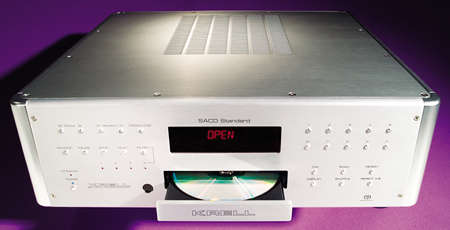
Perhaps that's why Krell—known for its price-no-object assaults on the state of the art—has entered the SACD wars by taking aim, with the $4000 SACD Standard, at a more modest segment of the market. Perhaps Krell figures that it's better to let the market shake itself out than to empty the corporate piggy-bank by laying odds on a risky bet.
Standard Krell
The good news is that, despite the mania for digital MP3 downloads and the media's focus on it, to get good sound, millions of discerning consumers are clearly still willing to pay for what they could easily steal online. (I don't care how greedy or evil the record biz might be—I think unauthorized file sharing is stealing.)
But the long-term survival of the SACD format remains uncertain. Now that DVD-Audio is finally awakening from its corporate-induced slumber, many consumers are taking a wait-and-hear stance toward both. The video-based DVD-A medium, in particular, is problematic for many audiophiles, who like to keep kosher when it comes to audio and video. But some great DVD-A titles are now being released, such as the recent reissue of the Beach Boys' Pet Sounds, featuring engineer Mark Linnett's superb 5.1-channel remix, along with the stereo and original mono mixes, in 24-bit/96kHz sound. Who wants to miss such a treat—and hundreds more like it—by buying an expensive player that decodes only SACD?
That's the issue dCS is facing, having issued the two-channel, $33,000 SACD assemblage of Verdi transport, Purcell D/D converter, and Elgar Plus DSD DAC, and which I reviewed in the April 2003 issue. No doubt there are some well-heeled audiophiles who have huge collections of CDs, are buying SACDs, and will invest in such a product because it maximizes CD sound and can decode SACD as well, but how many? Meanwhile, aside from Linn's Unidisk 1.1 universal player ($10,995), audiophiles wanting a high-quality universal player are still on hold. And the question remains: How many audiophiles want video anything in their audio systems?
Perhaps that's why Krell—known for its price-no-object assaults on the state of the art—has entered the SACD wars by taking aim, with the $4000 SACD Standard, at a more modest segment of the market. Perhaps Krell figures that it's better to let the market shake itself out than to empty the corporate piggy-bank by laying odds on a risky bet.
Standard Krell
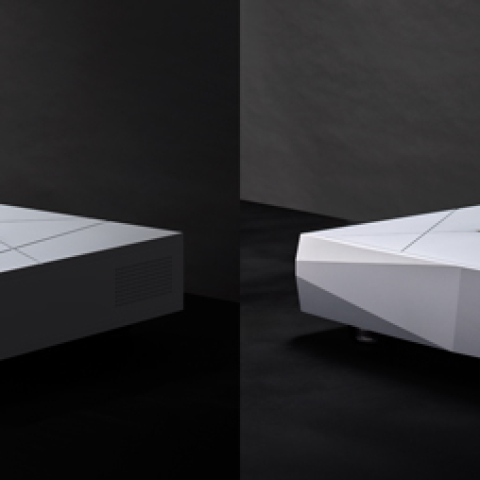
Despite its relatively modest price of $4000, Krell's SACD Standard has absorbed technology and build quality that Krell pioneered in its far more expensive products. The chassis-within-a-chassis design gives a fortress-like solidity designed to provide an ultra-stable, vibration-resistant platform for the Philips SACD transport. Once past the OEM drive kit (transport, display, and their power supply) and the differentially configured 24-bit Burr-Brown DACs, the circuitry is unique to Krell. This includes the discrete-topology, post-DAC filtering, with separate minimal phase-shift filters optimized for PCM and DSD signals. Power derives from a custom toroidal transformer wound with separate taps for the DACs and analog output stages. Several stages of discrete, Krell-designed linear output regulators are said to produce a quiet, stable, low-impedance voltage supply.
The dual-differential, fully balanced output stage features Krell's current-mode design, based on the circuits used in their KPS-28c CD player ($7500) and KCT (for Krell Current Tunnel) preamplifier ($22,500), whose bandwidth is claimed to be -3dB at 1.5MHz. Krell claims that a current-based audio circuit is capable of far greater bandwidth and is less susceptible to circuit-induced capacitances than the voltage-based variety. If left unchecked, such capacitances can have deleterious effects on the sound. Krell claims that its current-based design results in extended bandwidth and phase coherence for its output stage, even though the latter does act as a conventional voltage source.
The Standard, available in black or silver, is handsome but understatedly so—if you use the black version's front-panel controls instead of its remote control, you'd better have good lighting or you won't be able to identify the tiny, unlit buttons on either side of the central display and disc drawer. Fortunately, the layout of buttons is logical: to the left are the basic transport functions of Track Change, Search, Open/Close, Pause, Stop, and Play; to the right are Shuffle, Scan, Repeat, Repeat A/B, Display, and Dim. Also on the left is a Filter button that gives you a choice of two low-pass filters for PCM (CD), four for DSD (SACD). More about that later.
The remote control is likely to cause some controversy. Rather than using discrete, mechanical buttons, the SACD Standard's remote is a slim, "membrane"-type design more commonly used with such products as the Bose Wave radio—which, as we all know, can replace an entire rack's worth of bulky, old-fashioned components of the sort built by Krell. Krell's remote is far more substantial than what's commonly used with over-achieving table radios, and is far less likely to scratch the furniture than the remotes often found accompanying high-end gear, and which seem milled from a billet of kryptonite.
The SACD Standard's rear panel has stereo XLR balanced output jacks, 5.1-channel single-ended RCA jacks, coaxial and TosLink digital outs (PCM only), 12V trigger jacks, an IEC AC jack, the On/Off switch, and an additional remote IR sensor and RS-232 communications port to permit the player to be integrated into one of those touchpad universal control systems that pops your corn, rolls up your shades, flushes your toilet, and makes you think you're Master of the Universe.
The good news is that, despite the mania for digital MP3 downloads and the media's focus on it, to get good sound, millions of discerning consumers are clearly still willing to pay for what they could easily steal online. (I don't care how greedy or evil the record biz might be—I think unauthorized file sharing is stealing.)
But the long-term survival of the SACD format remains uncertain. Now that DVD-Audio is finally awakening from its corporate-induced slumber, many consumers are taking a wait-and-hear stance toward both. The video-based DVD-A medium, in particular, is problematic for many audiophiles, who like to keep kosher when it comes to audio and video. But some great DVD-A titles are now being released, such as the recent reissue of the Beach Boys' Pet Sounds, featuring engineer Mark Linnett's superb 5.1-channel remix, along with the stereo and original mono mixes, in 24-bit/96kHz sound. Who wants to miss such a treat—and hundreds more like it—by buying an expensive player that decodes only SACD?
Despite its relatively modest price of $4000, Krell's SACD Standard has absorbed technology and build quality that Krell pioneered in its far more expensive products. The chassis-within-a-chassis design gives a fortress-like solidity designed to provide an ultra-stable, vibration-resistant platform for the Philips SACD transport. Once past the OEM drive kit (transport, display, and their power supply) and the differentially configured 24-bit Burr-Brown DACs, the circuitry is unique to Krell. This includes the discrete-topology, post-DAC filtering, with separate minimal phase-shift filters optimized for PCM and DSD signals. Power derives from a custom toroidal transformer wound with separate taps for the DACs and analog output stages. Several stages of discrete, Krell-designed linear output regulators are said to produce a quiet, stable, low-impedance voltage supply.