I have reviewed and owned so many Paradigm speakers that they feel almost like members of the family. I've owned the v.2 and v.3 versions of the Reference Studio 60, and reviewed the v.3 version in Stereophile (in December 2004, Vol.27 No.12). My long and intimate relationship with this speaker is founded on the best of reasons: We are extremely compatible. The Studio 60, in all its incarnations, is large enough to be used as a full-range speaker with nearly any program material, and yet is compact enough to be easily accommodated in my relatively small Connecticut listening room. It neither looms over me nor disappears into the space. Used as a center-channel speaker, it's just short enough to clear my line of sight to the video display. Finally, and despite inevitable price creep over the last decade, the Studio 60 still comes in under $2000/pair—my line in the sand for a reasonably priced system.
 Join the family
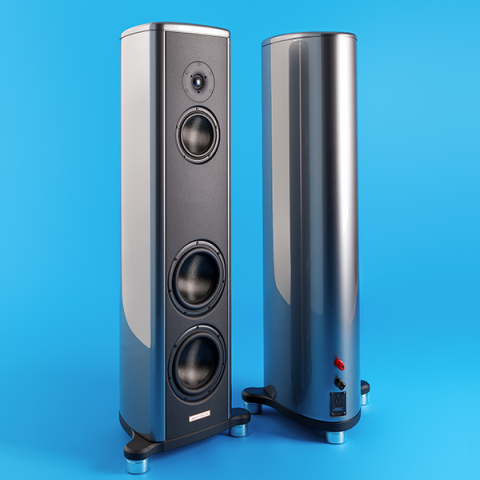
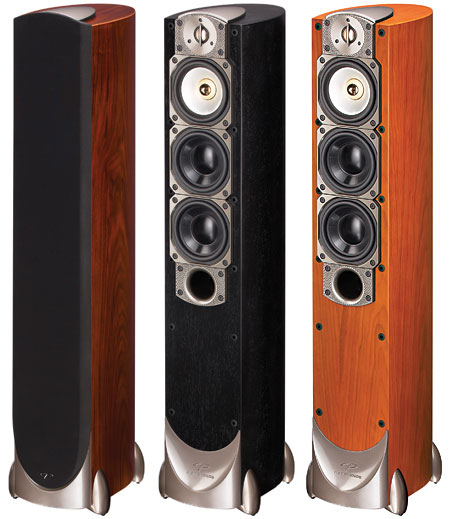
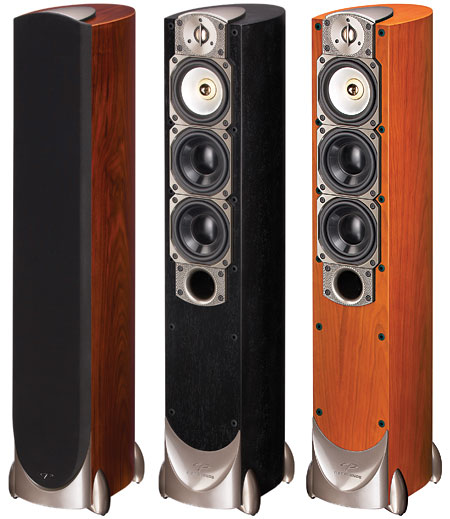
Unpacked and set up next to my Studio 60 v.3s, the Reference Studio 60 v.5s were much more attractive in finish and more shapely in design, though clearly (once I'd removed their grilles) based on the same DNA. In each, the dome tweeter sits in a cowl fitted to the top of the cabinet. All drivers and the front port are supported by heavy frames resiliently mounted to the front panel. (Paradigm calls this system IMS/Shock-Mounting.) Both models have cast-metal front bases with feet that match the cast feet in the rear. Finally, the upper cone driver, a mid-woofer in each case, differs in cone material from the woofers proper, and sports a brass dome or phase plug. As in the prior models, the dedicated woofers of the v.5 have mineral-filled polypropylene cones, but the v.5's mid-woofer is made of Paradigm's Satin-Anodized Pure-Aluminum (S-PAL), the dome tweeter of Gold-Anodized Pure-Aluminum (G-PAL). Despite these similarities, the v.5 is a much greater leap forward than any earlier Studio 60. Gone are the slab sides, replaced by curved panels that converge at the back. This not only contributes greatly to the speaker's appearance, it also increases the rigidity of the cabinet without increasing its mass; the new cabinet was satisfyingly free from noticeable vibrations. Equally notable is the change from the 7" midwoofer and 7" woofer pair to three 5.5" drivers. While this retains roughly the same total radiating surface in the bass, it significantly reduces the radiating surface at the crossover to the tweeter, affording a wider horizontal radiation pattern where it is most needed.
Still, I was initially disappointed in the Reference Studio 60 v.5 in two ways that may ultimately prove inconsequential. First, the Studio 60 still has not evolved into a true three-way design, but remains a 2.5-way system, its lower two 5.5" drivers being rolled off above 500Hz to leave the upper one to carry the midrange up to the 2kHz crossover to the tweeter. Fortunately, the use in the v.5 of the smaller 5.5" drivers should mitigate the slight off-axis brightness that characterizes my Studio v.3s. Second, I was surprised to find that the fixed, solid phase plug of the mid-woofer in the earlier versions has been replaced by a domed dustcap attached to the voice-coil former. This dustcap is now part of the cone/voice-coil assembly, adding to its moving mass. This lightweight bullet may look just like a phase plug, but in my opinion it's more likely to function like a modern version of the "whizzer cones" of ancient full-range drivers.
When I asked Paradigm's Mark Aling about the latter issue, he offered this detailed reply:
Replacing the phase plug with a dustcap has the following benefits:
Increased power handling. With a driver with "regular" excursion capability, a solid aluminum phase plug provides a good heatsink, which benefits long-term power handling. However, with a driver with relatively high excursion (as found in the woofers in the Studio v.5 series), increased power handling was required. Replacing the phase plug with a dustcap creates an "air pump," which forces air under the dustcap to move past the voice-coil at high velocity. This high-velocity air motion over the voice-coil was found to decrease the voice coil's temperature relative to the voice-coil's temperature when a phase plug was employed, thus improving power handling.
Eliminated air-chuffing noises that come from around the voice-coil at high driver excursion when a phase plug is used. At regular cone-excursion levels, the noise created by air passing by the voice-coil and top plate when a phase plug is used is below the threshold of audibility. However, due to the increased excursion capability of the new Studio drivers, the noise due to air rushing over the voice-coil is now audible. This audibility of this noise is completely eliminated by replacing the phase plug with a dustcap.
Increased driver efficiency due to increased radiating area. Because a phase plug does not move with the cone, it does not contribute to the radiating area of a driver, whereas a dustcap (which does move with the cone) does contribute to the radiating area of a driver. By increasing a driver's radiating area, the driver's efficiency is increased.
Join the system
I put the Reference Studio 60 v.5s in precisely the spots long occupied by the v.3s. My Integra DTC-9.8 and Arcam AV888 preamplifier-processors were set to reroute any center-channel info to the new Paradigms, and the pre-pros' v.3-tuned EQs were defeated. This way, when the system was used for multichannel signals, the remaining v.3 in the middle would be ignored and EQ issues would not be a factor. Immediately, I had an Oh-ho! response. The v.5s had a lively, inviting sound that contrasted clearly with the sound of the v.3s, and of the PSB Image Ts that had preceded them. More on that below.
Join the family
Unpacked and set up next to my Studio 60 v.3s, the Reference Studio 60 v.5s were much more attractive in finish and more shapely in design, though clearly (once I'd removed their grilles) based on the same DNA. In each, the dome tweeter sits in a cowl fitted to the top of the cabinet. All drivers and the front port are supported by heavy frames resiliently mounted to the front panel. (Paradigm calls this system IMS/Shock-Mounting.) Both models have cast-metal front bases with feet that match the cast feet in the rear. Finally, the upper cone driver, a mid-woofer in each case, differs in cone material from the woofers proper, and sports a brass dome or phase plug. As in the prior models, the dedicated woofers of the v.5 have mineral-filled polypropylene cones, but the v.5's mid-woofer is made of Paradigm's Satin-Anodized Pure-Aluminum (S-PAL), the dome tweeter of Gold-Anodized Pure-Aluminum (G-PAL). Despite these similarities, the v.5 is a much greater leap forward than any earlier Studio 60. Gone are the slab sides, replaced by curved panels that converge at the back. This not only contributes greatly to the speaker's appearance, it also increases the rigidity of the cabinet without increasing its mass; the new cabinet was satisfyingly free from noticeable vibrations. Equally notable is the change from the 7" midwoofer and 7" woofer pair to three 5.5" drivers. While this retains roughly the same total radiating surface in the bass, it significantly reduces the radiating surface at the crossover to the tweeter, affording a wider horizontal radiation pattern where it is most needed.
I put the Reference Studio 60 v.5s in precisely the spots long occupied by the v.3s. My Integra DTC-9.8 and Arcam AV888 preamplifier-processors were set to reroute any center-channel info to the new Paradigms, and the pre-pros' v.3-tuned EQs were defeated. This way, when the system was used for multichannel signals, the remaining v.3 in the middle would be ignored and EQ issues would not be a factor. Immediately, I had an Oh-ho! response. The v.5s had a lively, inviting sound that contrasted clearly with the sound of the v.3s, and of the PSB Image Ts that had preceded them. More on that below.