Dear Diary:
I'm on Day 324 of my quest for Real World Hi-Fi, and things haven't turned out as well as I'd have liked. I could have sworn that all this affordable stuff sounded great before I became accustomed to the muy expensivo gear I've been covering in Stereophile for the past couple of years, but now I'm not so sure. Maybe it was the government cheese I was eating back then, but inexpensive hi-fi gear didn't seem to sound so...so cheap back when it was all I had to listen to.
 Maybe I'm aiming too low. After all, "Real World" means different things to different people. When I asked David Wilson once if he was ever going to build a Real World speaker, he told me he wasn't sure if his customers were even interested in $5000 speakers.
Am I lowballing things here? Should I raise my price points a wee bit so I don't have to listen to so much garbage anymore?
NO! I made a deal with the devil and I'm going to stick to it! "Find me a killer pair of full-range speakers for under $1000 and we'll rule hell TOGETHER!!!" ol' Lucifer laughed. Hey, how can you pass up an offer like that?
So I asked around, trying to find some suitable candidates for the Ultimate Real World Speaker Under A Grand. I had a few ground rules: First, the speaker had to be full-range—none of that pipsqueak, no-bass, minimonitor crap. Second, if the speaker needed stands, it'd better work fine sitting on stacked cinderblocks—none of those muy expensivo specialty stands that cost more than the speaker. And finally, it had to be something I'd wholeheartedly recommend to people I actually know, none of whom are audiophiles in any sense of the word and all of whom would kick my ass if I steered them toward fussy, wimpified audiophile speakers that make Delbert McClinton sound like Engelbert Humperdinck.
One speaker that kept popping up as a possible candidate was Vandersteen's $695/pair Model 1B, the company's least expensive. The larger Vandersteens, the 2Ce and 3, have gotten favorable reviews from TJN and JA (Vol.16 No.4, p.217 and Vol.16 No.3, p.140, respectively). And most important, a pair of 1Bs with matching stands costs only $780, leaving a few bux under my $1000 limit to buy some real cheese at the grocery store.
Eric the half-1b
Maybe I'm aiming too low. After all, "Real World" means different things to different people. When I asked David Wilson once if he was ever going to build a Real World speaker, he told me he wasn't sure if his customers were even interested in $5000 speakers.
Am I lowballing things here? Should I raise my price points a wee bit so I don't have to listen to so much garbage anymore?
NO! I made a deal with the devil and I'm going to stick to it! "Find me a killer pair of full-range speakers for under $1000 and we'll rule hell TOGETHER!!!" ol' Lucifer laughed. Hey, how can you pass up an offer like that?
So I asked around, trying to find some suitable candidates for the Ultimate Real World Speaker Under A Grand. I had a few ground rules: First, the speaker had to be full-range—none of that pipsqueak, no-bass, minimonitor crap. Second, if the speaker needed stands, it'd better work fine sitting on stacked cinderblocks—none of those muy expensivo specialty stands that cost more than the speaker. And finally, it had to be something I'd wholeheartedly recommend to people I actually know, none of whom are audiophiles in any sense of the word and all of whom would kick my ass if I steered them toward fussy, wimpified audiophile speakers that make Delbert McClinton sound like Engelbert Humperdinck.
One speaker that kept popping up as a possible candidate was Vandersteen's $695/pair Model 1B, the company's least expensive. The larger Vandersteens, the 2Ce and 3, have gotten favorable reviews from TJN and JA (Vol.16 No.4, p.217 and Vol.16 No.3, p.140, respectively). And most important, a pair of 1Bs with matching stands costs only $780, leaving a few bux under my $1000 limit to buy some real cheese at the grocery store.
Eric the half-1b
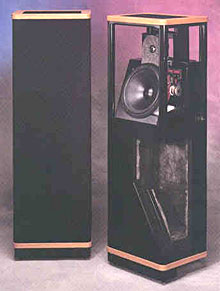
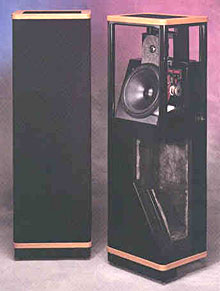
The floorstanding Vandersteen 1B sports an 8" polycone woofer in what Vandersteen terms a "transmission-line" loading, though the cutaway photo of the cabinet's interior looks more like a conventional vented enclosure with a rear-firing slotted port at the bottom of the cabinet. The 1B crosses this driver over at 2.8kHz to a 1" Vifa metal-dome tweeter, whose level is adjustable over a +1/–3dB range with a wirewound level-control pot mounted on the rear of the cabinet. I tried various settings of this tweeter control, but ultimately preferred the "0dB/Flat" for the best-sounding balance.
Like the rest of the Vandersteen line, the 1B's drivers are crossed over to each other with first-order 6dB/octave slopes, which means that the unit's 8" woofer had better be extremely well-behaved at the top end—and the 1" metal-dome tweeter had better be able to handle a higher level of upper-midrange energy before distorting than speakers which roll off their tweeters with steeper high-pass slopes. One way Richard Vandersteen helps his tweeters live to tweet another day is to provide the 1Bs with a kind of "overload-protection" circuit that reduces the output to each driver if you're stupid enough to crank your music as loudly as I do. In all my time with the 1Bs, these protection circuits came into play only once, during an extended session with the new Dunhill reissue of Creedence Clearwater Revival's Cosmo's Factory at Stupid-Approved levels. But after a few minutes of system cool-down, the speakers came up to speed again with no problems.
As with Vandersteen's larger models, the 1B's cabinet is constructed of unfinished MDF and sprayed Lowrider Flat Black, with a full-length black grillecloth "sock" pulled down around the entire cabinet to keep everything nice and purty-like. Cat owners should be warned that of all the speakers that have been through my house, the 1Bs were the most alluring to Muddy and his baby sister Eartha, who joined forces to pretty much totally scratch the hell out of both speakers' grillecloths. I finally gave up trying to keep them from incessantly clawing at the Vandersteens, but the ravaged Vandersocks had no adverse effect on the sound of the 1Bs. (Of course, the speakers now didn't exactly look like candidates for an Audio/Video Interiors photo spread, either.)
Like the larger Vandersteens, the 1B's drivers are staggered for a degree of time alignment, the 8" woofer mounted slightly forward of the tweeter and canted back to fire upward a bit (the tweeter fires directly forward). The tweeter is mounted atop the woofer in a separate sub-enclosure that's barely as wide across as the driver itself. To reduce the tweeter's reflections from the lip of the woofer cabinet, a piece of thin felt is stapled to the cabinet between the two drivers.
One of Vandersteen's construction features I've never understood are the four wooden dowels that connect the speaker's wooden cap to its baseplate. These 1¼"-wide rods are located approximately 30° to the sides of the drivers and about 5" from each driver. It just doesn't make any sense to me that Vandersteen doesn't mind sticking two thick, wooden dowels close to the front of its drivers when so much effort is expended elsewhere—with smallish, rounded cabinet sections and felt around the drivers—to minimize exterior cabinet reflections. But I'm sure Richard V. will set my 8-track mind straight in "Manufacturers' Comments."
The 1B is not bi-wireable—only a single pair of input posts appears on the rear, and they're banana jacks, so spade-lug–terminated speaker cable is out of the question with these littlest Vandys. You're limited to either banana plugs—which SUUUUUUUUCK!—or my own personal fave speaker connector, the cool-man Deltron type (sourced from the swingin' UK) that features a solid banana-sized pin with a tension spring to keep the connection nice'n'tight. According to Mr. Blackwell, banana plugs and heavy-metal spade lugs are OUT—the EZ-2-USE kwik-in, kwik-out Deltron is now the speaker connector of choice.
Although the $85 Vanderstands are sold separately as "optional," they should be considered mandatory because they vastly improve the speaker's low-end extension and optimize the degree of cabinet tilt for the best integration between the two drivers (more on this later). As recommended in the instructions, I filled the Vanderstands to the brim with sand and screwed them tightly to the bottom of each 1B. The three adjustable spiked feet were then tightened down after the correct cabinet tilt was determined according to Vandersteen's comprehensive manual.
Lissnin' in the real world
Although I did some preliminary auditioning of the 1Bs in my mighty He-Man rig (footnote 1), the Vandersteens spent most of the review period in my current Real World system of affordable, entry-level hi-fi gear. Amplification included, at one time or another: Adcom GFA-535 II and Rotel RB-960BX 60W solid-state separate amplifiers, used in conjunction with the Conrad-Johnson PV10A kilobuck tube preamp I reviewed in Vol.16 No.6 (p.167); Acurus DIA-100 100W integrated amp; and NAD's new 40W Model 705 receiver. Source material was almost exclusively CD, played on the cool-man JVC XL-Z1050TN and Rotel RCD-955AX players. All interconnects were the new budget-king Kimber PBJ, while speaker cables were 10' pairs of either Kimber 4TC or AudioQuest Type 4.
Footnote 1: Aragon 4004 Mk.II or Muse Model 160 amplifiers; Aunt Corey's Homemade Buffered Passive Preamp; Theta Gen.III/Data II digital rig; Well-Tempered Record Player; Sumiko Blue Point Special cartridge; Exposure Model XVII preamp; Kimber KCAG interconnect and Deltron-terminated 4TC speaker cables; Power Wedge AC line conditioners.
Maybe I'm aiming too low. After all, "Real World" means different things to different people. When I asked David Wilson once if he was ever going to build a Real World speaker, he told me he wasn't sure if his customers were even interested in $5000 speakers.
Am I lowballing things here? Should I raise my price points a wee bit so I don't have to listen to so much garbage anymore?
NO! I made a deal with the devil and I'm going to stick to it! "Find me a killer pair of full-range speakers for under $1000 and we'll rule hell TOGETHER!!!" ol' Lucifer laughed. Hey, how can you pass up an offer like that?
The floorstanding Vandersteen 1B sports an 8" polycone woofer in what Vandersteen terms a "transmission-line" loading, though the cutaway photo of the cabinet's interior looks more like a conventional vented enclosure with a rear-firing slotted port at the bottom of the cabinet. The 1B crosses this driver over at 2.8kHz to a 1" Vifa metal-dome tweeter, whose level is adjustable over a +1/–3dB range with a wirewound level-control pot mounted on the rear of the cabinet. I tried various settings of this tweeter control, but ultimately preferred the "0dB/Flat" for the best-sounding balance.
Although I did some preliminary auditioning of the 1Bs in my mighty He-Man rig (footnote 1), the Vandersteens spent most of the review period in my current Real World system of affordable, entry-level hi-fi gear. Amplification included, at one time or another: Adcom GFA-535 II and Rotel RB-960BX 60W solid-state separate amplifiers, used in conjunction with the Conrad-Johnson PV10A kilobuck tube preamp I reviewed in Vol.16 No.6 (p.167); Acurus DIA-100 100W integrated amp; and NAD's new 40W Model 705 receiver. Source material was almost exclusively CD, played on the cool-man JVC XL-Z1050TN and Rotel RCD-955AX players. All interconnects were the new budget-king Kimber PBJ, while speaker cables were 10' pairs of either Kimber 4TC or AudioQuest Type 4.
Footnote 1: Aragon 4004 Mk.II or Muse Model 160 amplifiers; Aunt Corey's Homemade Buffered Passive Preamp; Theta Gen.III/Data II digital rig; Well-Tempered Record Player; Sumiko Blue Point Special cartridge; Exposure Model XVII preamp; Kimber KCAG interconnect and Deltron-terminated 4TC speaker cables; Power Wedge AC line conditioners.