When I interviewed recording engineer Roy Halee (Simon and Garfunkel, The Byrds, The Lovin' Spoonful, etc.) at his home in Connecticut back in 1991, he pointed to his pair of monolithic Infinity IRS loudspeakers and said, "When I want to listen for pleasure, I listen to those." He then pointed to a pair of early-edition Wilson Audio Specialties WATT/Puppys in a second system set up in the corner of his large listening room. "When I want to hear what's on a recording I've made, I listen to those." It was obvious: Halee respected the Wilsons, but he loved the Infinitys. Not surprising, since Dave Wilson designed the WATT section to be a highly accurate portable monitor, and monitors are designed for respect, not love. A few years later, I attended a session at Sony Studios at which audio journalists listened to a live mike feed of a jazz trio through a pair of WATT/Puppys. At the turn of a switch, we could hear the same feed converted to 16-bit/44.1kHz digital, 16/44.1 processed with 20-bit Super Bit Mapping (SBM), 24/96, and 1-bit/2.83MHz via a prototype DSD (SACD) converter. We were told that the Wilson speakers had been chosen for their revealing nature. They revealed to many of us that the DSD conversion sounded closest to the mike feed, while to others—the real "experts"—it all sounded the same. Wilson's website claims that the WATT/Puppy is the best-selling over-$10,000 loudspeaker in history. I have no way of verifying that claim, nor can I figure out how Wilson can make it—privately held companies are under no obligation to reveal sales figures. But any speaker that's been in constant production in one iteration or another for more than 17 years, as the WATT/Puppy has, must have impressive stats, "best-selling" or otherwise. Somebody besides recording engineers must love them. Self-setup not recommended
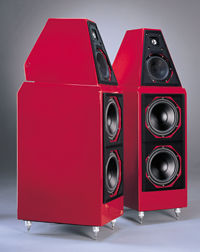
Instead of waiting for recording engineer and Wilson marketing VP Peter McGrath to arrive, I set up the WATT/Puppy 7s myself, following the well-written and easy-to-understand instructions. While moving the speakers to the usual locations in my room (confirmed with spooky accuracy by RPG's speaker-placement software), I was immediately struck by how small these heavy, two-piece, $22,400/pair speakers are. (Each WATT weighs 65 lbs, each Puppy 105 lbs.) Usually, speakers look bigger when they go from the show or showroom floor to my listening room; in this case, they actually looked smaller. Not quite 4' tall, about 1' wide, and 19" deep, the oft-imitated WATT/Puppy is friendly to small rooms. Yet, at audio shows, they've easily filled big rooms with sound.
If you're relatively new to this hobby, you may have seen a number of speakers that look like the WATT/Puppy—both in shape and driver configuration. Many companies market speakers with flattened pyramidal tops and dual-woofered rectangular bottoms, while others offer standalone speakers that look like just the top WATT section. But rest assured—to my knowledge, no speaker had this look before the WATT. The WATT/Puppy is the original. All of the others—among them the Joseph Audio Pearl and the Genesis V—are, to one degree or another, imitators. Wilson's excellent setup guide includes specific vertical angling requirements for the WATT, based on the height and distance from the speaker of the listener's ears. Wilson provides four sets of rear spikes for the Puppy so that you can adjust the system's height to ensure that the WATT's tweeter and midrange driver are at the correct height relative to your ears. Guesswork is eliminated: Plug in the numbers, and Wilson tells you which set of spikes to use. Before packing them up, John Atkinson measured the distance between the speakers and my listening chair and the height of my ear canal from the floor, so he could duplicate them in his measurements. While time coherence is claimed for the WATT/Puppy 7, phase coherence is not. (Wilson says that no speaker passes a squarewave unchanged.) When you spend $22,000 on a pair of speakers, you're entitled to professional setup. All Wilson Audio dealers are trained in this service, which they're required to provide when you buy a pair of Wilson speakers. But after Peter McGrath had futzed around for a few hours, the speakers had been moved barely 2" from where I'd plopped them down originally. Still, their bottom-end performance had improved dramatically, and that affected the entire presentation.
$22,400 for WATT?
The gleaming WATT/Puppy 7s are finished in automotive paint. But even after I'd examined them at leisure in my own home, I wondered what could possibly make them cost $22,000/pair, even taking into account the usual audiophile manufacturing markup. I asked Dave Wilson about it.
few years later, I attended a session at Sony Studios at which audio journalists listened to a live mike feed of a jazz trio through a pair of WATT/Puppys. At the turn of a switch, we could hear the same feed converted to 16-bit/44.1kHz digital, 16/44.1 processed with 20-bit Super Bit Mapping (SBM), 24/96, and 1-bit/2.83MHz via a prototype DSD (SACD) converter. We were told that the Wilson speakers had been chosen for their revealing nature. They revealed to many of us that the DSD conversion sounded closest to the mike feed, while to others—the real "experts"—it all sounded the same. Wilson's website claims that the WATT/Puppy is the best-selling over-$10,000 loudspeaker in history. I have no way of verifying that claim, nor can I figure out how Wilson can make it—privately held companies are under no obligation to reveal sales figures. But any speaker that's been in constant production in one iteration or another for more than 17 years, as the WATT/Puppy has, must have impressive stats, "best-selling" or otherwise. Somebody besides recording engineers must love them. Self-setup not recommended Instead of waiting for recording engineer and Wilson marketing VP Peter McGrath to arrive, I set up the WATT/Puppy 7s myself, following the well-written and easy-to-understand instructions. While moving the speakers to the usual locations in my room (confirmed with spooky accuracy by RPG's speaker-placement software), I was immediately struck by how small these heavy, two-piece, $22,400/pair speakers are. (Each WATT weighs 65 lbs, each Puppy 105 lbs.) Usually, speakers look bigger when they go from the show or showroom floor to my listening room; in this case, they actually looked smaller. Not quite 4' tall, about 1' wide, and 19" deep, the oft-imitated WATT/Puppy is friendly to small rooms. Yet, at audio shows, they've easily filled big rooms with sound.
The gleaming WATT/Puppy 7s are finished in automotive paint. But even after I'd examined them at leisure in my own home, I wondered what could possibly make them cost $22,000/pair, even taking into account the usual audiophile manufacturing markup. I asked Dave Wilson about it.