A proper speaker installation can take a full day and sometimes part of a second, even in a familiar room. But by the time the sun sets on Day One, the system should be almost there—wherever there is.
But imagine, at the end of Day One, the following scenario: Three exhausted, chain-smoking tech types dart frantically around the room. One moves a pair of subwoofers, one tweaks a half dozen or so unmarked potentiometers mounted in a small aluminum box; the third supervises these changes, then listens for what seems like the 150th time. Then, for what also seems the 150th time, collective consternation and shaken heads. After a heated three-way exchange, Trial No. 151 begins.
 I don't know exactly what's just been said because neither I nor my wife speak French, but I have a pretty good idea—I'm hearing what they're hearing, and it ain't subtle: the presentation is to sonic coherence what pulled pork is to a pig. There's blat but nothing resembling bass, and any rhythmic connection between the music coming from the satellite and the blat from the passive subwoofers seems purely coincidental.
The then-US importer, who earlier in the day let me know with a swagger that he was packing heat (or, for all I know, a plastic facsimile thereof), is in a foul mood. He nods to me and we step outside, perhaps to escape the smoke. Once out of earshot of the three techs, he utters an ethnic slur or two before engaging in a tirade. When he's finished, I remind him that, having forgotten to bring cables, the installation team has borrowed my lot of very expensive balanced wires and reversed their pin orientations using soldering techniques that had me humming "Mary Ann with the Shaky Hands."
In the end, I pulled the plug and told everyone to pack up and go home, which I'm sure was a relief to all. There was no point in reviewing a product that just wasn't working—not to mention one that apparently was not, contrary to what I'd been led to believe, quite finished. The time was the mid-1990s and the speaker system was an earlier version of the Cabasse "eyeball" speaker-and-subwoofer system that's the subject of this review.
You might think that, after that hellish day 10 years ago, I'd have preferred to keep my distance, but the "eyeball" part of the experience had been memorably good. Then, at last year's CEDIA Expo, I heard the latest version of the system, the Artis Baltic II ($4000 each) paired with Cabasse's newest powered subwoofer, the Artis Thor II ($2500 each). Even under show conditions, I could tell that the coherence issue had been resolved and that this was a serious system well worth reviewing. But it took a while to, um, get the ball rolling.
Speaker in the round
I don't know exactly what's just been said because neither I nor my wife speak French, but I have a pretty good idea—I'm hearing what they're hearing, and it ain't subtle: the presentation is to sonic coherence what pulled pork is to a pig. There's blat but nothing resembling bass, and any rhythmic connection between the music coming from the satellite and the blat from the passive subwoofers seems purely coincidental.
The then-US importer, who earlier in the day let me know with a swagger that he was packing heat (or, for all I know, a plastic facsimile thereof), is in a foul mood. He nods to me and we step outside, perhaps to escape the smoke. Once out of earshot of the three techs, he utters an ethnic slur or two before engaging in a tirade. When he's finished, I remind him that, having forgotten to bring cables, the installation team has borrowed my lot of very expensive balanced wires and reversed their pin orientations using soldering techniques that had me humming "Mary Ann with the Shaky Hands."
In the end, I pulled the plug and told everyone to pack up and go home, which I'm sure was a relief to all. There was no point in reviewing a product that just wasn't working—not to mention one that apparently was not, contrary to what I'd been led to believe, quite finished. The time was the mid-1990s and the speaker system was an earlier version of the Cabasse "eyeball" speaker-and-subwoofer system that's the subject of this review.
You might think that, after that hellish day 10 years ago, I'd have preferred to keep my distance, but the "eyeball" part of the experience had been memorably good. Then, at last year's CEDIA Expo, I heard the latest version of the system, the Artis Baltic II ($4000 each) paired with Cabasse's newest powered subwoofer, the Artis Thor II ($2500 each). Even under show conditions, I could tell that the coherence issue had been resolved and that this was a serious system well worth reviewing. But it took a while to, um, get the ball rolling.
Speaker in the round
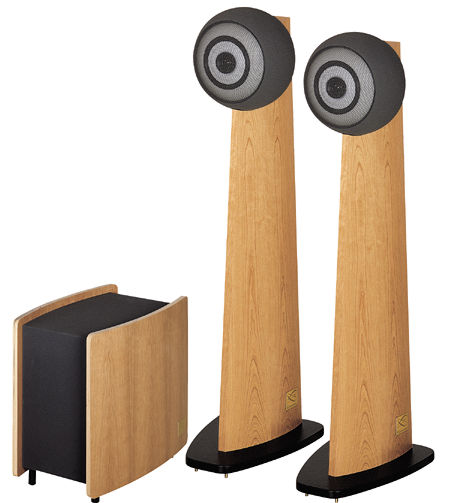
Founded by Georges Cabasse in 1950, Cabasse got its start building drivers and loudspeakers for the Cinemascope multichannel sound system developed by the film industry to lure patrons back to theaters following the introduction of television. Today the Cabasse line is diverse, though the triaxial TC22 compound driver, or "eyeball," that's the basis of the Artis Baltic II has become the company's most recognizable drive-unit. This unique, miniaturized marvel—a three-way coincident-source driver—is available as a wall-mounted unit, on a lightweight sculpted wooden stand (as reviewed), or as part of a full-range floorstander. You can grasp the ingenuity of the design from the "exploded" drawing—it's not simply three nested drivers but a complex jigsaw puzzle of them. Integrated into a ported, composite enclosure made of Rohacel—a specially processed, extremely rigid aerospace material—the Artis Baltic II covers the range from 80Hz to 22kHz and features an integral 80Hz, high-pass filter (all crossover slopes in the driver are 12dB/octave). The outer convex white ring radiator, which covers the lower midrange (80–600Hz), is a long-throw design made of a material Cabasse identifies as Duocell but otherwise doesn't detail. The outer driver's unusual reverse surround is hidden from view within the spherical enclosure. The inner white convex ring (600Hz–3.8kHz) looks similar to the outer one but is made of polypropylene or Kaladex, depending on where you look in Cabasse's literature. Finally, the tweeter, approximately 1" in diameter, uses a dome made of a DuPont Mylar, either Teonex or Kaladex (also depending on where you look).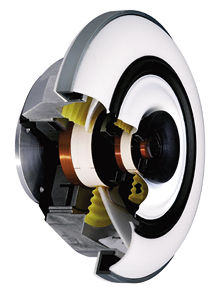 Cabasse calls its version of the coincident source the Spatial Coherent Source, or SCS. The conceptual advantage of a point source (here derived from concentric sources), in which all directional frequencies emanate from a central location, seems obvious. But Cabasse showed me a detailed PowerPoint presentation that concluded that coincidentally generated direct and reflected sounds result in greater transparency and a larger sweet spot when compared to stacked multidriver systems, whose reflected sound will, of necessity, be more disjointed.
The system has a specified voltage sensitivity of 93.5dB, but with a nominal 8 ohm impedance curve that drops below 4 ohms in places.
The multilanguage "instruction manual" accompanying this $13,000 system more closely resembles what comes with a $399 home theater in a box. Basically a one-sheet, it's entirely inadequate, and unacceptable for any high-end audio product, especially a sat-sub system as difficult to set up as this one is. Even companies that mandate dealer installation, such as Linn, provide better documentation. Cabasse needs to do better.
Speaker on the floor
Cabasse calls its version of the coincident source the Spatial Coherent Source, or SCS. The conceptual advantage of a point source (here derived from concentric sources), in which all directional frequencies emanate from a central location, seems obvious. But Cabasse showed me a detailed PowerPoint presentation that concluded that coincidentally generated direct and reflected sounds result in greater transparency and a larger sweet spot when compared to stacked multidriver systems, whose reflected sound will, of necessity, be more disjointed.
The system has a specified voltage sensitivity of 93.5dB, but with a nominal 8 ohm impedance curve that drops below 4 ohms in places.
The multilanguage "instruction manual" accompanying this $13,000 system more closely resembles what comes with a $399 home theater in a box. Basically a one-sheet, it's entirely inadequate, and unacceptable for any high-end audio product, especially a sat-sub system as difficult to set up as this one is. Even companies that mandate dealer installation, such as Linn, provide better documentation. Cabasse needs to do better.
Speaker on the floor
The Artis Thor II powered subwoofer is a large, gracefully curved, side-vented box finished in attractive veneers. Its 250W, class-AB amplifier drives a 12" Duocell cone that fires at the floor. The system accepts both line- and speaker-level inputs, and features pass-through facilities for both. Level, low-pass crossover frequency, and phase (switchable between 0° and 180°) can be adjusted with controls on the side-mounted control panel. The Thor II's rated frequency response is 22–200Hz (including the port contribution). Eyeballs to the wall
Not surprisingly, the Artis Thor II subs worked best when placed very close to where every loudspeaker I've reviewed in this room has ended up: about 38" from the front wall. The centers of the subs' floor-firing cones ended up on the strip of masking tape that marked where the front baffles of the Wilson Audio Specialties MAXX2s had been (see my review in the August 2005 Stereophile). This placement dictated that the Artis Baltic IIs be placed behind the Thor IIs, somewhat farther away from the listening position than usual and closer to the front wall. But because the eyeballs are bandwidth-limited to 80Hz and above, and because my room has no serious bass bumps, that worked out fine. I got subjectively smooth extension to below 30Hz.
Rather than passing the signal through the subs and then out to the satellites, I ran both the Baltics and Thors directly from the amplifier, which is the most direct connection. Cabasse provided a pair of Cardas Golden Reference AC cords to power the subs.
Getting the subs and eyeballs to blend acoustically was a bit trickier than choosing where to put them, and definitely required an experienced listener to dial in correctly. Basically, the user becomes the speaker designer, choosing bass level, crossover point, and phase. Though the eyeball is bandwidth-limited to 80Hz and the sub's crossover adjustment has a position marked "80Hz," setting it there left what sounded like a gaping hole between the two units; bumping up the sub's nominal crossover point to around 110Hz provided a far more satisfactory blend. There was definitely an interaction between crossover point and subwoofer level that had to be massaged in order to achieve an ideal blend. Once I was satisfied with the crossover point, I began listening to familiar material with the bass dialed out entirely, then slowly increased the level until there was sufficient bottom-end weight, but not too much—a balance not all that easy to achieve.
I don't know exactly what's just been said because neither I nor my wife speak French, but I have a pretty good idea—I'm hearing what they're hearing, and it ain't subtle: the presentation is to sonic coherence what pulled pork is to a pig. There's blat but nothing resembling bass, and any rhythmic connection between the music coming from the satellite and the blat from the passive subwoofers seems purely coincidental.
Founded by Georges Cabasse in 1950, Cabasse got its start building drivers and loudspeakers for the Cinemascope multichannel sound system developed by the film industry to lure patrons back to theaters following the introduction of television. Today the Cabasse line is diverse, though the triaxial TC22 compound driver, or "eyeball," that's the basis of the Artis Baltic II has become the company's most recognizable drive-unit. This unique, miniaturized marvel—a three-way coincident-source driver—is available as a wall-mounted unit, on a lightweight sculpted wooden stand (as reviewed), or as part of a full-range floorstander. You can grasp the ingenuity of the design from the "exploded" drawing—it's not simply three nested drivers but a complex jigsaw puzzle of them. Integrated into a ported, composite enclosure made of Rohacel—a specially processed, extremely rigid aerospace material—the Artis Baltic II covers the range from 80Hz to 22kHz and features an integral 80Hz, high-pass filter (all crossover slopes in the driver are 12dB/octave). The outer convex white ring radiator, which covers the lower midrange (80–600Hz), is a long-throw design made of a material Cabasse identifies as Duocell but otherwise doesn't detail. The outer driver's unusual reverse surround is hidden from view within the spherical enclosure. The inner white convex ring (600Hz–3.8kHz) looks similar to the outer one but is made of polypropylene or Kaladex, depending on where you look in Cabasse's literature. Finally, the tweeter, approximately 1" in diameter, uses a dome made of a DuPont Mylar, either Teonex or Kaladex (also depending on where you look).
Cabasse calls its version of the coincident source the Spatial Coherent Source, or SCS. The conceptual advantage of a point source (here derived from concentric sources), in which all directional frequencies emanate from a central location, seems obvious. But Cabasse showed me a detailed PowerPoint presentation that concluded that coincidentally generated direct and reflected sounds result in greater transparency and a larger sweet spot when compared to stacked multidriver systems, whose reflected sound will, of necessity, be more disjointed.
The system has a specified voltage sensitivity of 93.5dB, but with a nominal 8 ohm impedance curve that drops below 4 ohms in places.
The Artis Thor II powered subwoofer is a large, gracefully curved, side-vented box finished in attractive veneers. Its 250W, class-AB amplifier drives a 12" Duocell cone that fires at the floor. The system accepts both line- and speaker-level inputs, and features pass-through facilities for both. Level, low-pass crossover frequency, and phase (switchable between 0° and 180°) can be adjusted with controls on the side-mounted control panel. The Thor II's rated frequency response is 22–200Hz (including the port contribution). Eyeballs to the wall
Not surprisingly, the Artis Thor II subs worked best when placed very close to where every loudspeaker I've reviewed in this room has ended up: about 38" from the front wall. The centers of the subs' floor-firing cones ended up on the strip of masking tape that marked where the front baffles of the Wilson Audio Specialties MAXX2s had been (see my review in the August 2005 Stereophile). This placement dictated that the Artis Baltic IIs be placed behind the Thor IIs, somewhat farther away from the listening position than usual and closer to the front wall. But because the eyeballs are bandwidth-limited to 80Hz and above, and because my room has no serious bass bumps, that worked out fine. I got subjectively smooth extension to below 30Hz.