An equipment reviewer for one of the consumer hi-fi magazines once confided to a manufacturer that he found it hard to like electrostatics because of the kind of people who usually like electrostatics. His implication—that certain kinds of people gravitate towards certain kinds of sound—is an interesting thought, and one that might bear some further investigation. But there is no questioning the fact that electrostatic speakers in general do have a particular kind of sound, that might be characterized as "polite." 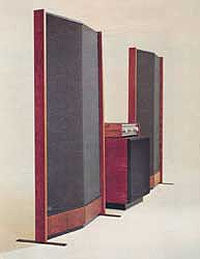 It could, in fact, be said with some truth that, if you wanted close-up, high-powered sound, you chose a good horn system or a similarly inclined cone type, and that if you preferred a more distant listening perspective, with the more subtle attributes of detail and transparency, you opted for electrostatics. Now, this general rule no longer holds true; the Infinity Servo-Statik 1 is what could be called an electrostatic for people who have never liked electrostatics. The SS-1 is appallingly expensive. The basic speaker system, consisting of two electrostatic panels, a bass "commode," and a combined electronic crossover and bass amplifier (100W RMS) costs $2000, and that's only for starters. (On top of that you need two power amplifiers —a very high-powered unit for the midrange electrostatics (Infinity recommends the Crown DC-300, at $685), and a more modestly-powered but equally distortion-free amp for the tweeters. This pushes the total price up to around $3000, which ain't peanuts.
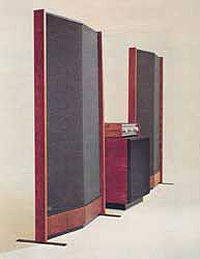
Each electrostatic panel is about 28" by 36" by 7", and contains two fairly large midrange radiators and a narrow, vertically oriented tweeter radiator. Each section is fed by its own amplifier, via the electronic crossover unit. The crossover cabinet also includes a separate 100W amplifier that feeds a blended-bass signal (below 100Hz) to the system's bass speaker. The woofer, a massive 18" cone unit facing downwards from the bottom of a 2' cubic enclosure, has a special sensing coil coincident with its main voice-coil. The electrical impulses generated by the sensing coil are fed back to the bass amplifier, and ay differences between the fed-back signal and the program signal are used to provide a correction to force the cone to follow more accurately the input signal. Hence, the "servo" designation. The system's midrange gain is fixed. The bass and treble balance are adjustable relative to this via slider controls on the crossover. At the back of the crossover is a slide switch marked Tri-Amp and Bi-Amp. This is normally used in the Tri-Amp position, but the Bi-Amp setting is there to allow the bass speaker and crossover to be used to fill in the bottom of any other "full-range" system whose owner would like a bit more sub-bass. Since deep-bass response is the major weakness of the KLH Nine electrostatic system, we decided to test this with the SS-1's bass channel, as well as testing the entire SS-1 system.
Our sample SS-1 was a fairly early-production unit, but was supposed to be representative, of current production. Since we already had our Model Nine system set up in the main listening room, our first move was to add the SS-1's crossover (Bi-Amp setting) and bass speaker to the KLH Nine setup. The driving amplifier for the Nine was the Crown DC-300, which we had found to be ideal for the purpose. The results were not altogether pleasing. Yes, the low end was improved beyond all expectation, and the 100Hz crossover from the Nine allowed it to put out considerably higher listening levels without strain. But the high end was noticeably hard and zippy in comparison with that of the Nine fed "straight," without passing the signal through the Servo-Statik crossover. This was not a matter of high-end rise. A frequency response check showed the crossover's high-end response to be extremely flat. It sounded very much like harmonic distortion, yet we could not measure any distortion at all through the crossover. (Admittedly, our distortion meter's residual reading is around 0.08%, which would normally show up any audible distortion in tube equipment but is apparently not sensitive enough to give valid readings from solid-state components.)
We contacted Infinity about this, and were told that everything that had been sent to us for testing was "normal production," except that some of the crossover networks had been made using a different brand of integrated circuit from the ones normally used. We were assured that this couldn't be causing the "problem," but just to be on the safe side, we were asked to try one of the crossovers with the usual ICs in it. It did make a difference—a dramatic difference. There was still a very slight tendency for the sound to be harder through the crossover than without the crossover, but the overall gain in sound quality when using the SS-1 bass speaker with the Nine more than compensated for this, in our opinion. The Nine sounded huge, rich, and stunningly realistic, and the bass speaker's contribution fully complemented the Nine's usual extraordinary tightness and detail.
It could, in fact, be said with some truth that, if you wanted close-up, high-powered sound, you chose a good horn system or a similarly inclined cone type, and that if you preferred a more distant listening perspective, with the more subtle attributes of detail and transparency, you opted for electrostatics. Now, this general rule no longer holds true; the Infinity Servo-Statik 1 is what could be called an electrostatic for people who have never liked electrostatics. The SS-1 is appallingly expensive. The basic speaker system, consisting of two electrostatic panels, a bass "commode," and a combined electronic crossover and bass amplifier (100W RMS) costs $2000, and that's only for starters. (On top of that you need two power amplifiers —a very high-powered unit for the midrange electrostatics (Infinity recommends the Crown DC-300, at $685), and a more modestly-powered but equally distortion-free amp for the tweeters. This pushes the total price up to around $3000, which ain't peanuts.
Each electrostatic panel is about 28" by 36" by 7", and contains two fairly large midrange radiators and a narrow, vertically oriented tweeter radiator. Each section is fed by its own amplifier, via the electronic crossover unit. The crossover cabinet also includes a separate 100W amplifier that feeds a blended-bass signal (below 100Hz) to the system's bass speaker. The woofer, a massive 18" cone unit facing downwards from the bottom of a 2' cubic enclosure, has a special sensing coil coincident with its main voice-coil. The electrical impulses generated by the sensing coil are fed back to the bass amplifier, and ay differences between the fed-back signal and the program signal are used to provide a correction to force the cone to follow more accurately the input signal. Hence, the "servo" designation. The system's midrange gain is fixed. The bass and treble balance are adjustable relative to this via slider controls on the crossover. At the back of the crossover is a slide switch marked Tri-Amp and Bi-Amp. This is normally used in the Tri-Amp position, but the Bi-Amp setting is there to allow the bass speaker and crossover to be used to fill in the bottom of any other "full-range" system whose owner would like a bit more sub-bass. Since deep-bass response is the major weakness of the KLH Nine electrostatic system, we decided to test this with the SS-1's bass channel, as well as testing the entire SS-1 system.
Our sample SS-1 was a fairly early-production unit, but was supposed to be representative, of current production. Since we already had our Model Nine system set up in the main listening room, our first move was to add the SS-1's crossover (Bi-Amp setting) and bass speaker to the KLH Nine setup. The driving amplifier for the Nine was the Crown DC-300, which we had found to be ideal for the purpose. The results were not altogether pleasing. Yes, the low end was improved beyond all expectation, and the 100Hz crossover from the Nine allowed it to put out considerably higher listening levels without strain. But the high end was noticeably hard and zippy in comparison with that of the Nine fed "straight," without passing the signal through the Servo-Statik crossover. This was not a matter of high-end rise. A frequency response check showed the crossover's high-end response to be extremely flat. It sounded very much like harmonic distortion, yet we could not measure any distortion at all through the crossover. (Admittedly, our distortion meter's residual reading is around 0.08%, which would normally show up any audible distortion in tube equipment but is apparently not sensitive enough to give valid readings from solid-state components.)
We contacted Infinity about this, and were told that everything that had been sent to us for testing was "normal production," except that some of the crossover networks had been made using a different brand of integrated circuit from the ones normally used. We were assured that this couldn't be causing the "problem," but just to be on the safe side, we were asked to try one of the crossovers with the usual ICs in it. It did make a difference—a dramatic difference. There was still a very slight tendency for the sound to be harder through the crossover than without the crossover, but the overall gain in sound quality when using the SS-1 bass speaker with the Nine more than compensated for this, in our opinion. The Nine sounded huge, rich, and stunningly realistic, and the bass speaker's contribution fully complemented the Nine's usual extraordinary tightness and detail.
It could, in fact, be said with some truth that, if you wanted close-up, high-powered sound, you chose a good horn system or a similarly inclined cone type, and that if you preferred a more distant listening perspective, with the more subtle attributes of detail and transparency, you opted for electrostatics. Now, this general rule no longer holds true; the Infinity Servo-Statik 1 is what could be called an electrostatic for people who have never liked electrostatics. The SS-1 is appallingly expensive. The basic speaker system, consisting of two electrostatic panels, a bass "commode," and a combined electronic crossover and bass amplifier (100W RMS) costs $2000, and that's only for starters. (On top of that you need two power amplifiers —a very high-powered unit for the midrange electrostatics (Infinity recommends the Crown DC-300, at $685), and a more modestly-powered but equally distortion-free amp for the tweeters. This pushes the total price up to around $3000, which ain't peanuts.