Has any modern designer of high-performance speakers extracted more music from a two-way box than ProAc's Stewart Tyler? His early-1990s stand-mounted Response 2 (later upgraded to the Response 2S) was an instant classic, and while his tiny Tablette proved controversial for being bass-shy and relatively pricey, his track record of two-way speakers remains unassailable.
 Although the Response 2S cost $3200/pair in 1996, adding a pair of dedicated high-quality stands upped that to about $4000, justifying Tyler's decision to add to the Response line the 2.5, a $4500/pair floorstander. For only $500 more, you could get significantly more performance in a far more attractive package; and sure enough, the 2.5 was popular.
In 2005 ProAc discontinued the Response 2.5 and replaced it with the Response D25, which in turn has been superseded by the Response D28 ($6000/pair). If you take a look at my review of the Response 2.5 (Stereophile, January 1996, Vol.19 No.1), you'll find in John Atkinson's "Measurements" the phrase "almost a textbook two-way design." In fact, JA twice used textbook to describe the 2.5's measurements, which he also stated were, overall, "excellent."
Coaxing high performance from a small two-way box is inherently as much art as science, and usually entails a delicate balance of compromises. The bigger the woofer, the more bass power it can provide, but because the woofer also acts as a midrange driver that must handle frequencies up to around 3kHz, it can't be too big. What you usually end up with is a speaker with a smaller-than-ideal woofer that must produce low-end heft while extending smoothly through the midband to a graceful handoff to the tweeter, all while limiting the upper-bandpass beaming caused by a midrange driver (the woofer) that's larger than the ideal.
Tyler managed all of that extremely well in the Response 2.5, settling for a serious compromise only in the speaker's rather low sensitivity of 83dB. The 2.5 produced music that sounded as pleasurable and relatively uncolored as JA's measurements predicted they might, though of course the observational part of the review was performed before the measurements.
I first heard the Response D28 just after its launch, in the summer of 2007, while conducting a seminar at Arizona Hi-Fi in Tempe. The pair was driven, as I recall, by a relatively low-powered tube amp. While what first caught my ear was this fairly small speaker's bottom-end extension, it was the uncommonly smooth, rich midrange and extended highs that ultimately left a deeper impression—one of a speaker capable of clean and shimmering trebles, extended and noticeably rich mids, and bass that descended further and more cleanly, without overhang or bloat, than any two-way had a right to do. I asked importer Richard Gerberg, of Modern Audio Consultants, who was also in attendance, for a pair to review.
Small physical presence
Although the Response 2S cost $3200/pair in 1996, adding a pair of dedicated high-quality stands upped that to about $4000, justifying Tyler's decision to add to the Response line the 2.5, a $4500/pair floorstander. For only $500 more, you could get significantly more performance in a far more attractive package; and sure enough, the 2.5 was popular.
In 2005 ProAc discontinued the Response 2.5 and replaced it with the Response D25, which in turn has been superseded by the Response D28 ($6000/pair). If you take a look at my review of the Response 2.5 (Stereophile, January 1996, Vol.19 No.1), you'll find in John Atkinson's "Measurements" the phrase "almost a textbook two-way design." In fact, JA twice used textbook to describe the 2.5's measurements, which he also stated were, overall, "excellent."
Coaxing high performance from a small two-way box is inherently as much art as science, and usually entails a delicate balance of compromises. The bigger the woofer, the more bass power it can provide, but because the woofer also acts as a midrange driver that must handle frequencies up to around 3kHz, it can't be too big. What you usually end up with is a speaker with a smaller-than-ideal woofer that must produce low-end heft while extending smoothly through the midband to a graceful handoff to the tweeter, all while limiting the upper-bandpass beaming caused by a midrange driver (the woofer) that's larger than the ideal.
Tyler managed all of that extremely well in the Response 2.5, settling for a serious compromise only in the speaker's rather low sensitivity of 83dB. The 2.5 produced music that sounded as pleasurable and relatively uncolored as JA's measurements predicted they might, though of course the observational part of the review was performed before the measurements.
I first heard the Response D28 just after its launch, in the summer of 2007, while conducting a seminar at Arizona Hi-Fi in Tempe. The pair was driven, as I recall, by a relatively low-powered tube amp. While what first caught my ear was this fairly small speaker's bottom-end extension, it was the uncommonly smooth, rich midrange and extended highs that ultimately left a deeper impression—one of a speaker capable of clean and shimmering trebles, extended and noticeably rich mids, and bass that descended further and more cleanly, without overhang or bloat, than any two-way had a right to do. I asked importer Richard Gerberg, of Modern Audio Consultants, who was also in attendance, for a pair to review.
Small physical presence
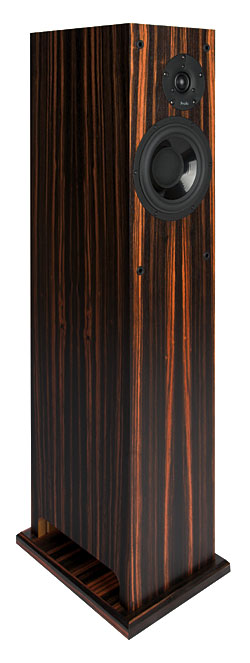
The Response D28 is a relatively compact ported two-way and, at 42.5" tall, 8" wide, and 11.25" deep, within about an inch of the Response 2.5's dimensions. The drivers are the same as were used in the D25: a 6.5" coated polypropylene-cone woofer with die-cast basket that's built in the UK by Volt (a well-known maker of pro-audio drivers) to ProAc's specifications, and a modified 1" silk-dome tweeter from Tymphany (who bought Vifa/Scan-Speak) that features internal damping, air cooling, and an unusually large surround similar to those used in Scan-Speak's ring-radiator drivers. These replaced the Response 25's Scan-Speak drivers: a 7" carbon-fiber–impregnated paper-cone woofer and a &#E190;" fabric-dome tweeter. ProAc claims that, among other benefits, the new woofer is more efficient.
In place of the 2.5's rear-firing port, the D25's port fired at the floor, conical feet providing the necessary clearance. That arrangement made speaker placement somewhat less critical, allowing the speaker to be positioned closer to the front wall while potentially reducing port noise.
The D28 takes the downfiring port a step further by incorporating the more complex baffle construction found in ProAc's more expensive models, which extends the cabinet's front and rear past the bottom of the box in order to form side vents for the port air. The cabinet is affixed to a lower platform fitted with conical feet. ProAc claims that the new venting arrangement produces superior bass control, better low-frequency extension, and higher senstivity; ProAc rates the D28 at 88.5dB/W/m compared to the 2.5's 86dB (JA measured 83dB). Decibels are measured on a logarithmic scale, so a difference of only 2dB is actually greater than it might seem. However, because the 2.5's impedance remained at or near 8 ohms throughout the speaker's frequency response, it did not present a difficult load for an amplifier to drive. ProAc recommends amplifiers rated from 10 to 200W for the Response D28, so one would assume that the new speaker, too, presents the amplifier with a relatively easy load.
Biwiring or biamping are permitted by two hefty, nicely machined, rhodium-plated five-way binding posts and a split crossover. The posts' location high on the rear baffle, opposite the drivers, makes sense: the posts are bolted directly to the crossover board, which is on the other side of the baffle. However, this leaves the speaker cables literally hanging and looks less than elegant, which is a shame—the D28 is beautifully finished and available in half a dozen natural wood veneers. The damped, well-braced cabinet weighs an impressive 60 lbs.
ProAc supplies annoying rod-type jumpers that, when inserted into the threaded post holes and locked down, leave too much space between the locking nut and the post flange, which makes getting a tight grip on spade lugs impossible. I replaced the rods with thin Stereovox jumpers fitted with spade lugs; that solved the problem. The D28's redesigned HQC (for High-Quality Crossover) features what ProAc says are "the finest dedicated components," linked with multistrand wiring of oxygen-free copper.
Setup
The Response D28s produced their most effective tonal balance when positioned where most speakers work best in my room: about 2.5' from the front wall, slightly more than 2' from the sidewalls, and almost 8' apart. ProAc recommends toeing-in the D28s so that they fire directly at the listener, but I preferred toeing them out slightly from there, so that the tweeter axes crossed behind my head. which opened up the soundstage without creating a lower-midrange suckout. I'll bet JA's measurements will show that, like the 2.5, the D28's low-treble output doesn't drop off precipitously until the listener sits quite a ways off axis. As with most speakers capable of pinpoint imaging and excellent soundstaging, minute changes in both toe-in and the distance between them can produce profound changes in the sonic picture, just as small movements toward or away from the front wall can greatly affect bass/midbass/lower midrange response in a two-way design. ProAc recommends 10–200W of amplification, but a more powerful amp won't hurt a speaker unless you crank it up to insane levels. In fact, underpowered amps going into clipping cause more damage to drive-units than do loafing behemoths, so I drove the D28s with Musical Fidelity's kW monoblocks, as well as with the 100Wpc Music Reference RM-200 tube amp (reviewed in April 2002)—which ultimately proved a better match for these speakers.
Although the Response 2S cost $3200/pair in 1996, adding a pair of dedicated high-quality stands upped that to about $4000, justifying Tyler's decision to add to the Response line the 2.5, a $4500/pair floorstander. For only $500 more, you could get significantly more performance in a far more attractive package; and sure enough, the 2.5 was popular.
In 2005 ProAc discontinued the Response 2.5 and replaced it with the Response D25, which in turn has been superseded by the Response D28 ($6000/pair). If you take a look at my review of the Response 2.5 (Stereophile, January 1996, Vol.19 No.1), you'll find in John Atkinson's "Measurements" the phrase "almost a textbook two-way design." In fact, JA twice used textbook to describe the 2.5's measurements, which he also stated were, overall, "excellent."
Coaxing high performance from a small two-way box is inherently as much art as science, and usually entails a delicate balance of compromises. The bigger the woofer, the more bass power it can provide, but because the woofer also acts as a midrange driver that must handle frequencies up to around 3kHz, it can't be too big. What you usually end up with is a speaker with a smaller-than-ideal woofer that must produce low-end heft while extending smoothly through the midband to a graceful handoff to the tweeter, all while limiting the upper-bandpass beaming caused by a midrange driver (the woofer) that's larger than the ideal.
The Response D28 is a relatively compact ported two-way and, at 42.5" tall, 8" wide, and 11.25" deep, within about an inch of the Response 2.5's dimensions. The drivers are the same as were used in the D25: a 6.5" coated polypropylene-cone woofer with die-cast basket that's built in the UK by Volt (a well-known maker of pro-audio drivers) to ProAc's specifications, and a modified 1" silk-dome tweeter from Tymphany (who bought Vifa/Scan-Speak) that features internal damping, air cooling, and an unusually large surround similar to those used in Scan-Speak's ring-radiator drivers. These replaced the Response 25's Scan-Speak drivers: a 7" carbon-fiber–impregnated paper-cone woofer and a &#E190;" fabric-dome tweeter. ProAc claims that, among other benefits, the new woofer is more efficient.
The Response D28s produced their most effective tonal balance when positioned where most speakers work best in my room: about 2.5' from the front wall, slightly more than 2' from the sidewalls, and almost 8' apart. ProAc recommends toeing-in the D28s so that they fire directly at the listener, but I preferred toeing them out slightly from there, so that the tweeter axes crossed behind my head. which opened up the soundstage without creating a lower-midrange suckout. I'll bet JA's measurements will show that, like the 2.5, the D28's low-treble output doesn't drop off precipitously until the listener sits quite a ways off axis. As with most speakers capable of pinpoint imaging and excellent soundstaging, minute changes in both toe-in and the distance between them can produce profound changes in the sonic picture, just as small movements toward or away from the front wall can greatly affect bass/midbass/lower midrange response in a two-way design. ProAc recommends 10–200W of amplification, but a more powerful amp won't hurt a speaker unless you crank it up to insane levels. In fact, underpowered amps going into clipping cause more damage to drive-units than do loafing behemoths, so I drove the D28s with Musical Fidelity's kW monoblocks, as well as with the 100Wpc Music Reference RM-200 tube amp (reviewed in April 2002)—which ultimately proved a better match for these speakers.