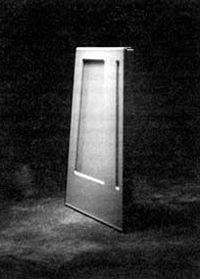
As Laura Atkinson shuffled into my listening room one evening, she spied the Stage loudspeakers tucked away in the corner. "Hey, Dick, those look like Apogees, but they're kind of small." Rising to the occasion, I responded with: "Honey, I shrunk the Apogees." At roughly 3' tall by 2' wide, the Stage is far from intimidating; it even feels more compact and is certainly much cuter looking than the old Quad ESL. Yet Junior's resemblance to the rest of the Apogee family is unmistakable. The canted baffle, the vertical tweeter/midrange along the inside edge of the baffle, and the pleated aluminum-foil woofer clearly bear the imprint of the larger Caliper and Duetta models. It's almost as though Apogee started shrinking the Duetta until the price tag shrank below two kilobucks.  But just because it's the baby in the line and their currently most affordable all-ribbon speaker, it would be a mistake to regard the Stage as a budget model. The level of finish is superb; no corners were cut. And surprisingly, the sound quality does not take a back seat to its more expensive relatives, which should be incredibly good news to most audiophiles. Ribbons: to Rib or not to Rib
The strict classical definition of a ribbon involves a metallic foil which is freely suspended in the primary field of a magnet. Apogee's tweeter/midrange ribbon obviously qualifies as a "ribbon," therefore. The metal conductors are supported only at top and bottom and hang between the opposed North and South poles of two arrays of magnets. There has been some controversy over the exact technical definition of the Apogee planar woofer, however. Is it really a ribbon? No, in the strict sense of the word. But in the jargon of the 1980s, it clearly qualifies as such. Modern ribbons usually consist of a thin aluminum conductor deposited on a plastic substrate which is then placed in the leakage field of a magnet. The conductor is adjacent to a sheet of magnets, but is never between the north-south poles of the magnetic circuit where the flux lines are strongest. Like a Magneplanar, but unlike an Eminent Technology push-pull Ribbon, the Stage woofer is a single-ended design. There is a single array of magnets on the back side to provide the driving force. Theoretically, a push-pull design is superior because it eliminates driving-force nonlinearities. For single-ended operation, the driving force becomes nonlinear as the ribbon is displaced farther and farther from the magnets. The nonlinearity, however, only becomes serious as the ribbon's excursion becomes large. And certainly the proof is in the listening. Both Apogee and Magneplanar have produced eminently listenable speakers over the years.
The crossover frequency is around 800Hz. The cutoff slope of the network is a constant-voltage 6dB/octave, gradually increasing to 12dB/octave, while a rear switch, labeled "High" and "Normal," allows the treble balance to be adjusted. Two pairs of five-way binding posts allow the Stage to be bi-wired, if so desired. The radiation pattern is dipole or figure-eight—with the main lobes to the front and back and little radiation to the sides. I personally like the controlled dispersion of a dipole because of the reduction of early sidewall reflections. Reflections arriving within an 8-10ms window of the first wavefront are most troublesome, as they color instrumental timbres and, depending on their intensity, also serve to diffuse image specificity. The real issue for a dipole, then, has to do with the backwave. What do you do with it? Surely, to place a dipole very close to the back wall is to court sonic disaster. Unless the back wall is a sonic "black hole," there will be many early reflections. One school of thought prescribes a breathing space of, say, four to five feet from the back wall. The logic behind this is that back-wall reflections will now be delayed at least 8ms and thus will offer only minimal interference with the direct sound. As a bonus, the argument goes, the late reflections will enhance the spaciousness and perceived depth of the soundstage. There is no doubt that this approach works, and that in some rooms it works well even without any acoustical treatment of the back wall; for example, the Sound-Lab A-3s in JGH's old listening room in Santa Fe. Here, even with a bare concrete back wall, the A-3 did very well as long as it was kept at least 5' out in the room. In general, however, I'm dubious that such an approach will work in most rooms without some acoustical damping of the back wall.
But just because it's the baby in the line and their currently most affordable all-ribbon speaker, it would be a mistake to regard the Stage as a budget model. The level of finish is superb; no corners were cut. And surprisingly, the sound quality does not take a back seat to its more expensive relatives, which should be incredibly good news to most audiophiles. Ribbons: to Rib or not to Rib The strict classical definition of a ribbon involves a metallic foil which is freely suspended in the primary field of a magnet. Apogee's tweeter/midrange ribbon obviously qualifies as a "ribbon," therefore. The metal conductors are supported only at top and bottom and hang between the opposed North and South poles of two arrays of magnets. There has been some controversy over the exact technical definition of the Apogee planar woofer, however. Is it really a ribbon? No, in the strict sense of the word. But in the jargon of the 1980s, it clearly qualifies as such. Modern ribbons usually consist of a thin aluminum conductor deposited on a plastic substrate which is then placed in the leakage field of a magnet. The conductor is adjacent to a sheet of magnets, but is never between the north-south poles of the magnetic circuit where the flux lines are strongest. Like a Magneplanar, but unlike an Eminent Technology push-pull Ribbon, the Stage woofer is a single-ended design. There is a single array of magnets on the back side to provide the driving force. Theoretically, a push-pull design is superior because it eliminates driving-force nonlinearities. For single-ended operation, the driving force becomes nonlinear as the ribbon is displaced farther and farther from the magnets. The nonlinearity, however, only becomes serious as the ribbon's excursion becomes large. And certainly the proof is in the listening. Both Apogee and Magneplanar have produced eminently listenable speakers over the years.