Mirage /ma-'räzh/ n [F, fr mirer to look at. fr. L mirari] 1: an optical effect that is sometimes seen at sea, in the desert, or over a hot pavement, that may have the appearance of a pool of water or a mirror... 2: something illusory and unattainable, like a mirage.
 During our long wait for the now well-known Mirage M-1, this latter definition seemed the more apt. Its journey started in June of 1987, when I made a special trip up to the Audio Products International suite after that year's Chicago CES had closed down. All the Canadian worthies from API were sitting back after a successful and exhausting show, when I came in for a demonstration! Ever gentlemanly, Jeff Percy of API hooked up the M-1s and I gave a brief listen. Even briefly, it was definitely one of the better sounds at the Show. As is our wont, I enquired about review possibilities and left feeling we were near the top of the list of potential reviewers.
Well, three CESes later we were still in the same place. It was never clear whether final production had never really cranked up (Stereophile tries to be adamant in not reviewing immature product), other reviewers got installed above us, or the list simply didn't budge. Nevertheless, we were most happy to finally have a pair in Santa Fe for review, even happier given that Jeff Percy, one of the founders of Mirage before it was swallowed up by API, accompanied the speakers on their way to Santa Fe from the past Las Vegas CES.
Mirage was started back in 1979; the principals were Jeff Percy, Jeff Soltysek, and Patrick Dempster. The original designs were done by Kevin Voecks (the current designer for Snell Acoustics), who at the time had his own speaker company, Symdex. (Following the sale of Symdex, Kevin moved to Canada to join Mirage as full-time designer.) In those days, Mirage's specialty was high-quality, but relatively low-cost, conventional box loudspeakers. As luck, and the products' just desserts, would have it, the reviews which met these speakers were almost uniformly favorable, and demand for the product soared.
Not unusually, though (as many high-end companies will testify), good reviews carry risk as well as reward: the standard accompaniment to increased demand for product is a vastly increased need for capital, not to mention administrative and business talent. Mirage found a new shareholder who in 1981 was able to put in over $1 million of investment capital, and things began going great guns—great enough to attract a buyout offer from Bose in 1984. Since the management of Mirage wanted both to remain involved with the company and to be situated in Canada, neither likely in the event of a Bose takeover, they searched for a "white knight," and found one in the person of Audio Products International—a not illogical choice, since API was at the time assembling all the Mirage product!
This was a time of dramatic growth for API, who had just six months earlier purchased Energy Loudspeakers (founded by the ebullient George Baker, who up until two months ago remained as VP of Marketing for API). API was also building and marketing the Paisley line of speakers, and built cabinets for many other Canadian loudspeaker lines. (Their production line, which I visited in 1984, is the biggest I've seen.) API then launched the Image line in late '87, one of whose products was reviewed by John Atkinson in Vol.11 No.8.
From my limited vantage point here in the States, it seemed that Mirage went pretty much on the back burner after the API acquisition, but what really happened, according to Percy, was a natural dealer pullback in the face of the unknown new management, combined with some production problems in the just recently introduced Mirage line. Although Mirage has maintained a presence in the US since then, I feel certain that their profile will become much more visible once key high-end dealers begin spending time with the M-1, Mirage's flagship re-entry into the US market.
This process actually began back in late 1984 when Kevin Voecks, still working for Mirage in Toronto, did the initial conceptual work on the M-1. About a year later, though, Kevin left for sunny southern California, and responsibility for making the M-1 a working product fell on the shoulders of Ian Paisley, the force behind API's Paisley line. Two years later, with different driver complement, cabinet dimensions and bracing, and crossover, the first M-1s appeared at CES, but my guess is that production—currently pumping out an impressive 60 pairs a week—didn't get really cranked up until mid-'88.
Basics
During our long wait for the now well-known Mirage M-1, this latter definition seemed the more apt. Its journey started in June of 1987, when I made a special trip up to the Audio Products International suite after that year's Chicago CES had closed down. All the Canadian worthies from API were sitting back after a successful and exhausting show, when I came in for a demonstration! Ever gentlemanly, Jeff Percy of API hooked up the M-1s and I gave a brief listen. Even briefly, it was definitely one of the better sounds at the Show. As is our wont, I enquired about review possibilities and left feeling we were near the top of the list of potential reviewers.
Well, three CESes later we were still in the same place. It was never clear whether final production had never really cranked up (Stereophile tries to be adamant in not reviewing immature product), other reviewers got installed above us, or the list simply didn't budge. Nevertheless, we were most happy to finally have a pair in Santa Fe for review, even happier given that Jeff Percy, one of the founders of Mirage before it was swallowed up by API, accompanied the speakers on their way to Santa Fe from the past Las Vegas CES.
Mirage was started back in 1979; the principals were Jeff Percy, Jeff Soltysek, and Patrick Dempster. The original designs were done by Kevin Voecks (the current designer for Snell Acoustics), who at the time had his own speaker company, Symdex. (Following the sale of Symdex, Kevin moved to Canada to join Mirage as full-time designer.) In those days, Mirage's specialty was high-quality, but relatively low-cost, conventional box loudspeakers. As luck, and the products' just desserts, would have it, the reviews which met these speakers were almost uniformly favorable, and demand for the product soared.
Not unusually, though (as many high-end companies will testify), good reviews carry risk as well as reward: the standard accompaniment to increased demand for product is a vastly increased need for capital, not to mention administrative and business talent. Mirage found a new shareholder who in 1981 was able to put in over $1 million of investment capital, and things began going great guns—great enough to attract a buyout offer from Bose in 1984. Since the management of Mirage wanted both to remain involved with the company and to be situated in Canada, neither likely in the event of a Bose takeover, they searched for a "white knight," and found one in the person of Audio Products International—a not illogical choice, since API was at the time assembling all the Mirage product!
This was a time of dramatic growth for API, who had just six months earlier purchased Energy Loudspeakers (founded by the ebullient George Baker, who up until two months ago remained as VP of Marketing for API). API was also building and marketing the Paisley line of speakers, and built cabinets for many other Canadian loudspeaker lines. (Their production line, which I visited in 1984, is the biggest I've seen.) API then launched the Image line in late '87, one of whose products was reviewed by John Atkinson in Vol.11 No.8.
From my limited vantage point here in the States, it seemed that Mirage went pretty much on the back burner after the API acquisition, but what really happened, according to Percy, was a natural dealer pullback in the face of the unknown new management, combined with some production problems in the just recently introduced Mirage line. Although Mirage has maintained a presence in the US since then, I feel certain that their profile will become much more visible once key high-end dealers begin spending time with the M-1, Mirage's flagship re-entry into the US market.
This process actually began back in late 1984 when Kevin Voecks, still working for Mirage in Toronto, did the initial conceptual work on the M-1. About a year later, though, Kevin left for sunny southern California, and responsibility for making the M-1 a working product fell on the shoulders of Ian Paisley, the force behind API's Paisley line. Two years later, with different driver complement, cabinet dimensions and bracing, and crossover, the first M-1s appeared at CES, but my guess is that production—currently pumping out an impressive 60 pairs a week—didn't get really cranked up until mid-'88.
Basics
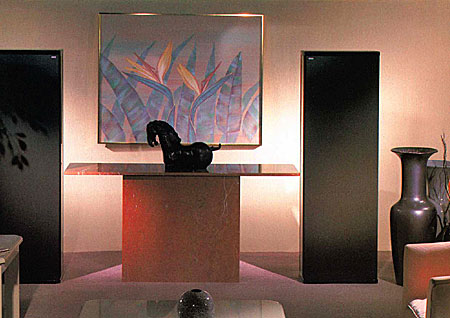
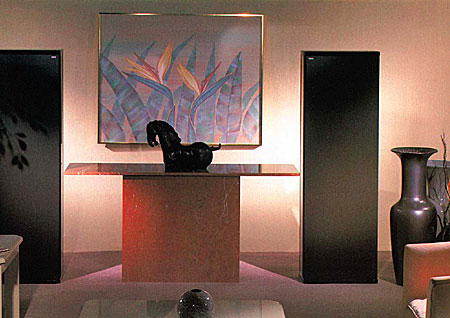
Just to look at them, the M-1s seem conventional loudspeakers. The exterior is tall, sleek, and handsome, doing a superb job of avoiding hugeness in what is still a good-sized speaker. The removable top and side panels are black-lacquered wood, while the interior cabinet, covered with black grille cloth front and rear, is well-braced MDF (medium density fiberboard). The grille cloth is not particularly easy to remove (and even harder to refit), but doing so reveals a fairly normal-looking driver complement on the front face. Go further, though, and you find the same driver complement on the back! The front and back bass drivers are positioned differently with respect to floor and speaker side, and there are ports on the back. The cabinet's internal cavity is divided diagonally front-to-back, so that each bass driver has its own acoustically separate enclosure and port.
This speaker's claim to fame is that it's a full-range bipolar-radiating "conventional" (moving-coil electromagnetic drivers) loudspeaker. Others have utilized dipolar radiation schemes in conventional-driver loudspeakers—the Wharfedale Option One, ZSE 380, and Enigma subwoofer come readily to mind—where the backwave is out of phase with that from the front, but the Mirage is the first bipolar loudspeaker I've heard of. Reportedly, the use of that term itself is controversial, since it normally has to do with transistors. Others have suggested "front and back radiation" as a more accurate, if awkward, appellation. As JA would say, I'm not fussed what you call it, and will stick with Mirage's choice.
Bipolar means the front-facing and rear-facing drivers are wired electrically in phase with each other, attempting to mimic the behavior of the (some would say) theoretically perfect pulsating sphere. In fact, the Mirage is more like a pulsating column. This is exactly what the more familiar dipole loudspeakers (Magnepans, Apogees, Acoustats, MartinLogans, Sound Labs) don't do, and couldn't do without some complicated arrangement of double diaphragms with damping between them. To put it more simply, the M-1 consists of two loudspeakers per side, acting in unison—sort of a two-for-one special. The question is, why would Mirage want to create a bipolar loudspeaker?
During our long wait for the now well-known Mirage M-1, this latter definition seemed the more apt. Its journey started in June of 1987, when I made a special trip up to the Audio Products International suite after that year's Chicago CES had closed down. All the Canadian worthies from API were sitting back after a successful and exhausting show, when I came in for a demonstration! Ever gentlemanly, Jeff Percy of API hooked up the M-1s and I gave a brief listen. Even briefly, it was definitely one of the better sounds at the Show. As is our wont, I enquired about review possibilities and left feeling we were near the top of the list of potential reviewers.
Well, three CESes later we were still in the same place. It was never clear whether final production had never really cranked up (Stereophile tries to be adamant in not reviewing immature product), other reviewers got installed above us, or the list simply didn't budge. Nevertheless, we were most happy to finally have a pair in Santa Fe for review, even happier given that Jeff Percy, one of the founders of Mirage before it was swallowed up by API, accompanied the speakers on their way to Santa Fe from the past Las Vegas CES.
Just to look at them, the M-1s seem conventional loudspeakers. The exterior is tall, sleek, and handsome, doing a superb job of avoiding hugeness in what is still a good-sized speaker. The removable top and side panels are black-lacquered wood, while the interior cabinet, covered with black grille cloth front and rear, is well-braced MDF (medium density fiberboard). The grille cloth is not particularly easy to remove (and even harder to refit), but doing so reveals a fairly normal-looking driver complement on the front face. Go further, though, and you find the same driver complement on the back! The front and back bass drivers are positioned differently with respect to floor and speaker side, and there are ports on the back. The cabinet's internal cavity is divided diagonally front-to-back, so that each bass driver has its own acoustically separate enclosure and port.