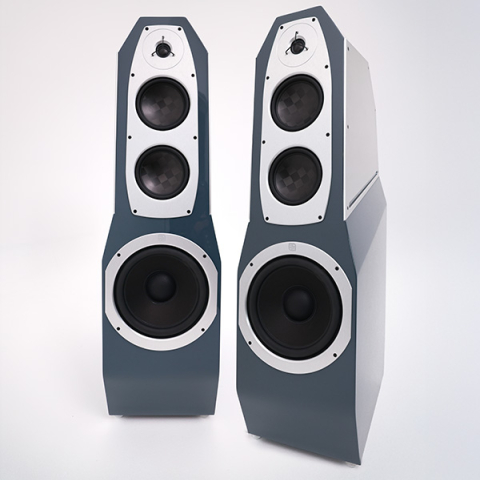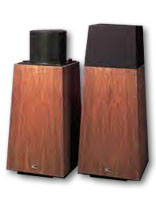
The Ohm Walsh 5 displaces the Ohm F at the top of the Ohm line, and the current Walsh 5 production run represents a "limited edition" of 500 pairs worldwide. There's even a certificate of authenticity—hand-signed by Ohm Acoustics President John Strohbeen—packed with the speakers that makes it all official. I think that this is more than a clever marketing gesture and clearly demonstrates Ohm Acoustics' pride in their new flagship loudspeaker.
 The entire Ohm line, and, in fact, the company itself, owe their existence to the Walsh driver developed by the late Lincoln Walsh (1903–1971). This driver, in principle, can operate over the entire audio bandwidth from 20Hz to 20kHz and is capable of producing a coherent cylindrical soundfield around the driver cone. It is a dynamic moving-coil design but with strikingly unconventional and original packaging. Sound is radiated from the surface of an inverted cone that visually resembles an upside-down woofer or a very large ice-cream cone. The face of the cone radiates into an enclosure and generates what is equivalent to a backwave from an ordinary driver.
The voice-coil and magnet are located where you'd expect them—at the apex of the cone (see fig.1). As the apex of the cone is compressed or stretched, the area around the apex radiates a soundwave into the surrounding air at the speed of sound or about 1127ft/s. At the same time, the vibrations ripple down the cone toward the rim with a propagation velocity characteristic of the cone material. For a typical paper cone the radial velocity through the midrange frequencies is in the range 400–800ft/s. Is it possible to vibrate the rim of the cone exactly when the airwave from the apex is directly over the rim? Such synchronism would guarantee the propagation of a time-aligned coherent wavefront toward the listener, but obviously requires the cone vibrations to travel faster than the speed of sound in air. Walsh showed that this was possible when the cone is engineered with the proper angle and materials.
The entire Ohm line, and, in fact, the company itself, owe their existence to the Walsh driver developed by the late Lincoln Walsh (1903–1971). This driver, in principle, can operate over the entire audio bandwidth from 20Hz to 20kHz and is capable of producing a coherent cylindrical soundfield around the driver cone. It is a dynamic moving-coil design but with strikingly unconventional and original packaging. Sound is radiated from the surface of an inverted cone that visually resembles an upside-down woofer or a very large ice-cream cone. The face of the cone radiates into an enclosure and generates what is equivalent to a backwave from an ordinary driver.
The voice-coil and magnet are located where you'd expect them—at the apex of the cone (see fig.1). As the apex of the cone is compressed or stretched, the area around the apex radiates a soundwave into the surrounding air at the speed of sound or about 1127ft/s. At the same time, the vibrations ripple down the cone toward the rim with a propagation velocity characteristic of the cone material. For a typical paper cone the radial velocity through the midrange frequencies is in the range 400–800ft/s. Is it possible to vibrate the rim of the cone exactly when the airwave from the apex is directly over the rim? Such synchronism would guarantee the propagation of a time-aligned coherent wavefront toward the listener, but obviously requires the cone vibrations to travel faster than the speed of sound in air. Walsh showed that this was possible when the cone is engineered with the proper angle and materials.
 The cone in the Ohm A, the first commercial product to embody the Walsh driver, was made of titanium and aluminum. It was very inefficient, required almost endless power, and had a propensity for blowing up when pushed very hard. Only a few dozen were ever made, and the Ohm A was soon replaced with the Ohm F, which was about 6dB more efficient. In 1982, the Walsh driver was re-engineered for the Ohm Walsh 2. Sensitivity was improved another 7dB by using a plastic cone, and a controlled dispersion technique was used for the first time by Ohm to widen the stereo seat. A scaled-up version of this driver is used in the Ohm Walsh 5.
Strictly speaking, none of the current Walsh drivers are full-range; rather, they should be considered wide-range, as their response is augmented at the frequency extremes by ancillary radiators. In the deep bass, the bass response is extended by the bass-reflex port, while the treble above 10kHz is filled in by a titanium-dome supertweeter. The Walsh driver is allowed to roll off mechanically in the highs without the usual low-pass filtration, while a simple, first-order, high-pass filter protects the supertweeter from low frequencies. This tweeter is mounted on top of the Walsh driver and is fired at 45° off the main axis so that the speakers' polar patterns intersect on a line bisecting the center of the stereo seat. There is also a sound-absorbing assembly, called a Tufflex transmission block, positioned around the Walsh driver, that similarly controls dispersion through the mids.
The effect is that, as you move from left to right, for example, you start moving outside the lobe of the right channel, which roughly compensates for the increase in intensity due to the increased proximity of the right channel. This prevents the soundstage from shifting and shrinking to the nearest speaker, as commonly happens, maintaining a stable stereo soundstage over a very wide listening area. Felt padding on the outside of the can housing the Walsh driver provides for some attenuation of side-directed radiation to accommodate speaker placements near side-walls.
The cabinet is rigidly constructed, with lots of bracing, and the panels are mass-loaded with lead-sheet lining to dampen panel resonances. Internal wiring is with Monster Cable OEM speaker cable. Connections are via gold-plated binding posts, just the kind I like, with a hexagonal body shape that allows me to crank down on spade lugs with a nut driver. Each cabinet sits on top of four heavy-duty casters that not only make it easy to move the speakers, but also give the bottom-firing vent room to breath.
Three controls are provided near the binding posts in the form of three-position slide-switches. These are labeled: "Low Frequency," "High Frequency," and "Perspective." The upper switch positions offer "flat response," while the middle and bottom positions decrease the bass, mids, and treble by as much as 4dB. It's true that such controls can be useful in accommodating speakers to a variety of listening room acoustics, from dead to live, but I'd rather see them provided before the power amp—preferably at the preamp stage. All of the passive parts necessary to implement these controls, the electrolytic capacitors, coils, and resistors, are bound to degrade the sound quality. The Ohm Walsh 5 is the kind of speaker that needs to have the listening room cater to its acoustic desires anyway, so why not just dispense with the controls entirely?
A Few Reflective Moments
The cone in the Ohm A, the first commercial product to embody the Walsh driver, was made of titanium and aluminum. It was very inefficient, required almost endless power, and had a propensity for blowing up when pushed very hard. Only a few dozen were ever made, and the Ohm A was soon replaced with the Ohm F, which was about 6dB more efficient. In 1982, the Walsh driver was re-engineered for the Ohm Walsh 2. Sensitivity was improved another 7dB by using a plastic cone, and a controlled dispersion technique was used for the first time by Ohm to widen the stereo seat. A scaled-up version of this driver is used in the Ohm Walsh 5.
Strictly speaking, none of the current Walsh drivers are full-range; rather, they should be considered wide-range, as their response is augmented at the frequency extremes by ancillary radiators. In the deep bass, the bass response is extended by the bass-reflex port, while the treble above 10kHz is filled in by a titanium-dome supertweeter. The Walsh driver is allowed to roll off mechanically in the highs without the usual low-pass filtration, while a simple, first-order, high-pass filter protects the supertweeter from low frequencies. This tweeter is mounted on top of the Walsh driver and is fired at 45° off the main axis so that the speakers' polar patterns intersect on a line bisecting the center of the stereo seat. There is also a sound-absorbing assembly, called a Tufflex transmission block, positioned around the Walsh driver, that similarly controls dispersion through the mids.
The effect is that, as you move from left to right, for example, you start moving outside the lobe of the right channel, which roughly compensates for the increase in intensity due to the increased proximity of the right channel. This prevents the soundstage from shifting and shrinking to the nearest speaker, as commonly happens, maintaining a stable stereo soundstage over a very wide listening area. Felt padding on the outside of the can housing the Walsh driver provides for some attenuation of side-directed radiation to accommodate speaker placements near side-walls.
The cabinet is rigidly constructed, with lots of bracing, and the panels are mass-loaded with lead-sheet lining to dampen panel resonances. Internal wiring is with Monster Cable OEM speaker cable. Connections are via gold-plated binding posts, just the kind I like, with a hexagonal body shape that allows me to crank down on spade lugs with a nut driver. Each cabinet sits on top of four heavy-duty casters that not only make it easy to move the speakers, but also give the bottom-firing vent room to breath.
Three controls are provided near the binding posts in the form of three-position slide-switches. These are labeled: "Low Frequency," "High Frequency," and "Perspective." The upper switch positions offer "flat response," while the middle and bottom positions decrease the bass, mids, and treble by as much as 4dB. It's true that such controls can be useful in accommodating speakers to a variety of listening room acoustics, from dead to live, but I'd rather see them provided before the power amp—preferably at the preamp stage. All of the passive parts necessary to implement these controls, the electrolytic capacitors, coils, and resistors, are bound to degrade the sound quality. The Ohm Walsh 5 is the kind of speaker that needs to have the listening room cater to its acoustic desires anyway, so why not just dispense with the controls entirely?
A Few Reflective Moments
Although the Ohm Walsh 5 is far from being an omnidirectional radiator over its entire bandwidth, its polar response through the middle octaves is nonetheless much broader than that of a conventional speaker. This leads us to the subject of reflections and reverberation. I'd like to first distinguish between reflections and reverb on the basis of arrival times. Reflections arrive early, say within 50ms of the direct sound, and are therefore not perceived as a distinct sonic event. Reverb, on the other hand, consists of "late" reflections that are perceived as a distinct echo. That is not to say that it is impossible to recognize the presence of early reflections below the echo threshold. In fact, reflections will not only change the loudness and timbre of the primary sound, but will also affect the spaciousness of the sound. By spaciousness, I mean a spatial spreading of the soundsource to fill a larger space within the soundstage than is defined by the visual contours of the source itself. Such a spatial impression is actually desirable in the concert hall, being synonymous with "good acoustics," and it has been found that a sufficient number of lateral reflections are necessary to achieve it. In the classical "shoe-box"-shaped concert hall, strong lateral reflections cover the entire hall, whereas in the modern fan-shaped or arena type of auditorium, there is a lack of lateral reflections in the center of the hall. Incidentally, proper reverb is also important for good acoustics, about 2s being ideal for the concert hall. The reverb results in an apparent increase of the distance of the sound source from the listener, while the decaying portion of the reverb, of course, gives us information about the size of the hall.
The precise delay times of the reflections don't matter much over a large range between 5 and 80ms. Neither does it matter whether there's single or multiple reflections. Rather, spaciousness depends on the ratio of the sound energy arriving from lateral reflections to the total sound energy and the angle of incidence of the reflections on the ear. Another interesting observation is that the degree of spaciousness depends on the overall sound level, so that increasing the volume level during playback will unmask a lot more hall sound.
Let's switch gears back to the listening room. If lateral reflections are so desirable in the concert hall, might they not also be a good idea in the listening room? Purists would argue that all of the necessary hall ambience is already contained on the original recording and that it is folly to superimpose the sonic signature of the room on the reproduced performance. But there is another side to the coin; it can be argued that there is something the matter with conventional stereo. The classical concept of stereo has to do with proper localization of instruments across and within the soundstage, and perfectionist recording techniques such as Blumlein miking do this very well indeed.
Unfortunately, stereo does a poor job in handling hall sound. All reflections and reverb are projected from the frontal plane, which grossly distorts the ambience of the original recording site and undermines the illusion of a realistic soundstage. To synthesize the original space in a listening room means properly immersing the listener in the original hall sound and requires many more than two channels. Some researchers have estimated that at least 20 channels are necessary to get all the reflection angles right and to really do a bang-up job. Quadraphony is a step in the right direction, but is not capable of generating a convincing image to the sides of the listener. As a practical compromise, six channels are probably required for good surround sound—two channels for the front, two for the back and two more for the sides.
The entire Ohm line, and, in fact, the company itself, owe their existence to the Walsh driver developed by the late Lincoln Walsh (1903–1971). This driver, in principle, can operate over the entire audio bandwidth from 20Hz to 20kHz and is capable of producing a coherent cylindrical soundfield around the driver cone. It is a dynamic moving-coil design but with strikingly unconventional and original packaging. Sound is radiated from the surface of an inverted cone that visually resembles an upside-down woofer or a very large ice-cream cone. The face of the cone radiates into an enclosure and generates what is equivalent to a backwave from an ordinary driver.
The voice-coil and magnet are located where you'd expect them—at the apex of the cone (see fig.1). As the apex of the cone is compressed or stretched, the area around the apex radiates a soundwave into the surrounding air at the speed of sound or about 1127ft/s. At the same time, the vibrations ripple down the cone toward the rim with a propagation velocity characteristic of the cone material. For a typical paper cone the radial velocity through the midrange frequencies is in the range 400–800ft/s. Is it possible to vibrate the rim of the cone exactly when the airwave from the apex is directly over the rim? Such synchronism would guarantee the propagation of a time-aligned coherent wavefront toward the listener, but obviously requires the cone vibrations to travel faster than the speed of sound in air. Walsh showed that this was possible when the cone is engineered with the proper angle and materials.
The cone in the Ohm A, the first commercial product to embody the Walsh driver, was made of titanium and aluminum. It was very inefficient, required almost endless power, and had a propensity for blowing up when pushed very hard. Only a few dozen were ever made, and the Ohm A was soon replaced with the Ohm F, which was about 6dB more efficient. In 1982, the Walsh driver was re-engineered for the Ohm Walsh 2. Sensitivity was improved another 7dB by using a plastic cone, and a controlled dispersion technique was used for the first time by Ohm to widen the stereo seat. A scaled-up version of this driver is used in the Ohm Walsh 5.
Although the Ohm Walsh 5 is far from being an omnidirectional radiator over its entire bandwidth, its polar response through the middle octaves is nonetheless much broader than that of a conventional speaker. This leads us to the subject of reflections and reverberation. I'd like to first distinguish between reflections and reverb on the basis of arrival times. Reflections arrive early, say within 50ms of the direct sound, and are therefore not perceived as a distinct sonic event. Reverb, on the other hand, consists of "late" reflections that are perceived as a distinct echo. That is not to say that it is impossible to recognize the presence of early reflections below the echo threshold. In fact, reflections will not only change the loudness and timbre of the primary sound, but will also affect the spaciousness of the sound. By spaciousness, I mean a spatial spreading of the soundsource to fill a larger space within the soundstage than is defined by the visual contours of the source itself. Such a spatial impression is actually desirable in the concert hall, being synonymous with "good acoustics," and it has been found that a sufficient number of lateral reflections are necessary to achieve it. In the classical "shoe-box"-shaped concert hall, strong lateral reflections cover the entire hall, whereas in the modern fan-shaped or arena type of auditorium, there is a lack of lateral reflections in the center of the hall. Incidentally, proper reverb is also important for good acoustics, about 2s being ideal for the concert hall. The reverb results in an apparent increase of the distance of the sound source from the listener, while the decaying portion of the reverb, of course, gives us information about the size of the hall.