The conventional wisdom in publishing is that magazines are dependent on scoops—that getting the news out to the readers first is of primary importance. Yes, being timely with what it has to say is important for any publication. But soon after I joined Stereophile in 1986, a series of negative experiences with review samples that were little better than prototypes led me to rethink the need for scoops. As a result, I decided to impose restrictions on what we chose to review; this would allow us to focus the magazine's review resources on products that were out of beta testing and were ready for prime time, and, most important, would be representative of what our readers could audition for themselves at specialty retailers, confident in the knowledge that what they heard would be what we had reviewed.
 I also didn't want Stereophile to become an intrinsic part of a new company's marketing effort—or, indeed, its only marketing effort. If a company wanted to crack the US market, then they would first have to do the legwork of setting up distribution and signing up dealers before this magazine would review its products.
The result was what we call, in-house, "The Five Dealer Rule": a product must be available through at least five US retail outlets before it qualifies for a full review in Stereophile.
Inevitably, this rule, as well-intentioned and effective as it may be, results in the magazine occasionally being scooped on "hot" products that explode onto the scene at hi-fi shows. An example was the Mini, a $20,000 stand-mounted speaker from Magico, a Bay Area manufacturer new to me. At the 2006 Consumer Electronics Show, the buzz among audio writers was "Have you heard the Mini?" But CES is so big and so brief that I didn't get to hear the Magico Mini there. A scoop review appeared in the August 2006 issue of The Abso!ute Sound, but, as Magico's founder, Alon Wolf, told me when I finally did get to the company's room at the 2007 CES, it wouldn't have made any difference—at the time, he still didn't have enough dealers to qualify for a review in Stereophile.
At CES 2007, Magico had three dealers and was well on track to getting more. I found Wolf's honesty refreshing and promised him that, when Magico had reached the magic number of five dealers, I wanted to review not the Mini but the new V3. The V3 had impressed me at CES while playing There Lies the Home, by the male vocal group Cantus, which I had engineered (CD, Cantus CTS-1206). In the meantime, I asked Jason Victor Serinus to work on an interview with Alon Wolf, which appears elsewhere in this issue.
The V3
I also didn't want Stereophile to become an intrinsic part of a new company's marketing effort—or, indeed, its only marketing effort. If a company wanted to crack the US market, then they would first have to do the legwork of setting up distribution and signing up dealers before this magazine would review its products.
The result was what we call, in-house, "The Five Dealer Rule": a product must be available through at least five US retail outlets before it qualifies for a full review in Stereophile.
Inevitably, this rule, as well-intentioned and effective as it may be, results in the magazine occasionally being scooped on "hot" products that explode onto the scene at hi-fi shows. An example was the Mini, a $20,000 stand-mounted speaker from Magico, a Bay Area manufacturer new to me. At the 2006 Consumer Electronics Show, the buzz among audio writers was "Have you heard the Mini?" But CES is so big and so brief that I didn't get to hear the Magico Mini there. A scoop review appeared in the August 2006 issue of The Abso!ute Sound, but, as Magico's founder, Alon Wolf, told me when I finally did get to the company's room at the 2007 CES, it wouldn't have made any difference—at the time, he still didn't have enough dealers to qualify for a review in Stereophile.
At CES 2007, Magico had three dealers and was well on track to getting more. I found Wolf's honesty refreshing and promised him that, when Magico had reached the magic number of five dealers, I wanted to review not the Mini but the new V3. The V3 had impressed me at CES while playing There Lies the Home, by the male vocal group Cantus, which I had engineered (CD, Cantus CTS-1206). In the meantime, I asked Jason Victor Serinus to work on an interview with Alon Wolf, which appears elsewhere in this issue.
The V3
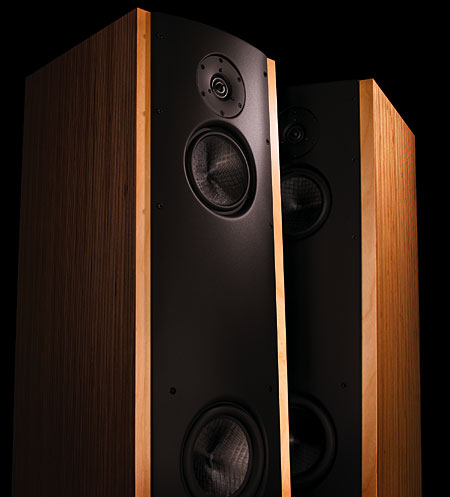
By the time it was officially introduced in summer 2007, the Magico V3 ($25,000/pair) had changed a little from the prototype I had seen and heard at CES the previous January, but its enclosure still featured truly heroic construction. Alon Wolf's intention was to give the drive-units the ultimate stable platform from which to launch sound into the room. The front baffle and the rear panel are CNC-machined from 1"-thick aluminum, this anodized black to give a hard, matte finish. Seen from above, the baffle has a visually pleasing convex curve, and the two aluminum sections are held together under tension by internal rods. Squeezed tightly between the front and rear panels, the side and top panels are formed from hollowed-out, vertical rectangular sheets of 1"-thick plywood (I counted 17 plys), but these are rotated through 90° so that the edges face to the sides. Multiple sheets of plywood (I counted 15) are laminated to give the desired cabinet depth, the edges of the ply sheets giving the sides of the speaker an attractive striped appearance. The top is veneered, as are the front section surrounding the aluminum baffle and the rear section covering most of the aluminum rear panel, these sealed with an attractive satin finish. The enclosure sits on a black plinth that's coupled to the floor with carpet-piercing spikes.
The drivers are clamped to the rear surface of the front baffle—radiused recesses on the front surface minimize any cavity effects—so there is no danger of the fasteners working loose over time, as can happen with woodscrews and MDF. Unusually for a relatively new company, three of the V3's four drive-units are manufactured in-house. All three were designed by Magico's chief technology officer, Yair Tammam.
The exception is the tweeter, the top-of-the-line 1" ring-radiator Revelator unit from ScanSpeak. It is actually mounted flush with the baffle at the sides, but the convex curve of the latter does give rise to a small lip above and below the mounting plate. Mounted just below the tweeter is the 6" midrange unit. This has what appears to be a cone formed from a black woven material and is terminated with a half-roll rubber surround. There is no dustcap, the cone smoothly continuing to the center. The cone isn't woven, however, but is made of a sandwich material. A core of Rohacell, a foam/composite material used to make helicopter rotor blades, is coated with layers of carbon nanotubes, which Magico calls Nano-Tec. The whole is said to be extraordinarily stiff yet exceedingly light, allowing the cone to behave as a perfect piston throughout its operating range.
The twin 7" woofers, mounted one above the other at the base of the baffle, use cones of the same material, but with a larger half-roll surround to allow greater linear excursion. Like its midrange unit, the V3's woofer uses a powerful neodymium magnet and a titanium voice-coil, with an underhung structure to minimize magnetic nonlinearities.
The V3's crossover is built of high-quality parts manufactured by the German Raimund Mundorf company, including Mcap ultra-low–inductance capacitors, and inductors wound from oxygen-free copper foil. The topology is said to be the world's first Elliptical Symmetry Crossover (ESXO). The internal wiring is "six nines" (99.99997%) solid-core copper in various gauges, and electrical connection is via a single pair of binding posts at the base of the cabinet's rear aluminum panel. There is no grille.
Super Sonics
Although its sealed-box woofer loading means that the rate of low-frequency rolloff is half that of an equivalent ported design, the V3 did require some care in setup so that the bass didn't sound a little lean. In fact, even though the review samples had been broken-in before they were shipped to me, the low frequencies continued to loosen up over the next two weeks of daily use. Not that the V3 will ever sound overripe, but once it had settled in, and with the right choice of amplifier, its low frequencies offered perhaps the best combination of low-frequency extension, bass weight, and overall definition I have experienced in my room. It even surpassed in this respect the KEF Reference 207/2, which I reviewed in February, though that speaker, with its three 10" lower-frequency drive-units, had considerably greater dynamic range in the bass region. However, the V3 was fussy when it came to amplification. It definitely worked best with the Mark Levinson No.33H monoblocks and No.380S preamp, a combination that can sound a bit bloated and slow with some speakers. The Parasound Halo JC 2 preamp and Halo JC 1 monoblocks, which had worked so well with the KEF 207/2s, were just too lean with the Magicos, as was the balance when I tried the Musical Fidelity Superchargers. But with the Levinsons, there was a coupling of bass weight and low-frequency definition that I found addictive.
I also didn't want Stereophile to become an intrinsic part of a new company's marketing effort—or, indeed, its only marketing effort. If a company wanted to crack the US market, then they would first have to do the legwork of setting up distribution and signing up dealers before this magazine would review its products.
The result was what we call, in-house, "The Five Dealer Rule": a product must be available through at least five US retail outlets before it qualifies for a full review in Stereophile.
By the time it was officially introduced in summer 2007, the Magico V3 ($25,000/pair) had changed a little from the prototype I had seen and heard at CES the previous January, but its enclosure still featured truly heroic construction. Alon Wolf's intention was to give the drive-units the ultimate stable platform from which to launch sound into the room. The front baffle and the rear panel are CNC-machined from 1"-thick aluminum, this anodized black to give a hard, matte finish. Seen from above, the baffle has a visually pleasing convex curve, and the two aluminum sections are held together under tension by internal rods. Squeezed tightly between the front and rear panels, the side and top panels are formed from hollowed-out, vertical rectangular sheets of 1"-thick plywood (I counted 17 plys), but these are rotated through 90° so that the edges face to the sides. Multiple sheets of plywood (I counted 15) are laminated to give the desired cabinet depth, the edges of the ply sheets giving the sides of the speaker an attractive striped appearance. The top is veneered, as are the front section surrounding the aluminum baffle and the rear section covering most of the aluminum rear panel, these sealed with an attractive satin finish. The enclosure sits on a black plinth that's coupled to the floor with carpet-piercing spikes.
Although its sealed-box woofer loading means that the rate of low-frequency rolloff is half that of an equivalent ported design, the V3 did require some care in setup so that the bass didn't sound a little lean. In fact, even though the review samples had been broken-in before they were shipped to me, the low frequencies continued to loosen up over the next two weeks of daily use. Not that the V3 will ever sound overripe, but once it had settled in, and with the right choice of amplifier, its low frequencies offered perhaps the best combination of low-frequency extension, bass weight, and overall definition I have experienced in my room. It even surpassed in this respect the KEF Reference 207/2, which I reviewed in February, though that speaker, with its three 10" lower-frequency drive-units, had considerably greater dynamic range in the bass region. However, the V3 was fussy when it came to amplification. It definitely worked best with the Mark Levinson No.33H monoblocks and No.380S preamp, a combination that can sound a bit bloated and slow with some speakers. The Parasound Halo JC 2 preamp and Halo JC 1 monoblocks, which had worked so well with the KEF 207/2s, were just too lean with the Magicos, as was the balance when I tried the Musical Fidelity Superchargers. But with the Levinsons, there was a coupling of bass weight and low-frequency definition that I found addictive.