"What are you saying?" I sputtered. "That being an audiophile and being a music lover are mutually exclusive? How can a speaker designed for someone who loves music not be a speaker designed for an audiophile?"
His cryptic reply: "Let me know what you think after you listen."
Until the Beethoven Concert Grands arrived in my listening room, I'd never heard a Vienna Acoustics loudspeaker, nor was I very familiar with the company or its products. I'd seen them, of course, at American distributor Sumiko Audio's exhibits at Consumer Electronics Shows, but during those visits I'd paid more attention to the flashier-looking Sonus Faber line, which Sumiko also imports (footnote 1).
I'd met Vienna Acoustics designer Peter Gansterer during a trip to Europe in winter 2004. It was a social call; I more clearly remember playing with his Rhodesian ridgeback hound in the company's sun-splashed offices than talking about loudspeakers. I do remember running my fingers over the speakers lined up in the office, noting the narrow baffles I'd come to appreciate while reviewing Audio Physic products, and pressing the unusual ribbed, transparent woofer cones, and admiring the overall superb craftsmanship, especially the woodworking.
Then, a few months ago, Sumiko's John Hunter asked if I'd like to review a pair of Vienna Acoustics speakers, and suggested the recently redesigned Beethoven Concert Grand. Knowing nothing about the VA line, or where in it the Beethoven fit, I said, "Okay."
Shortly thereafter, two tall, narrow boxes arrived, each light enough for one person to handle, but I decided to wait a few days for Hunter to arrive and go through Sumiko's traditional speaker-setup routine with Jennifer Warnes' "Ballad of the Runaway Horse." It didn't take him long to discover that the Beethoven Concert Grands sounded best when placed very near where every other pair of speakers has sounded best in my room.
Description
As John Hunter went about his work, I couldn't help noticing the quality of the Beethoven's workmanship and the careful attention paid to small details. The cabinet's curved front and rear baffles, meticulously veneered and lacquered, are 1½" thick. The powder-black, high-pressure, die-cast aluminum vestigial stand, fitted with thick steel spikes, is among the sturdiest I've seen. It not only lifts the cabinet's base off the floor, it wraps around and protects the base like a scuff guard, its thick metal curving and tucking under the speaker for extra-rigid support. A narrow insert runs about two-thirds of the way up the speakers rear baffle and incorporates two ports and a single pair of knurled speaker terminals, and is finished in an opaque, soft-textured black that was especially pleasing to the touch.
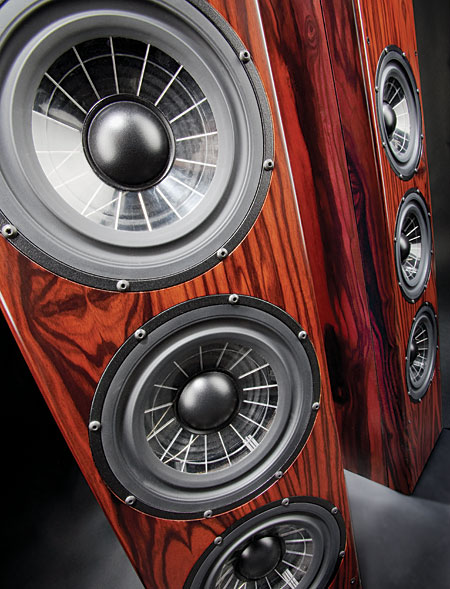
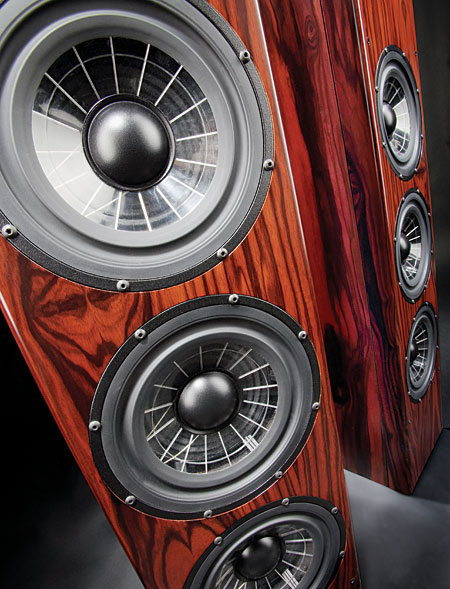
Think of the Beethoven Concert Grand as a small (42.7" H by 7.5" W by 15.7" D), two-way, rear-ported speaker run almost full-range, with the good fortune to be integrated into a ported passive subwoofer-and-base. The five drive-units are all newly designed by Vienna: a 1.1" hand-coated, silk-dome tweeter (made by ScanSpeak), a 6" X3P-cone midrange driver, and three transparent, 7" XPP Spidercone woofers. While they're all mounted on the same baffle, the midrange is internally isolated in its own chamber (its rear port shares the rear baffle with the larger woofer port). The result is 21" of woofer power that, thanks to being divided among three drivers, promises to be able to move a great deal of air while being fast and responsive.
XPP is a proprietary, Japan-sourced thermoplastic that VA molds in its own tools, then sends to ScanSpeak for final driver assembly. X3P is XPP with three more new polymers, to give the midrange driver an unusually wide bandwidth and high resolution of detail, per VA. The woofers are ribbed with XXP for stiffness. The midrange and woofer drivers take advantage of a newly developed inverted rubber surround that VA claims offers a "breakthrough" in "no-loss" damping of cone edge resonances.
Also new in the Beethoven Concert Grand is a linear crossover layout to which are directly connected new gold-silver-alloy speaker terminals and new, proprietary internal copper wiring. Crossover components include 1%-tolerance MKP capacitors and 1% metal-film resistors. Even the grille is special: its aluminum frame is fitted with a V-shaped phase diffuser to control tweeter dispersion. VA specifies 91dB sensitivity, a frequency range of 28Hz–22kHz, and a nominal impedance of 4 ohms. Sounds like an audiophile speaker to me.
First impressions
But Beautiful: The Best of Shirley Horn (CD, Verve B0004068-02) had arrived the day before the Beethoven Concert Grands were set up, and I very much wanted to hear the new bonus live tracks, recorded at New York City's Au Bar in January 2005, eight months before Horn's death (and when she was still playing piano in concert). I popped the disc in the Musical Fidelity SACD player and went straight to the first bonus cut, track 12. (I liked the idea of first hearing something totally unfamiliar.) Halfway through Billy Eckstine's "Jelly, Jelly," with Roy Hargrove on trumpet, the first word that sprang to mind was vivid. The second was rich. The third was inviting, followed closely by delicate.
Horn's voice had a buttery, palpable presence, her piano sounded warm and clear, and drummer Steve Williams' snare had a nice pop and pleasing sizzle. Hargrove's trumpet was a little dry, Ed Howard's bass a bit prominent and boomy. There was good soundstage depth, but that often goes along with excess midbass. However, not knowing the recording, I wasn't drawing any conclusions.
I skipped back to the familiar first track, "I Just Found Out About Love," originally released in 1991 on Horn's comeback album, You Won't Forget Me (CD, Verve 847 482-2). I concluded that the Beethoven Grand was a vivid, rich, inviting, and delicate-sounding speaker that produced good soundstage depth, but not because its midbass was excessive or boomy—that was an issue with the recording and/or mixing of "Jelly, Jelly." In contrast, the Beethoven's bass was articulate, detailed, and extended on the earlier track.
I then played the entire CD, the speakers producing in me a relaxation I usually associate with cognac. When the disc ended, I thought, This speaker is designed more to draw you into the music than to bowl you over with it. At the end of that first session, I concluded that while the Beethoven was drawing me in by slightly recessing and softening the presence region, designer Gansterer hadn't overplayed that card—the sound never led to boredom, nor did I hear any overt colorations. It was more a feeling and a sensation.
Wondering how the Beethoven might handle a sparkly harpsichord, I pulled out a Vox Box of music by François Couperin, performed by Alan Curtis (3 LPs, Vox SVBX 5448), that I've enjoyed for (gulp!) 36 years. The harpsichord—whose strings, unlike a piano's, are not struck but plucked—can sound raucous, but should sound brilliant (as in bright), with a buzzy undertone. The Beethoven took a bit of edge off the transient attack, but not to where it sounded muted or soft, and there was plenty of air behind the instrument.
Footnote 1: Sumiko Audio advertises on Michael Fremer's website, www.musicangle.com.