Back in the day, one of the first reviews to be posted in our free online archives at www.stereophile.com was Michael Fremer's June 1999 report on the Sonus Faber Amati Homage loudspeaker. The Amati was the second in the Italian manufacturer's top range, the Homage line, which is dedicated to the master makers of stringed instruments of 17th-century Cremona. The first was the Guarneri Homage (reviewed by Martin Colloms in July 1994), while the third was the Stradivari Homage (reviewed by MF in January 2005). Mikey was so impressed by the Amati that he purchased the review samples and used them as his reference for almost three years.
 My own experience of Sonus Faber designs had been limited to less expensive models: the Concerto Grand Piano, which MF reported on in May 1998 and which I had used for a while in Stereophile's Santa Fe listening room; and the Cremona, which I reviewed in March 2004 and had been almost equally positive about. So when I saw, at the 2005 CEDIA Expo, that the Amati Homage had been updated and relaunched in an anniversario edition, to celebrate the 500th anniversary of the birth of Andrea Amati, I thought it high time I took a crack at reviewing an Homage.
Anniversario
My own experience of Sonus Faber designs had been limited to less expensive models: the Concerto Grand Piano, which MF reported on in May 1998 and which I had used for a while in Stereophile's Santa Fe listening room; and the Cremona, which I reviewed in March 2004 and had been almost equally positive about. So when I saw, at the 2005 CEDIA Expo, that the Amati Homage had been updated and relaunched in an anniversario edition, to celebrate the 500th anniversary of the birth of Andrea Amati, I thought it high time I took a crack at reviewing an Homage.
Anniversario
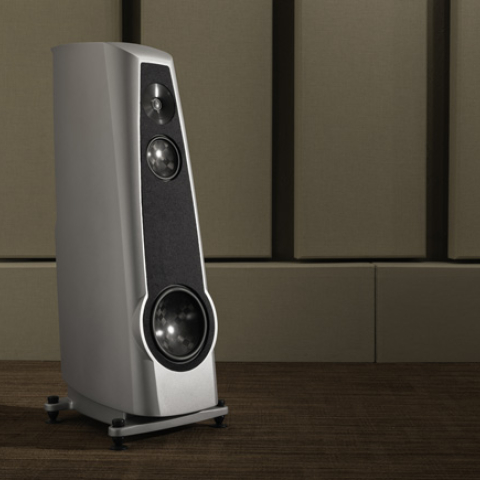
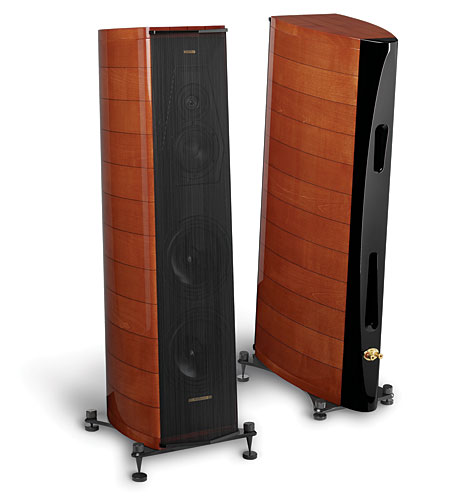
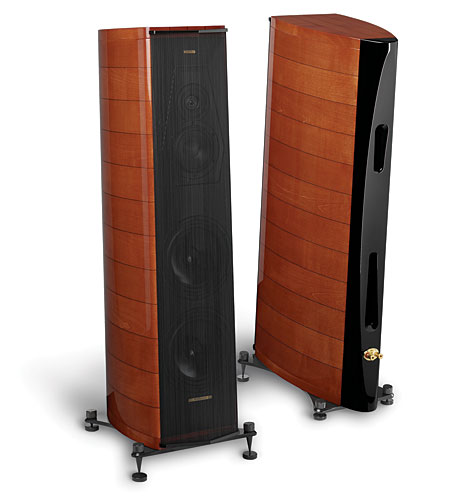
Like Sonus Faber's other Homage designs, the Amati's lute-profiled cabinet is constructed from horizontal layers of maple of varying thicknesses, joined with a polymer glue that provides internal damping and reinforced with internal ribs. The result is said to have maximal rigidity to control panel and air-space resonances; finished in seven layers of high-gloss lacquer, with a baffle covered in black leather and a piano-gloss black rear panel; it also makes for a delicious, if heavy, piece of eye candy, especially with Sonus Faber's traditional vertical-string grille in place.
The four drive-units are mounted vertically in-line on the front baffle. Whereas the original Amati Homage used a 28mm soft-dome tweeter, the anniversario tweeter is a version of ScanSpeak's 1" (25mm) ring-radiator design, this using a silk diaphragm and fitted with a dual-cardioid rear chamber to eliminate reflections and resonances. Covering the range above 4kHz, it crosses over below that frequency to a 6" polymer-cone midrange unit. Constructed on a "skeletal" diecast chassis and mounted in its own subchamber decoupled from the main enclosure, this uses a voice-coil wound on a Kapton former with a Faraday ring on the pole-piece to reduce distortion. All moving elements are said to be vented "for resonance-free response." Twin 8.5" woofers take over below 350Hz, these each using an aluminum-magnesium–alloy cone fitted with a distinctive-looking ventilated phase plug. (The original Amati had pulp-cone woofers.)
Whereas the earlier Amati used first-order crossover filters, the anniversario's filters are more complex. Internal wiring is specified as using pairs of silver-palladium ribbon conductors, and electrical connection is via a single pair of binding posts at the base of the cabinet rear, beneath the lower of the two rounded rectangular ports. Black metal bottom plates can be fitted with spikes of differing lengths to allow the speaker to be raked back.
The original Amati was moderately expensive, at $20,000/pair; the Anniversario edition costs $27,500/pair, a modest rise in price considering the intervening seven years of inflation and the devaluation of the US dollar against the euro.
Sound quality
As he had when I reviewed the Sonus Faber Cremona, Sumiko's John Hunter set up the Amati anniversarios in my listening room. Finding the approximately optimal placement didn't take long, but then followed a couple of hours of fine-tuning of both rake-back angle and speaker positions. For the former, John adjusted the speaker's front and rear spikes to slope the top of the enclosure back by 4", so that my ears were level with the top of the midrange unit. (Sitting above that axis made the upper mids sound a little "shouty.") In terms of speaker placement, it took final movements of as little as half an inch to bring the stereo image into focus and best manage the transition between the mid- and upper bass. Once John had left, I did some experimentation of my own, but ended up with the speakers back where he'd left them.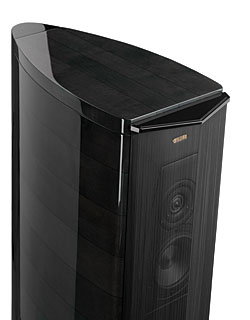 I began my auditioning with the speakers' elegant-looking grilles left off, but ultimately preferred the sound with them on; this way, while there was a little less top-octave air, the upper mids sounded very slightly less forward. Even so, though the Amati didn't sound bright per se, the speaker's high frequencies were not reticent or mellow. My room is not particularly absorptive at high frequencies, the sidewalls and the wall behind me being more dispersive to give a sound that is live rather than dead. Under those conditions, the Amatis gave a full measure of treble.
It was a treble, however, that was impressively clean and grain-free. Billy Drummond's collection of Zildjian cymbals on Duke Ellington's "The Mooche," from Editor's Choice (CD, Stereophile STPH016-2), were well-differentiated and sounded like real cymbals instead of the textured white noise they can turn into with lesser tweeters. Through the Amatis, the violin sound on the new SACD of Tchaikovsky's Symphony 6, "Pathétique," from Daniel Gatti and the Royal Philharmonic (Harmonia Mundi HMU 807394), was the best—ie, the most natural—I have heard from the medium.
The treble was also well-balanced by low frequencies that were both extended and tight. I had always thought the original Amati's bass was on the overcooked side, with too much of a tendency to blur the leading edges of bass-instrument lines. But the anniversario edition's bass was closer to a sealed-box design in its clarity. The 1/3-octave warble tones on Editor's Choice were reproduced at full level down to the 32Hz band, with the 25Hz band still sounding strong and only the 20Hz band weak. The 125Hz band sounded a bit "woofy" in absolute terms, but my Fender bass on this CD's channel-identification tracks sounded rich and warm without the notes' leading edges losing definition. The "pat'n'purr" of Jerome Harris's acoustic Taylor bass on "The Mooche" was spot on through the Amatis, while Marcus Miller's percussive Fender-bass riff on "My Man's Gone Now," from Miles Davis's We Want Miles (CD, Columbia 469402 2), roared from the speakers in a most satisfying manner!
The Amati loved female voices. Diana Krall's singing and piano playing have grown on me in the past year or so, and her The Girl in the Other Room (SACD, Verve B0002293-36) has been spinning a lot in my room these past few weeks. That husky edge to her throaty delivery wasn't thrust unnaturally forward in the soundstage, but was properly integrated in space with the body of her tone. The double bass on this album was also rich and round-toned. However, perhaps there was a bit too much of a good thing going on with female voice—occasionally, I thought I heard a slight emphasis on high notes. And when I walked behind the speakers while listening to male spoken voice, such as the introduction to the channel ID tracks on Editor's Choice, I could hear a fluty coloration coming from the upper port.
Stereo imaging was superbly stable and well defined. Images hung in space, in the main solidly locked in position. The only exception was in the low treble, where central images widened a bit. Even so, throughout my auditioning of the Amatis, the thing that most impressed me was how much the speakers managed to "disappear." Whatever recording I played, there was never any sense of sound being localized at the speaker positions. Instead, the space between and behind them took on the character of the recorded soundstage. You might ask, isn't that what stereo loudspeakers are supposed to do? Yes, of course it is. But there is too often something that gets in the way of the necessary suspension of disbelief, whether it be coloration, cabinet resonances, or grain'n'grit from optimistically specified drive-units.
When I played my recording of the complete Beethoven piano sonatas (CD, OrpheumMasters KSP830), the walls of the Santa Monica hall were clearly revealed as being a bit too close for the powerful Bösendorfer instrument on which Robert Silverman was performing. But the piano's left-hand register sounded rich and powerful on the Sonus Fabers, and the percussive high notes that punctuate the descending trill passages in Sonata 31 came across as pinpoint flashes of light.
Playing the session recordings of the forthcoming There Lies the Home CD, from male-voice choir Cantus (to be released this summer), which I began to edit and mix at the end of the review period, I could also easily discern the superbly supportive acoustic of Sioux Falls' Washington Pavilion around and behind the baritone soloist in "Drake's Drum," from Sir Charles Stanford's Songs of the Sea. In turn, the singer was unambiguously positioned in front of the piano, which again sounded powerful without boom or blur. The Amati anniversarios opened onto the recording venue a clean, uncolored, undistorted window.
I was finishing the editing of the 24-bit master of Robert Silverman's Diabelli Variations CD (see the feature elsewhere in this issue) while I had the Amati anniversarios in house. Yes, the speaker's extended bass was very revealing of the occasional low-frequency noise, such as distant thunder or the thump of a door slamming. But it also accurately reproduced the piano's powerful left-hand register. The big sweep of sound produced by the Amatis brought out the dynamics of Bob's playing, their uncolored midrange and grain-free highs laid bare the subtle interplay between the overtones as the Steinway's notes decayed, and their excellent stereo imaging easily portrayed the relationship between the instrument and the somewhat anonymous acoustic of Weber State University's Austad Auditorium. When a speaker allows the musical values within the recording to emerge unscathed, as the Amati anniversario did, it's about as good as reproduced sound can get.
Summing up
I began my auditioning with the speakers' elegant-looking grilles left off, but ultimately preferred the sound with them on; this way, while there was a little less top-octave air, the upper mids sounded very slightly less forward. Even so, though the Amati didn't sound bright per se, the speaker's high frequencies were not reticent or mellow. My room is not particularly absorptive at high frequencies, the sidewalls and the wall behind me being more dispersive to give a sound that is live rather than dead. Under those conditions, the Amatis gave a full measure of treble.
It was a treble, however, that was impressively clean and grain-free. Billy Drummond's collection of Zildjian cymbals on Duke Ellington's "The Mooche," from Editor's Choice (CD, Stereophile STPH016-2), were well-differentiated and sounded like real cymbals instead of the textured white noise they can turn into with lesser tweeters. Through the Amatis, the violin sound on the new SACD of Tchaikovsky's Symphony 6, "Pathétique," from Daniel Gatti and the Royal Philharmonic (Harmonia Mundi HMU 807394), was the best—ie, the most natural—I have heard from the medium.
The treble was also well-balanced by low frequencies that were both extended and tight. I had always thought the original Amati's bass was on the overcooked side, with too much of a tendency to blur the leading edges of bass-instrument lines. But the anniversario edition's bass was closer to a sealed-box design in its clarity. The 1/3-octave warble tones on Editor's Choice were reproduced at full level down to the 32Hz band, with the 25Hz band still sounding strong and only the 20Hz band weak. The 125Hz band sounded a bit "woofy" in absolute terms, but my Fender bass on this CD's channel-identification tracks sounded rich and warm without the notes' leading edges losing definition. The "pat'n'purr" of Jerome Harris's acoustic Taylor bass on "The Mooche" was spot on through the Amatis, while Marcus Miller's percussive Fender-bass riff on "My Man's Gone Now," from Miles Davis's We Want Miles (CD, Columbia 469402 2), roared from the speakers in a most satisfying manner!
The Amati loved female voices. Diana Krall's singing and piano playing have grown on me in the past year or so, and her The Girl in the Other Room (SACD, Verve B0002293-36) has been spinning a lot in my room these past few weeks. That husky edge to her throaty delivery wasn't thrust unnaturally forward in the soundstage, but was properly integrated in space with the body of her tone. The double bass on this album was also rich and round-toned. However, perhaps there was a bit too much of a good thing going on with female voice—occasionally, I thought I heard a slight emphasis on high notes. And when I walked behind the speakers while listening to male spoken voice, such as the introduction to the channel ID tracks on Editor's Choice, I could hear a fluty coloration coming from the upper port.
Stereo imaging was superbly stable and well defined. Images hung in space, in the main solidly locked in position. The only exception was in the low treble, where central images widened a bit. Even so, throughout my auditioning of the Amatis, the thing that most impressed me was how much the speakers managed to "disappear." Whatever recording I played, there was never any sense of sound being localized at the speaker positions. Instead, the space between and behind them took on the character of the recorded soundstage. You might ask, isn't that what stereo loudspeakers are supposed to do? Yes, of course it is. But there is too often something that gets in the way of the necessary suspension of disbelief, whether it be coloration, cabinet resonances, or grain'n'grit from optimistically specified drive-units.
When I played my recording of the complete Beethoven piano sonatas (CD, OrpheumMasters KSP830), the walls of the Santa Monica hall were clearly revealed as being a bit too close for the powerful Bösendorfer instrument on which Robert Silverman was performing. But the piano's left-hand register sounded rich and powerful on the Sonus Fabers, and the percussive high notes that punctuate the descending trill passages in Sonata 31 came across as pinpoint flashes of light.
Playing the session recordings of the forthcoming There Lies the Home CD, from male-voice choir Cantus (to be released this summer), which I began to edit and mix at the end of the review period, I could also easily discern the superbly supportive acoustic of Sioux Falls' Washington Pavilion around and behind the baritone soloist in "Drake's Drum," from Sir Charles Stanford's Songs of the Sea. In turn, the singer was unambiguously positioned in front of the piano, which again sounded powerful without boom or blur. The Amati anniversarios opened onto the recording venue a clean, uncolored, undistorted window.
I was finishing the editing of the 24-bit master of Robert Silverman's Diabelli Variations CD (see the feature elsewhere in this issue) while I had the Amati anniversarios in house. Yes, the speaker's extended bass was very revealing of the occasional low-frequency noise, such as distant thunder or the thump of a door slamming. But it also accurately reproduced the piano's powerful left-hand register. The big sweep of sound produced by the Amatis brought out the dynamics of Bob's playing, their uncolored midrange and grain-free highs laid bare the subtle interplay between the overtones as the Steinway's notes decayed, and their excellent stereo imaging easily portrayed the relationship between the instrument and the somewhat anonymous acoustic of Weber State University's Austad Auditorium. When a speaker allows the musical values within the recording to emerge unscathed, as the Amati anniversario did, it's about as good as reproduced sound can get.
Summing up
Yes, it's expensive. Yes, it comes under strong competition from Wilson Audio's WATT/Puppy 7 and Peak Consult's Empress in the same price region, not to mention the B&W 802D that Kal Rubinson reviewed last December and the Genesis 5.2 that I reviewed in February, both of which are priced significantly lower. But the Sonus Faber Amati anniversario sounds simply superb, and is finished to an equally superb standard. Not only did I enjoy the insight into my music the Amati offered during the two months I spent with it, it was also gorgeous to look at. For me, a loudspeaker doesn't get much better than this.
My own experience of Sonus Faber designs had been limited to less expensive models: the Concerto Grand Piano, which MF reported on in May 1998 and which I had used for a while in Stereophile's Santa Fe listening room; and the Cremona, which I reviewed in March 2004 and had been almost equally positive about. So when I saw, at the 2005 CEDIA Expo, that the Amati Homage had been updated and relaunched in an anniversario edition, to celebrate the 500th anniversary of the birth of Andrea Amati, I thought it high time I took a crack at reviewing an Homage.
Anniversario
Like Sonus Faber's other Homage designs, the Amati's lute-profiled cabinet is constructed from horizontal layers of maple of varying thicknesses, joined with a polymer glue that provides internal damping and reinforced with internal ribs. The result is said to have maximal rigidity to control panel and air-space resonances; finished in seven layers of high-gloss lacquer, with a baffle covered in black leather and a piano-gloss black rear panel; it also makes for a delicious, if heavy, piece of eye candy, especially with Sonus Faber's traditional vertical-string grille in place.
As he had when I reviewed the Sonus Faber Cremona, Sumiko's John Hunter set up the Amati anniversarios in my listening room. Finding the approximately optimal placement didn't take long, but then followed a couple of hours of fine-tuning of both rake-back angle and speaker positions. For the former, John adjusted the speaker's front and rear spikes to slope the top of the enclosure back by 4", so that my ears were level with the top of the midrange unit. (Sitting above that axis made the upper mids sound a little "shouty.") In terms of speaker placement, it took final movements of as little as half an inch to bring the stereo image into focus and best manage the transition between the mid- and upper bass. Once John had left, I did some experimentation of my own, but ended up with the speakers back where he'd left them.
I began my auditioning with the speakers' elegant-looking grilles left off, but ultimately preferred the sound with them on; this way, while there was a little less top-octave air, the upper mids sounded very slightly less forward. Even so, though the Amati didn't sound bright per se, the speaker's high frequencies were not reticent or mellow. My room is not particularly absorptive at high frequencies, the sidewalls and the wall behind me being more dispersive to give a sound that is live rather than dead. Under those conditions, the Amatis gave a full measure of treble.
It was a treble, however, that was impressively clean and grain-free. Billy Drummond's collection of Zildjian cymbals on Duke Ellington's "The Mooche," from Editor's Choice (CD, Stereophile STPH016-2), were well-differentiated and sounded like real cymbals instead of the textured white noise they can turn into with lesser tweeters. Through the Amatis, the violin sound on the new SACD of Tchaikovsky's Symphony 6, "Pathétique," from Daniel Gatti and the Royal Philharmonic (Harmonia Mundi HMU 807394), was the best—ie, the most natural—I have heard from the medium.
The treble was also well-balanced by low frequencies that were both extended and tight. I had always thought the original Amati's bass was on the overcooked side, with too much of a tendency to blur the leading edges of bass-instrument lines. But the anniversario edition's bass was closer to a sealed-box design in its clarity. The 1/3-octave warble tones on Editor's Choice were reproduced at full level down to the 32Hz band, with the 25Hz band still sounding strong and only the 20Hz band weak. The 125Hz band sounded a bit "woofy" in absolute terms, but my Fender bass on this CD's channel-identification tracks sounded rich and warm without the notes' leading edges losing definition. The "pat'n'purr" of Jerome Harris's acoustic Taylor bass on "The Mooche" was spot on through the Amatis, while Marcus Miller's percussive Fender-bass riff on "My Man's Gone Now," from Miles Davis's We Want Miles (CD, Columbia 469402 2), roared from the speakers in a most satisfying manner!
Yes, it's expensive. Yes, it comes under strong competition from Wilson Audio's WATT/Puppy 7 and Peak Consult's Empress in the same price region, not to mention the B&W 802D that Kal Rubinson reviewed last December and the Genesis 5.2 that I reviewed in February, both of which are priced significantly lower. But the Sonus Faber Amati anniversario sounds simply superb, and is finished to an equally superb standard. Not only did I enjoy the insight into my music the Amati offered during the two months I spent with it, it was also gorgeous to look at. For me, a loudspeaker doesn't get much better than this.