Since the introduction of the original B&W 801 monitor loudspeaker in 1980, it has been adopted as a reference by several recording studios around the world, Over the past five years, I have seen 801s present in just about every recording session with which I have been artistically involved. While the original 801 monitor had its strong points, I was never satisfied with the detached and muddy-sounding bass, discontinuous driver balance, and low sensitivity. Unless this speaker was driven by an enormous solid-state power amplifier, with an elevated high-frequency response, the tubby and slow bass response often obliterated any detail in the two bottom octaves of musical material.  Well, all this has changed...for the better. The new Matrix 801 Series 2 is as different from the original 801 as apples are from oranges. For me to say that this is just another excellent loudspeaker would make me guilty of gross understatement. In short, this is the most musically complete and revealing fullrange loudspeaker that I have heard to date, effectively redefining such terms as coherent, dynamic, open, and involving. Technical Highlights
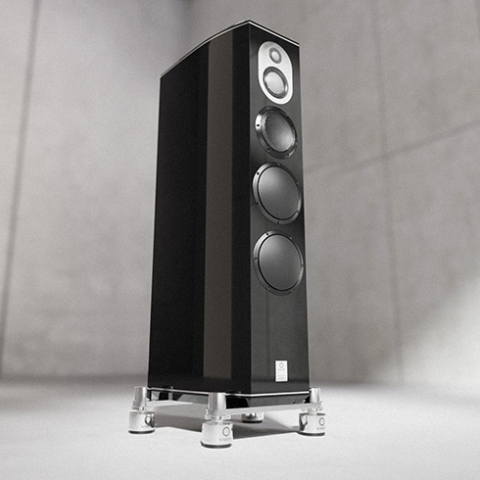
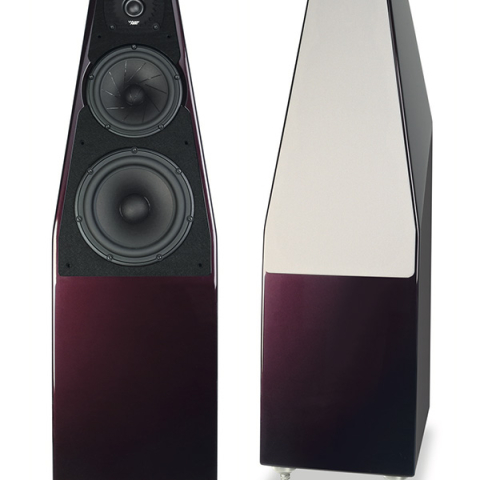
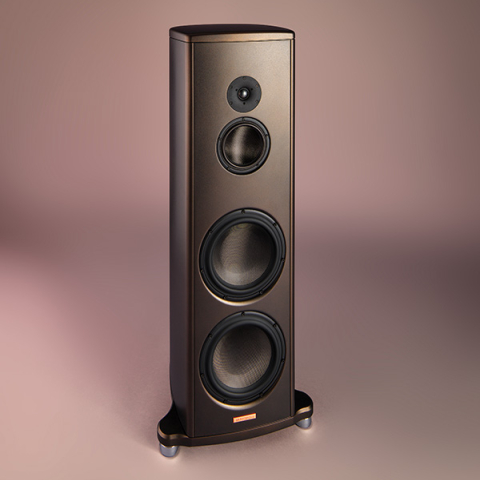
The Matrix 801 Monitor is a large loudspeaker, employing a massive, front-vented cabinet housing the low-frequency driver and crossover network, with a separate fibercrete head housing the midrange driver (the tweeter is mounted in free field above) placed directly above the bass cabinet. The midrange/tweeter head is electrically connected with the lower cabinet via a short umbilical and an XLR connector, and is secured b y a very long bolt that runs completely through the head, down into the bass enclosure. There are two sets of speaker terminal connectors on the bottom rear of the bass cabinet, in order to allow the listener to bi- wire the speakers (these connectors are normally internally bridged, so in order to bi-wire, the bottom cover under the bass cabinet must be removed, and two very short jumpers removed...a less-than-ideal setup). The cabinet construction is excellent, showing a great deal of attention to assembly and aesthetic detail, except for the quality of the speaker terminal connectors. Rather than utilizing standard five-way binding posts (as B&W does with their less expensive 802 speakers), they have opted. for some rather poor-quality, screw-type terminals that just don't belong on a product of this quality. Except for the round port vented on the front of the bass cabinet directly below the woofer, the new Matrix 801 is visibly similar to its predecessor. The casters mounted on the bottom are nice to have when moving these behemoths around the house or studio. But since the speakers really need to be placed on stands in order to operate at full potential, this otherwise practical addition is somewhat useless.
The internal design and components represent a clear departure from the earlier 801. By using their effective Matrix technology of incorporating an internal system of honeycombs within the bass cabinet, the engineers at B&W claim to have reduced low-frequency enclosure resonances and colorations to a significant degree (I agree). Additionally, but using a sixth-order Butterworth alignment through the addition of an outboard equalizer, they have been able to achieve extraordinary low-frequency response (-6dB at 17.5Hz) without compromising bass attack and clarity. Although the speaker can operate without this optional equalizer (thereby effectively representing a fourth-order Bessel filter with a -9dB point at 19Hz), the addition of this device clearly enhances its overall musical accuracy. The midrange fibercrete head assembly and Kevlar-coned driver remain basically unchanged from the earlier 801. The high-frequency driver (the TS26 tweeter), on the other hand, represents an entirely new design, incorporating a metal-domed diaphragm. This design was arrived at partially through B&W's computer-aided design (CAD), and is a modified version of the metal-dome tweeter used in the less costly Concept 90 series of loudspeakers. B&W claims that this new tweeter "exhibits perfect piston-like behavior to frequencies well beyond audibility." The newly redesigned bass driver has a cone of specially formulated plastic compound, is heavily damped to remove sonic colorations, and employs a 13lb, 13,000 Gauss magnet. In order to protect the drivers from over load, B&W has upgraded the already existing Audio-Powered Overload Circuit (APOC) by incorporating two such units: one operates on the bass section, the other on the midrange! tweeter, allowing complete protection even when the system is bi-wired.
Design of a true monitor: not just another loudspeaker
While attending last summer's CES in Chicago, I had the pleasure of a lengthy discussion with John Bowers, the driving force behind B&W loudspeaker design. His musically intuitive design approach and clearly defined product goals (something too often lacking in high-end audio) gave me the impression that he knew exactly what he wanted to achieve, and how best to do so. When I asked him about the role of monitor speakers vs those without such designation, he stated that a true monitor should reproduce exactly what is contained in the recorded material, good or bad, rather than presenting an editorialized picture of what one might want to hear. His point is well taken, since many audiophiles choose their loudspeakers for various sonic attributes that add colorations to effectively create a predetermined spectral balance or acoustic environment. Of course, we all know that such a thing as an accurate loudspeaker does not exist, and even if it did, we would have no way of ascertaining its accuracy unless the recordings were identical to live music. How, then, can anyone claim that they are able to design an accurate loudspeaker?
Well, all this has changed...for the better. The new Matrix 801 Series 2 is as different from the original 801 as apples are from oranges. For me to say that this is just another excellent loudspeaker would make me guilty of gross understatement. In short, this is the most musically complete and revealing fullrange loudspeaker that I have heard to date, effectively redefining such terms as coherent, dynamic, open, and involving. Technical Highlights The Matrix 801 Monitor is a large loudspeaker, employing a massive, front-vented cabinet housing the low-frequency driver and crossover network, with a separate fibercrete head housing the midrange driver (the tweeter is mounted in free field above) placed directly above the bass cabinet. The midrange/tweeter head is electrically connected with the lower cabinet via a short umbilical and an XLR connector, and is secured b y a very long bolt that runs completely through the head, down into the bass enclosure. There are two sets of speaker terminal connectors on the bottom rear of the bass cabinet, in order to allow the listener to bi- wire the speakers (these connectors are normally internally bridged, so in order to bi-wire, the bottom cover under the bass cabinet must be removed, and two very short jumpers removed...a less-than-ideal setup). The cabinet construction is excellent, showing a great deal of attention to assembly and aesthetic detail, except for the quality of the speaker terminal connectors. Rather than utilizing standard five-way binding posts (as B&W does with their less expensive 802 speakers), they have opted. for some rather poor-quality, screw-type terminals that just don't belong on a product of this quality. Except for the round port vented on the front of the bass cabinet directly below the woofer, the new Matrix 801 is visibly similar to its predecessor. The casters mounted on the bottom are nice to have when moving these behemoths around the house or studio. But since the speakers really need to be placed on stands in order to operate at full potential, this otherwise practical addition is somewhat useless.
While attending last summer's CES in Chicago, I had the pleasure of a lengthy discussion with John Bowers, the driving force behind B&W loudspeaker design. His musically intuitive design approach and clearly defined product goals (something too often lacking in high-end audio) gave me the impression that he knew exactly what he wanted to achieve, and how best to do so. When I asked him about the role of monitor speakers vs those without such designation, he stated that a true monitor should reproduce exactly what is contained in the recorded material, good or bad, rather than presenting an editorialized picture of what one might want to hear. His point is well taken, since many audiophiles choose their loudspeakers for various sonic attributes that add colorations to effectively create a predetermined spectral balance or acoustic environment. Of course, we all know that such a thing as an accurate loudspeaker does not exist, and even if it did, we would have no way of ascertaining its accuracy unless the recordings were identical to live music. How, then, can anyone claim that they are able to design an accurate loudspeaker?