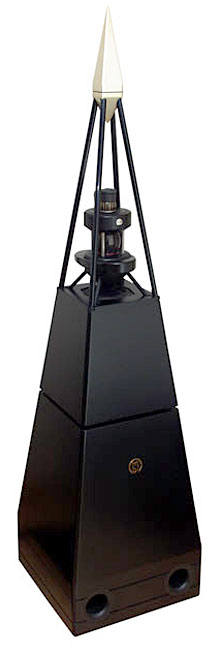
The speaker review in the July 1996 issue of the German audio magazine Stereoplay didn't hold back the praise. "Absolut Spitzenklasse III Referenz" was their overall rating, which I guess translates to "You'd better hear this, buddy," in American English. So when MBL of America's Marc Lawrence called to find out if I wanted to review the subject of that review, the MBL 111, I didn't need to be asked twice.
 Radialstrahler
The 111 is a serious attempt at producing a true omnidirectional speaker, radiating the same sound balance in every lateral direction. This has significant implications for the speaker's behavior in a room, as will be seen later in this report. An earlier omnidirectional MBL loudspeaker, the 101, caused quite a stir at a Consumer Electronics Show a few years back with its impressive sound quality, but also because of its weird appearance: "accordions from Mars" and "electronic watermelons" were some of the kinder epithets hurled the speaker's way. The 101 features three drive-units quite different from the normal coil-driving-a-cone type. Each Radialstrahler is based on a magnet/coil assembly, but this is arranged vertically rather than horizontally. The voice-coil is fastened to the ends of a number of vertical petallike elements, these arranged in a circle around a central sphere. Each "petal" is fixed to a cap at its other end. As the coil moves up and down in response to the electrical signal, the petals are forced to bend in and out, producing sound in a manner analogous to the ideal "pulsating sphere." And because of the circular array of petals, there is no preferred axis, implying an omnidirectional radiation pattern.
Three such "Radialstrahler" drivers were used in the MBL 101C: a small one for the high frequencies, a slightly bigger one for the midrange, and a tall one, using aluminum petals, as a woofer. While the 101 achieved a spectacular level of performance, particularly regarding soundstaging, I always felt its sound at shows had a somewhat metallic coloration, which I ascribed to the woofer. The 101C also needed to be used with a subwoofer to achieve any serious low-frequency extension. (The new 101D, launched at the recent WCES, doesn't need a subwoofer.)
According to the designer, MBL's Jürgen Reis, this kind of drive-unit has only a small window of linear operation; otherwise, the greater its excursion, the smaller the driving force required to achieve the same incremental excursion. It therefore takes considerable ingenuity on the part of the designer to construct such a driver which will behave in a sufficiently linear manner over an operating region large enough to be useful.
The One-Eleven
The pyramidal MBL 111 retains the tweeter and midrange drive-units from the 101, mounted one above the other and crossed-over at 3.5kHz. The tweeter has 25 high-stiffness carbon-fiber petals, while the midrange unit has 12. Between 130Hz and 670Hz, the lower midrange is covered by a conventional 5" moving-coil unit. Made by MBL, this unit is mounted facing upward in a sub-enclosure—a conical diffusor beneath the magnet of the midrange Radialstrahler unit reflecting the lower-midrange sound in a 360° pattern. (Because the wavelengths of the sounds emitted by this conventional driver are large compared with its size and the size of the reflector, its output should be the same in all lateral directions, with no "hot spots.") A star-shaped felt diffusor around the same magnet optimizes the radiation resistance of the upper-midrange unit.
 Below 130Hz, the lower-midrange driver hands over to a separate woofer enclosure. This houses a high-power 12" cone unit, again made by MBL, with a large, 4" voice-coil. The 24mm-long voice-coil operates in a 10mm magnetic gap, making for a linear drive system. This unit does not communicate directly with the outside world, however; it energizes an internal cavity, which in turn radiates sound from two 2"-diameter flared ports. This "bandpass" arrangement can be both efficient and extend low in frequency. Because the wavelengths of sound below are enormous compared with the size of the radiating ports—greater than 10' vs 2"—the 111's low-frequency driver is inherently omnidirectional.
The fact that the tweeter and the two midrange units are very closely spaced will give good dispersion in the vertical plane. Reis claims that the speaker radiates vertically over a 270° angle. However, this will also be affected by the drive-unit's acoustic environment in this plane. The magnets of the two Radialstrahler units will give some vertical-response anomalies. In addition, the various rods supporting the drive-units will have some effect. However, for me the more worrisome aspect of the speaker's construction is the array of four corner rods that continue the speaker's pyramidal profile until they meet at a gold-plated metal diffusor. While the diffusor optimizes high-frequency dispersion, it does look to me as if the rods will give some reflections of the sound, particularly from the tweeter. However, this entire assembly can be replaced with optional pyramidal cloth dustcovers.
The acoustic crossover slopes are fourth-order Linkwitz-Riley between all units. (The bandpass unit's inherent second-order acoustic low-pass rolloff is reinforced by a second-order electrical network.) The upper-range crossover is housed in a sub-enclosure inside the lower-midrange cabinet, which is filled with silica sand. High-quality components are used, and the inductors are carefully arranged to minimize magnetic interactions. Electrical connection is via two pairs of WBT binding posts.
Sound
Below 130Hz, the lower-midrange driver hands over to a separate woofer enclosure. This houses a high-power 12" cone unit, again made by MBL, with a large, 4" voice-coil. The 24mm-long voice-coil operates in a 10mm magnetic gap, making for a linear drive system. This unit does not communicate directly with the outside world, however; it energizes an internal cavity, which in turn radiates sound from two 2"-diameter flared ports. This "bandpass" arrangement can be both efficient and extend low in frequency. Because the wavelengths of sound below are enormous compared with the size of the radiating ports—greater than 10' vs 2"—the 111's low-frequency driver is inherently omnidirectional.
The fact that the tweeter and the two midrange units are very closely spaced will give good dispersion in the vertical plane. Reis claims that the speaker radiates vertically over a 270° angle. However, this will also be affected by the drive-unit's acoustic environment in this plane. The magnets of the two Radialstrahler units will give some vertical-response anomalies. In addition, the various rods supporting the drive-units will have some effect. However, for me the more worrisome aspect of the speaker's construction is the array of four corner rods that continue the speaker's pyramidal profile until they meet at a gold-plated metal diffusor. While the diffusor optimizes high-frequency dispersion, it does look to me as if the rods will give some reflections of the sound, particularly from the tweeter. However, this entire assembly can be replaced with optional pyramidal cloth dustcovers.
The acoustic crossover slopes are fourth-order Linkwitz-Riley between all units. (The bandpass unit's inherent second-order acoustic low-pass rolloff is reinforced by a second-order electrical network.) The upper-range crossover is housed in a sub-enclosure inside the lower-midrange cabinet, which is filled with silica sand. High-quality components are used, and the inductors are carefully arranged to minimize magnetic interactions. Electrical connection is via two pairs of WBT binding posts.
Sound
I used the MBL 111s exclusively with their rods and metal diffusor, which, according to Wes Phillips, made them look vaguely "Goddard rocket–like." The omnidirectional MBLs were much more critical regarding room placement and setup than regular, front-firing loudspeakers. Placed where I had sited the Epos ES12s reviewed elsewhere in this issue, 36" from the wall behind them—MBL recommends a minimum of 20"—the MBLs' midbass was exaggerated, while the lower midrange lacked power. As I point out in the "Measurements" sidebar, this placement gave a coincidence between the distances of the upward-facing midrange unit from the floor and the wall behind the speaker. I ended up pulling the speaker about 12" farther out into the room and slightly farther away from the sidewalls; this gave a better midrange balance and evened-out the low-frequency response. However, it also affected the speaker's high-treble output. The exact balance between the low treble and the top two octaves was very dependent on both the room acoustics and the distance between the Radialstrahler drive-units and the room boundaries. In a sparsely furnished room with lively acoustics, it's possible that the MBL 111s might sound tilted-up. In the Stereophile listening room and my own, both of which use a combination of absorptive and dispersive surfaces to give a relatively uniform reverberation time, the high-frequency balance was a little mellow overall, though this made the speaker remarkably forgiving of recorded problems. Marc Lawrence had recommended toeing-in the speakers to the listening position; this was how I did all my serious listening. The recommended listening axis is with one's ears level with the top of the tweeter magnet—with the speakers on spikes, this is a quite high 44" from the floor. My usual listening chair puts my ears 36" from the floor, level with the top of the lower-midrange enclosure. For critical listening, I sat up straight in my seat and tilted the speakers forward a little with the spikes to get the optimal balance.
Once I had the MBLs optimally set-up, I was able to hear quite how remarkable these weird-looking speakers could sound. The integration between the four drive-units was excellent. And images floated in two-dimensional space completely free of the speaker positions. The stereo imaging was superbly stable and well-defined.
There seems to be a movement in audiophile circles these days to diss imaging as an important characteristic of reproduced sound. Let me say for the record that this attitude is plain wrong. I agree that some sad components give great soundstage while managing to sound fundamentally unmusical. For music composed since the early baroque, however, the spatial aspects of the performance are, if not quite as important as the notes played, still essential to the live experience. The ability of an audio system to envelop a listener in the music is therefore critically dependent on its ability to throw an accurate soundstage—that is, if the recordings have true spatial information captured in the pits/grooves.
A problem I have always had with many orchestral recordings, for example, is that they fail to preserve the relative sizes of live soundsources, to the detriment of the music. When you experience, say, a violin concerto live, the solo instrument is tiny compared with the angular spread of the orchestra. Yet on record you often get the impression of a relatively tiny orchestra peeking over the shoulders of an enormous violin—musical nonsense, when you consider that the raison d'être of a classical concerto is the contrast between the soloist's limited size/power and that of the orchestra.
One of the best (ie, most naturally recorded and balanced) orchestral recordings to spend time spinning in my Levinson transport recently is Yan Pascal Tortelier's reading of Holst's Planets with the BBC Philharmonic (Vol.5 No.1, BBC MM49, available from BBC Music Magazine Back Issues, (800) 205-0402). Recorded in Manchester's Bridgewater Hall in the UK, this disc presents the orchestra naturally spread between and behind the speakers, with superbly stable, naturally sized individual images within that spread.
While Holst scored this work for a huge orchestra, including a maxed-out woodwind section, two harps, six horns, six timps, a double women's choir, and an entire kitchen's worth of percussion instruments, only a small number of instruments plays for much of the time. The contrasts between different orchestral tone colors was carefully achieved. "Saturn, the Bringer of Old Age," for example, starts with two flutes and a bass flute, doubled by the harps, rocking between two double-tritone chords (A/F/B and G/E-flat/A) to represent the ticking of time's arrow. The double basses then enter with a theme based on a different tonal center (a long-held low F), rising through B-natural to C, and just a little later introduce an accompanying figure based on, of all things, a descending E-major scale over which trombones play a stately theme.
Radialstrahler
The 111 is a serious attempt at producing a true omnidirectional speaker, radiating the same sound balance in every lateral direction. This has significant implications for the speaker's behavior in a room, as will be seen later in this report. An earlier omnidirectional MBL loudspeaker, the 101, caused quite a stir at a Consumer Electronics Show a few years back with its impressive sound quality, but also because of its weird appearance: "accordions from Mars" and "electronic watermelons" were some of the kinder epithets hurled the speaker's way. The 101 features three drive-units quite different from the normal coil-driving-a-cone type. Each Radialstrahler is based on a magnet/coil assembly, but this is arranged vertically rather than horizontally. The voice-coil is fastened to the ends of a number of vertical petallike elements, these arranged in a circle around a central sphere. Each "petal" is fixed to a cap at its other end. As the coil moves up and down in response to the electrical signal, the petals are forced to bend in and out, producing sound in a manner analogous to the ideal "pulsating sphere." And because of the circular array of petals, there is no preferred axis, implying an omnidirectional radiation pattern.
The pyramidal MBL 111 retains the tweeter and midrange drive-units from the 101, mounted one above the other and crossed-over at 3.5kHz. The tweeter has 25 high-stiffness carbon-fiber petals, while the midrange unit has 12. Between 130Hz and 670Hz, the lower midrange is covered by a conventional 5" moving-coil unit. Made by MBL, this unit is mounted facing upward in a sub-enclosure—a conical diffusor beneath the magnet of the midrange Radialstrahler unit reflecting the lower-midrange sound in a 360° pattern. (Because the wavelengths of the sounds emitted by this conventional driver are large compared with its size and the size of the reflector, its output should be the same in all lateral directions, with no "hot spots.") A star-shaped felt diffusor around the same magnet optimizes the radiation resistance of the upper-midrange unit.
Below 130Hz, the lower-midrange driver hands over to a separate woofer enclosure. This houses a high-power 12" cone unit, again made by MBL, with a large, 4" voice-coil. The 24mm-long voice-coil operates in a 10mm magnetic gap, making for a linear drive system. This unit does not communicate directly with the outside world, however; it energizes an internal cavity, which in turn radiates sound from two 2"-diameter flared ports. This "bandpass" arrangement can be both efficient and extend low in frequency. Because the wavelengths of sound below are enormous compared with the size of the radiating ports—greater than 10' vs 2"—the 111's low-frequency driver is inherently omnidirectional.
The fact that the tweeter and the two midrange units are very closely spaced will give good dispersion in the vertical plane. Reis claims that the speaker radiates vertically over a 270° angle. However, this will also be affected by the drive-unit's acoustic environment in this plane. The magnets of the two Radialstrahler units will give some vertical-response anomalies. In addition, the various rods supporting the drive-units will have some effect. However, for me the more worrisome aspect of the speaker's construction is the array of four corner rods that continue the speaker's pyramidal profile until they meet at a gold-plated metal diffusor. While the diffusor optimizes high-frequency dispersion, it does look to me as if the rods will give some reflections of the sound, particularly from the tweeter. However, this entire assembly can be replaced with optional pyramidal cloth dustcovers.
The acoustic crossover slopes are fourth-order Linkwitz-Riley between all units. (The bandpass unit's inherent second-order acoustic low-pass rolloff is reinforced by a second-order electrical network.) The upper-range crossover is housed in a sub-enclosure inside the lower-midrange cabinet, which is filled with silica sand. High-quality components are used, and the inductors are carefully arranged to minimize magnetic interactions. Electrical connection is via two pairs of WBT binding posts.
I used the MBL 111s exclusively with their rods and metal diffusor, which, according to Wes Phillips, made them look vaguely "Goddard rocket–like." The omnidirectional MBLs were much more critical regarding room placement and setup than regular, front-firing loudspeakers. Placed where I had sited the Epos ES12s reviewed elsewhere in this issue, 36" from the wall behind them—MBL recommends a minimum of 20"—the MBLs' midbass was exaggerated, while the lower midrange lacked power. As I point out in the "Measurements" sidebar, this placement gave a coincidence between the distances of the upward-facing midrange unit from the floor and the wall behind the speaker. I ended up pulling the speaker about 12" farther out into the room and slightly farther away from the sidewalls; this gave a better midrange balance and evened-out the low-frequency response. However, it also affected the speaker's high-treble output. The exact balance between the low treble and the top two octaves was very dependent on both the room acoustics and the distance between the Radialstrahler drive-units and the room boundaries. In a sparsely furnished room with lively acoustics, it's possible that the MBL 111s might sound tilted-up. In the Stereophile listening room and my own, both of which use a combination of absorptive and dispersive surfaces to give a relatively uniform reverberation time, the high-frequency balance was a little mellow overall, though this made the speaker remarkably forgiving of recorded problems. Marc Lawrence had recommended toeing-in the speakers to the listening position; this was how I did all my serious listening. The recommended listening axis is with one's ears level with the top of the tweeter magnet—with the speakers on spikes, this is a quite high 44" from the floor. My usual listening chair puts my ears 36" from the floor, level with the top of the lower-midrange enclosure. For critical listening, I sat up straight in my seat and tilted the speakers forward a little with the spikes to get the optimal balance.