"Viagra couldn't cure our voltage droop!" "We've got a midbass hump so big, it's X-rated!" "We need another day of break-in—come back tomorrow!" "The room's flexing like a Slinky!" Knock on doors at a Consumer Electronics Show and that's the kind of stuff you hear as manufacturers make excuses for bad sound. 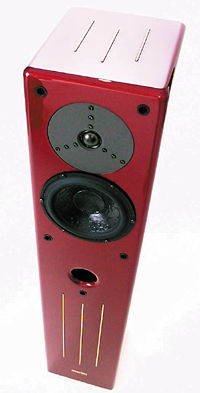 More often than not, the complaints are justified. Getting music from a hi-fi at a Show is tough under the best of circumstances. Cramped hotel rooms, polluted electrical lines, sadistic freight handlers, and dozens of other problems create a nightmare environment for high-quality audio—and not acknowledging the sonic problems can leave CES attendees thinking manufacturers actually like the bile oozing from their loudspeakers. It's better to begin with a pre-emptive whine. Getting even merely credible sound at a show is generally considered a coup. Which is what made Merlin Music Systems' performances at the Consumer Electronics and the Stereophile-sponsored shows of the past few years so impressive. Somehow, Merlin always seems to get memorable sound from its loudspeakers. I can't remember a show when I was less than impressed by what I heard in a Merlin room. Among reviewers, I'm hardly alone in that opinion. So when I got the opportunity to review the Millennium, the latest iteration of Merlin's VSM, it was a no-brainer.
Your basic two-way box
More often than not, the complaints are justified. Getting music from a hi-fi at a Show is tough under the best of circumstances. Cramped hotel rooms, polluted electrical lines, sadistic freight handlers, and dozens of other problems create a nightmare environment for high-quality audio—and not acknowledging the sonic problems can leave CES attendees thinking manufacturers actually like the bile oozing from their loudspeakers. It's better to begin with a pre-emptive whine. Getting even merely credible sound at a show is generally considered a coup. Which is what made Merlin Music Systems' performances at the Consumer Electronics and the Stereophile-sponsored shows of the past few years so impressive. Somehow, Merlin always seems to get memorable sound from its loudspeakers. I can't remember a show when I was less than impressed by what I heard in a Merlin room. Among reviewers, I'm hardly alone in that opinion. So when I got the opportunity to review the Millennium, the latest iteration of Merlin's VSM, it was a no-brainer.
Your basic two-way box
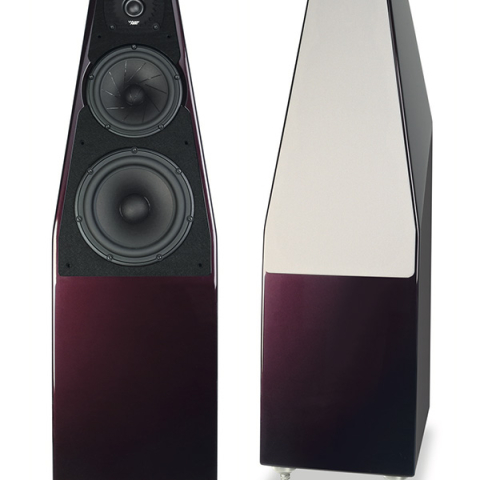
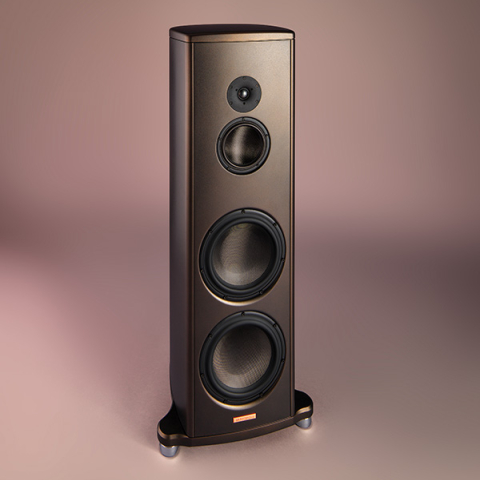
Strip away its exotic accoutrements, like the automotive clear-coat finish and the metal inlay strips, and the VSM Millennium is your basic two-way vented box—a floorstanding minimonitor. Yeah, and a Ferrari is your basic engine, tranny, and four wheels. The VSM's guts consist of a proprietary (high mass, more damping) edition of a ScanSpeak woofer used in many familiar designs, including Wilson Audio's WATT Puppy, and a Dynaudio D330 Esotar tweeter. According to designer Bobby Palkovic, this Dynaudio tweeter, once available to consumer kit builders but now withdrawn from the market, was, at $800/pair, among the most expensive OEM tweeters ever sold. Palkovic also told me that Dynaudio stopped selling the 1", ferrofluid-cooled, silk-dome driver "over the counter" and to most other speaker manufacturers (EgglestonWorks is the most obvious exception) because most end-users didn't use it properly. The two drivers are mounted in a modestly sized box made from Pan-fiber, a material similar to MDF but, according to Palkovic, including more pulp and less glue and solvent than regular MDF, thus making it more inert. The front baffle is 1.5" thick, the sides and back 0.75".
A chamber at the bottom of the cabinet is filled at the factory with 23 lbs of sand. This increases the mass, lowers the center of gravity, and raises the box off the floor so that the VSM's "acoustic center"—midway between the drivers—is at an average listening height of 36". Above the sand chamber is a 5" plug of solid MDF, and above that the front-ported, 19-liter woofer cabinet proper, which is braced with strategically placed discs and damped with a compound made by 3M. The box is lined with broadband-damping Dacron fiber fill. A removable (for upgrades), second-order, 2250Hz symmetrical crossover network sits behind the tweeter. The crossover is a hardwired, epoxy-potted, three-dimensional circuit using Cardas Crossfield wire made only for Merlin, radially wound and fitted with extra dielectric to reduce microphonics. Cardas silver-copper Quadtectic solder (2% silver, 1% copper) secures proprietary Caddock MP820 and 821-series Micronoxü non-inductive metal-film resistors, Hovland film/foil MusiCap capacitors, and Hovland ultra-low-resistance inductors ("they look like sausages," says Palkovic) featuring huge cores and very little wire. This last is important, says Palkovic: It reduces resistance at the knee of the crossover eight or ten times more than do typical air-core inductors. This, he says, makes the VSM much easier to drive and gives it "a nice warmth." No point in going to all this trouble if connection to the outside world is less than stellar. Merlin uses Cardas' unique copper-terminal connector, which has no threads in the connecting rods and doesn't use the rods for actually tightening the speaker connectors. (A single plastic knob tightens both connections simultaneously.) Ayre uses these high-contact-area, low-deformation terminals on their power amps, and they're the most effective speaker terminals I've used. An outboard Zobel network, consisting of a series Hovland capacitor and a resistor is placed across the tweeter terminals of this biwirable system. This is said to cut RFI and EMI distortion components while presenting the power amp with a stable 10 ohm load. The drivers are wired in phase.
The enclosure is finished in five coats of DuPont polyurethane automotive clear coat, available in 20 colors, with custom finishes offered for an additional $200.
More often than not, the complaints are justified. Getting music from a hi-fi at a Show is tough under the best of circumstances. Cramped hotel rooms, polluted electrical lines, sadistic freight handlers, and dozens of other problems create a nightmare environment for high-quality audio—and not acknowledging the sonic problems can leave CES attendees thinking manufacturers actually like the bile oozing from their loudspeakers. It's better to begin with a pre-emptive whine. Getting even merely credible sound at a show is generally considered a coup. Which is what made Merlin Music Systems' performances at the Consumer Electronics and the Stereophile-sponsored shows of the past few years so impressive. Somehow, Merlin always seems to get memorable sound from its loudspeakers. I can't remember a show when I was less than impressed by what I heard in a Merlin room. Among reviewers, I'm hardly alone in that opinion. So when I got the opportunity to review the Millennium, the latest iteration of Merlin's VSM, it was a no-brainer. Strip away its exotic accoutrements, like the automotive clear-coat finish and the metal inlay strips, and the VSM Millennium is your basic two-way vented box—a floorstanding minimonitor. Yeah, and a Ferrari is your basic engine, tranny, and four wheels. The VSM's guts consist of a proprietary (high mass, more damping) edition of a ScanSpeak woofer used in many familiar designs, including Wilson Audio's WATT Puppy, and a Dynaudio D330 Esotar tweeter. According to designer Bobby Palkovic, this Dynaudio tweeter, once available to consumer kit builders but now withdrawn from the market, was, at $800/pair, among the most expensive OEM tweeters ever sold. Palkovic also told me that Dynaudio stopped selling the 1", ferrofluid-cooled, silk-dome driver "over the counter" and to most other speaker manufacturers (EgglestonWorks is the most obvious exception) because most end-users didn't use it properly. The two drivers are mounted in a modestly sized box made from Pan-fiber, a material similar to MDF but, according to Palkovic, including more pulp and less glue and solvent than regular MDF, thus making it more inert. The front baffle is 1.5" thick, the sides and back 0.75".