The idea of mating a dynamic woofer to a ribbon midrange/tweeter is appealing on paper. Such a "hybrid" loudspeaker would have the many advantages of a dipole ribbon transducer, yet be more practical and affordable than full-range ribbon designs. Among the ribbon's great strengths is its narrow vertical dispersion (reducing the ceiling and floor reflections), contributing to the ribbon driver's well-deserved reputation for transparency, terrific soundstaging, transient zip, and excellent resolution of detail. By adding a dynamic woofer to a ribbon midrange/tweeter, the system cost can be contained compared to a full-range design.
 Despite the lure of affordable dynamic/ribbon hybrids, many such products have failed—musically, technically, and commercially. The biggest problem is mating the woofer's spherical, or omnidirectional, radiation pattern to the ribbon's dipole, or figure-eight, radiation. The differences invite audible discontinuities at the crossover point. The "seamless" crossover has been a long-elusive goal for designers of dynamic/ribbon hybrid loudspeakers.
Few products have managed to pull off this technical sleight of hand. The $22,000 Genesis II.5 loudspeaker, which has become my reference, is a rare example of a hybrid that works. Unfortunately, its cost puts it out of the range of most music-lovers. What the world needs is a loudspeaker that brings the transparency, soundstaging, and detail of a ribbon driver to a product with good bass performance—at an affordable price.
An attempt at this lofty ideal was made by Apogee Acoustics with their $1195/pair Centaur Minor loudspeaker. In my review of that product in January 1992 (Vol.15 No.1), I found that the Centaur Minor offered exceptional midrange transparency, great soundstaging, and a smooth tonal balance. There was no question about the ribbon's performance—Apogee has been at the forefront of creating excellent full-range ribbon loudspeakers for more than 15 years. But the dynamic woofer and enclosure half of the design was less well executed. Specifically, I criticized the Minor's lack of bass extension, its inability to play loudly, limited dynamics, and somewhat colored bass, which was probably caused by cabinet resonances. Nonetheless, the Minor was superbly musical, and particularly recommendable to those who value soundstaging, detail, and liquidity over the ability to play rock at high levels.
Four years later, Apogee has taken another crack at the affordable hybrid loudspeaker with their $1995/pair Centaurus Slant 6.
Description
Despite the lure of affordable dynamic/ribbon hybrids, many such products have failed—musically, technically, and commercially. The biggest problem is mating the woofer's spherical, or omnidirectional, radiation pattern to the ribbon's dipole, or figure-eight, radiation. The differences invite audible discontinuities at the crossover point. The "seamless" crossover has been a long-elusive goal for designers of dynamic/ribbon hybrid loudspeakers.
Few products have managed to pull off this technical sleight of hand. The $22,000 Genesis II.5 loudspeaker, which has become my reference, is a rare example of a hybrid that works. Unfortunately, its cost puts it out of the range of most music-lovers. What the world needs is a loudspeaker that brings the transparency, soundstaging, and detail of a ribbon driver to a product with good bass performance—at an affordable price.
An attempt at this lofty ideal was made by Apogee Acoustics with their $1195/pair Centaur Minor loudspeaker. In my review of that product in January 1992 (Vol.15 No.1), I found that the Centaur Minor offered exceptional midrange transparency, great soundstaging, and a smooth tonal balance. There was no question about the ribbon's performance—Apogee has been at the forefront of creating excellent full-range ribbon loudspeakers for more than 15 years. But the dynamic woofer and enclosure half of the design was less well executed. Specifically, I criticized the Minor's lack of bass extension, its inability to play loudly, limited dynamics, and somewhat colored bass, which was probably caused by cabinet resonances. Nonetheless, the Minor was superbly musical, and particularly recommendable to those who value soundstaging, detail, and liquidity over the ability to play rock at high levels.
Four years later, Apogee has taken another crack at the affordable hybrid loudspeaker with their $1995/pair Centaurus Slant 6.
Description
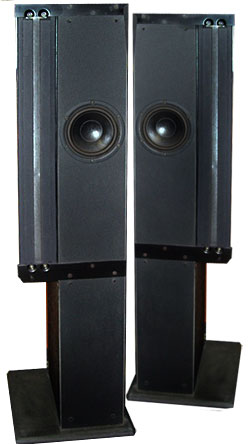
The Slant 6's tall, narrow shape, small footprint, and slanted rear panel make the handsome, elegant loudspeaker less obtrusive in a room than most conventional box loudspeakers. Essentially, the Slant 6 is a flat panel on which the ribbon midrange/tweeter is mounted with an offset woofer enclosure attached to the panel rear. The entire structure rests on a flat base. Two pairs of high-quality binding posts allow for bi-wiring, and four spikes are supplied for adjusting the rake angle (how far the Slant 6 tilts back) and for coupling the loudspeaker to the floor. A three-position toggle switch on the input-terminal cup selects between "high," "low," and "normal" woofer levels. This switch engages different power resistors in the crossover. Rather than adjust the overall woofer level up and down, the switch is more of a Q control that affects only the bottom two octaves.
The 0.8ft3 (24 liter) woofer enclosure is nearly as tall as the front panel, but not as wide, so it doesn't interfere with the ribbon's dipolar radiation pattern. The "Slant" name comes from the wedge-shaped woofer cabinet that narrows to a point at the top of the front panel. This design adds volume to the woofer enclosure while making the loudspeaker more visually appealing. The slant design has other technical advantages, including discouraging resonances inside the enclosure by reducing the parallel surface area, and avoiding the abrupt transition from no cabinet to cabinet, which could affect the dispersion of the ribbon's rear-radiated energy. The new 3/4" MDF woofer cabinet is also well-braced, with a figure-eight brace, two staggered cross-braces, and a shelf brace—all made from Baltic birch, which is claimed to be more rigid than MDF. Finally, the slant design provides better support for the front baffle than does a small box attached to the bottom of the panel.
A 6.5" cone woofer is reflex-loaded in the enclosure, with the port firing to the rear. Although the Slant 6's woofer is the same size as that used in the Centaur Minor, the new driver has a larger magnet, a 1.5" voice-coil (instead of 1"), double the power handling, and much greater excursion. Apogee's larger loudspeakers (including the Slant 8 and Mini-Grand) use the same family of drivers, which are made by Danish manufacturer Vifa to Apogee's specifications.
The heart of the Slant 6 is the 26"-long ribbon transducer used to reproduce the midrange and treble. The driver is a refinement of that used in the Minor and Stage loudspeakers. It now has a magnet structure that extends the full length of the ribbon to increase power handling and dynamic range, and has a suspension to stabilize the ribbon during high excursions. This is a tiny device attached to the rear of the ribbon that keeps it from twisting during loud passages. At low sound levels, the suspension has no effect. The Slant 6's ribbon is identical to that used in the Mini-Grand.
The system crosses over at 1kHz, with 6dB/octave slopes through the crossover region, steepening to 12dB/octave out of band. This technique allows the drivers to be wired in-phase for better time behavior, while maintaining the power-handling advantages conferred by steeper slopes. The crossover uses Apogee's custom-wound air-core inductors and metalized polypropylene film capacitors—the same components used in the Studio Grand and Mini-Grand. No printed circuit board is used in the crossover; all wiring is hand-soldered point-to-point.
Overall, the Centaurus Slant 6 appears to build on the strengths of the Centaur Minor while addressing the latter's shortcomings. Moreover, unlike the Centaur Minor, the Slant 6 needs no base (which added $295 to the Minor's cost). For the $400 difference in price (figuring the Minor with bases), the Slant 6 looks to be a much better loudspeaker.
Setup
Apogee's Jason Bloom set up the Slant 6es in my new listening room last October. Since then, they've shared space with the Genesis II.5, another dynamic/ribbon hybrid with a dipolar radiation pattern. Watching Jason set up and demonstrate his loudspeakers was great fun—as anyone who's gone to a CES in the past 15 years will attest. Even after all this time, Jason gets excited about finding the one little tweak—sometimes a loudspeaker movement of 1"—that snaps the soundstage into focus and best integrates the speaker's bass with the room (footnote 1).
Footnote 1: At a late-1980s CES, Jason was playing both LPs and CDs for the first time at a Show (his previous demos had been LP only). A group of salesmen from a mid-fi chain—many of them looked like kids to Jason—wandered off-course and found their way into Jason's room. On seeing him putting an LP on the turntable, one of them said, "Look! That guy must really be an audiophile—he's using a record player!"
Despite the lure of affordable dynamic/ribbon hybrids, many such products have failed—musically, technically, and commercially. The biggest problem is mating the woofer's spherical, or omnidirectional, radiation pattern to the ribbon's dipole, or figure-eight, radiation. The differences invite audible discontinuities at the crossover point. The "seamless" crossover has been a long-elusive goal for designers of dynamic/ribbon hybrid loudspeakers.
Few products have managed to pull off this technical sleight of hand. The $22,000 Genesis II.5 loudspeaker, which has become my reference, is a rare example of a hybrid that works. Unfortunately, its cost puts it out of the range of most music-lovers. What the world needs is a loudspeaker that brings the transparency, soundstaging, and detail of a ribbon driver to a product with good bass performance—at an affordable price.
An attempt at this lofty ideal was made by Apogee Acoustics with their $1195/pair Centaur Minor loudspeaker. In my review of that product in January 1992 (Vol.15 No.1), I found that the Centaur Minor offered exceptional midrange transparency, great soundstaging, and a smooth tonal balance. There was no question about the ribbon's performance—Apogee has been at the forefront of creating excellent full-range ribbon loudspeakers for more than 15 years. But the dynamic woofer and enclosure half of the design was less well executed. Specifically, I criticized the Minor's lack of bass extension, its inability to play loudly, limited dynamics, and somewhat colored bass, which was probably caused by cabinet resonances. Nonetheless, the Minor was superbly musical, and particularly recommendable to those who value soundstaging, detail, and liquidity over the ability to play rock at high levels.
The Slant 6's tall, narrow shape, small footprint, and slanted rear panel make the handsome, elegant loudspeaker less obtrusive in a room than most conventional box loudspeakers. Essentially, the Slant 6 is a flat panel on which the ribbon midrange/tweeter is mounted with an offset woofer enclosure attached to the panel rear. The entire structure rests on a flat base. Two pairs of high-quality binding posts allow for bi-wiring, and four spikes are supplied for adjusting the rake angle (how far the Slant 6 tilts back) and for coupling the loudspeaker to the floor. A three-position toggle switch on the input-terminal cup selects between "high," "low," and "normal" woofer levels. This switch engages different power resistors in the crossover. Rather than adjust the overall woofer level up and down, the switch is more of a Q control that affects only the bottom two octaves.
Apogee's Jason Bloom set up the Slant 6es in my new listening room last October. Since then, they've shared space with the Genesis II.5, another dynamic/ribbon hybrid with a dipolar radiation pattern. Watching Jason set up and demonstrate his loudspeakers was great fun—as anyone who's gone to a CES in the past 15 years will attest. Even after all this time, Jason gets excited about finding the one little tweak—sometimes a loudspeaker movement of 1"—that snaps the soundstage into focus and best integrates the speaker's bass with the room (footnote 1).
Footnote 1: At a late-1980s CES, Jason was playing both LPs and CDs for the first time at a Show (his previous demos had been LP only). A group of salesmen from a mid-fi chain—many of them looked like kids to Jason—wandered off-course and found their way into Jason's room. On seeing him putting an LP on the turntable, one of them said, "Look! That guy must really be an audiophile—he's using a record player!"