It's been five years since David Wilson's X-1/Grand SLAMM speaker system invaded our audio consciousness with its 500W power capacity and very high (95dB/W) sensitivity (footnote 1). Capable of an earsplitting 123dB at 1m, with a bandwidth to match, this was one speaker system that refused to be ignored. The X-1 has since evolved to $70,000/pair Mk.II form. It now provides some flexibility of tonal balance for different room acoustics, and is distinguished by greater subtlety in its differentiation of timbre. Beneath the X-1 in Wilson's range comes the WATT/Puppy ensemble, now in its 5.1 iteration (footnote 2). The WATT/Puppy has survived for over 10 years, and sets a benchmark for the Wilson line at its $17,270 system price.  But that still left a clear gap in the Wilson range. The company hopes that the MAXX, introduced at HI-FI '98 in Los Angeles and priced at just over half the cost of an X-1/Grand SLAMM, or twice the price of the WATT/Puppy, will fill that gap. Great things should be expected of this speaker. The MAXX's dynamic range means that a pair of them, driven by up to 1000Wpc of amplification, will be capable of driving a large listening room of 8580 cubic feet volume to realistically high sound levels of about 110dB. That dynamic range should be available over a wide frequency range, and deliverable without distortion or compression down to a low-frequency extreme of, typically, 25Hz or below. An accurate tonal balance is mandatory for a speaker when such high sound levels are possible—and its price is taken into consideration! A rough, uneven frequency response quickly becomes hard and fatiguing at increasingly high volume levels. Likewise, high levels should go hand in hand with low distortion, which will help maintain tonal integrity and clarity over a wide dynamic range. High standards are also expected for stereo imaging performance. Even though the MAXX is a large speaker, its designer must make it "appear" acoustically small at higher frequencies, to maintain stable, precise image focus.
Meeting all of these requirements is no trivial engineering task. Design and build
But that still left a clear gap in the Wilson range. The company hopes that the MAXX, introduced at HI-FI '98 in Los Angeles and priced at just over half the cost of an X-1/Grand SLAMM, or twice the price of the WATT/Puppy, will fill that gap. Great things should be expected of this speaker. The MAXX's dynamic range means that a pair of them, driven by up to 1000Wpc of amplification, will be capable of driving a large listening room of 8580 cubic feet volume to realistically high sound levels of about 110dB. That dynamic range should be available over a wide frequency range, and deliverable without distortion or compression down to a low-frequency extreme of, typically, 25Hz or below. An accurate tonal balance is mandatory for a speaker when such high sound levels are possible—and its price is taken into consideration! A rough, uneven frequency response quickly becomes hard and fatiguing at increasingly high volume levels. Likewise, high levels should go hand in hand with low distortion, which will help maintain tonal integrity and clarity over a wide dynamic range. High standards are also expected for stereo imaging performance. Even though the MAXX is a large speaker, its designer must make it "appear" acoustically small at higher frequencies, to maintain stable, precise image focus.
Meeting all of these requirements is no trivial engineering task. Design and build
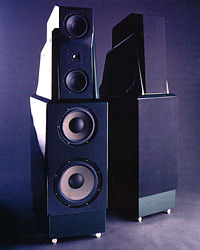
The MAXX's five drive-units are arranged in a three-way configuration. Two Focal drivers handle the bass, working in a common volume. As in the SLAMM, they're of different sizes: 10" and 12" (in the X-1, 12" and 15"). These are tuned to a low 23Hz by a 12.2"-deep, 5"-diameter port on the rear panel, midway between the two drivers. The effective bandwidth of this section is 20-200Hz. Mid and treble ranges are handled by the separate head-unit enclosure's time-aligned, three-way vertical driver array.. This is equipped with a central, 1" Focal tweeter flanked by a pair of 7" ScanSpeak midrange drivers. These cover 200Hz-2kHz; the tweeter covers 2kHz-22kHz. Wilson has allowed for fine adjustment of tonal balance to accommodate room placement and, to a lesser degree, the variations in system sound that result from different combinations of source and amplification components and cables. These adjustments are generally left in the hands of the Wilson dealer, and are made via the relatively small Caddock metal-film power resistors used for mid- and treble-driver protection. These are bolted to a heatsink and are accessible under an alloy coverplate on the back of the head module. Independent ±0.5, ±1, and 1.5dB adjustments are possible for the mid and treble sections. In case of gross overload, these resistors go harmlessly open-circuit and are easily replaced, even if they do cost much more than an ordinary fuse. Fuses have complex thermal behavior that can be audible; the Caddocks remain sonically transparent until they fail. Enclosing a volume of 3.88 cubic feet, the MAXX's bass bin is reflex-loaded, using a fairly well-damped, room-matched alignment. The large port will sustain the system's full power bandwidth and power handling. The cabinet is made of ultra-high-density phenolic bonded laminate, with the interior extensively cross-braced in all planes by high-density MDF panels. The result is an exceedingly rigid enclosure of minimal flexural resonance and stray acoustic output. The review samples came finished in an immaculate high-gloss, black-graphite metallic lacquer.
Secured to the floor by heavy-duty, hardened-steel spikes, the bass enclosure forms a rigid, stable, high-mass platform for the head unit. This is a monolithic structure—the Grand SLAMM's was in three parts—optimized with regard to local reflections and diffractions. The head unit's drive-unit array forms a focused arc, with the tweeter correctly displaced behind the radiating planes of the midrange drivers. The array itself is recessed relative to the bass section. The head unit is also built of very-high-density phenolic panels, and as a result is exceedingly inert and rigid, exhibiting a fine combination of stray-resonance damping and stiffness. Three-point coupling is used between the upper and lower enclosures, helping to uncouple higher-frequency energy pathways without the imprecision of elastic or similar polymeric decoupling components.
Footnote 1: The X-1 was reviewed for Stereophile by Martin Colloms in December 1994 (Vol.17 No.12), with Follow-Ups by John Atkinson in December 1995 (Vol.18 No.12), and by Jack English in May 1996 (Vol.19 No.5). It was the magazine's 1995 Product of the Year.
Footnote 2: See Wes Phillips' review in the October 1995 issue of Stereophile (Vol.19 No.10).
But that still left a clear gap in the Wilson range. The company hopes that the MAXX, introduced at HI-FI '98 in Los Angeles and priced at just over half the cost of an X-1/Grand SLAMM, or twice the price of the WATT/Puppy, will fill that gap. Great things should be expected of this speaker. The MAXX's dynamic range means that a pair of them, driven by up to 1000Wpc of amplification, will be capable of driving a large listening room of 8580 cubic feet volume to realistically high sound levels of about 110dB. That dynamic range should be available over a wide frequency range, and deliverable without distortion or compression down to a low-frequency extreme of, typically, 25Hz or below. An accurate tonal balance is mandatory for a speaker when such high sound levels are possible—and its price is taken into consideration! A rough, uneven frequency response quickly becomes hard and fatiguing at increasingly high volume levels. Likewise, high levels should go hand in hand with low distortion, which will help maintain tonal integrity and clarity over a wide dynamic range. High standards are also expected for stereo imaging performance. Even though the MAXX is a large speaker, its designer must make it "appear" acoustically small at higher frequencies, to maintain stable, precise image focus. The MAXX's five drive-units are arranged in a three-way configuration. Two Focal drivers handle the bass, working in a common volume. As in the SLAMM, they're of different sizes: 10" and 12" (in the X-1, 12" and 15"). These are tuned to a low 23Hz by a 12.2"-deep, 5"-diameter port on the rear panel, midway between the two drivers. The effective bandwidth of this section is 20-200Hz. Mid and treble ranges are handled by the separate head-unit enclosure's time-aligned, three-way vertical driver array.. This is equipped with a central, 1" Focal tweeter flanked by a pair of 7" ScanSpeak midrange drivers. These cover 200Hz-2kHz; the tweeter covers 2kHz-22kHz. Wilson has allowed for fine adjustment of tonal balance to accommodate room placement and, to a lesser degree, the variations in system sound that result from different combinations of source and amplification components and cables. These adjustments are generally left in the hands of the Wilson dealer, and are made via the relatively small Caddock metal-film power resistors used for mid- and treble-driver protection. These are bolted to a heatsink and are accessible under an alloy coverplate on the back of the head module. Independent ±0.5, ±1, and 1.5dB adjustments are possible for the mid and treble sections. In case of gross overload, these resistors go harmlessly open-circuit and are easily replaced, even if they do cost much more than an ordinary fuse. Fuses have complex thermal behavior that can be audible; the Caddocks remain sonically transparent until they fail. Enclosing a volume of 3.88 cubic feet, the MAXX's bass bin is reflex-loaded, using a fairly well-damped, room-matched alignment. The large port will sustain the system's full power bandwidth and power handling. The cabinet is made of ultra-high-density phenolic bonded laminate, with the interior extensively cross-braced in all planes by high-density MDF panels. The result is an exceedingly rigid enclosure of minimal flexural resonance and stray acoustic output. The review samples came finished in an immaculate high-gloss, black-graphite metallic lacquer.
Footnote 1: The X-1 was reviewed for Stereophile by Martin Colloms in December 1994 (Vol.17 No.12), with Follow-Ups by John Atkinson in December 1995 (Vol.18 No.12), and by Jack English in May 1996 (Vol.19 No.5). It was the magazine's 1995 Product of the Year.