I've long been a fan of Naim electronic gear, and have used it for many years. I also have admiration and respect for the company's uncompromisingly consistent and determinedly individualistic approach to the various tasks and problems of loudspeaker design. But my enthusiasm for Naim speakers has long been tempered by a feeling that mechanical aspects of the design are given priority over acoustics and styling.  Naim's new NBL loudspeaker has been wowing plenty of hi-fi show visitors recently, and is unquestionably the most attractive-looking speaker the company has yet produced. The main man behind it is experienced speaker designer Phil Ward, who joined Naim a couple of years back, after the Canon speaker operation closed down. As well as Canon, Phil's résumé includes time spent at Mordaunt-Short, where he was involved with the 442, a radical speaker whose drivers were attached to a backbone/stand and decoupled from the enclosure—an approach rather different from Naim's, if more in execution than intention (footnote 1). The three-way NBL—Phil's first design for Naim—is an elegant variation on several familiar proprietary themes. Its initials stand for "nested box loudspeaker," and it's more or less a cross between the two-way SBL ("separate box loudspeaker") and a decidedly larger three-way, the DBL ("decoupled box loudspeaker"). Each NBL consists of two SBL bass sections crossing over to a DBL midrange/tweeter section, so there's little new at the drive-unit end of the technology. The clever bit comes in the way everything's been put together to create a package that not only comfortably bests its forebears on aesthetic grounds, but that also does away with the lengthy and elaborate setup procedures required by the SBL and DBL.
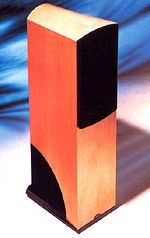
A crucial, probably unique ingredient of all Naim multi-box designs is their use of complex, multiple mechanical decoupling systems to prevent the communication of driver-frame vibrations to the enclosures, as well as between the various enclosures. This approach is made still more complicated by an unusual bass-loading technique—a variation on the sealed-box principle in which the bass drivers are loaded by two separate enclosures. A small enclosure immediately behind the drive-units helps control excessive cone excursion; a much larger box is coupled to the first via a tightly specified acoustic resistance panel, to keep the fundamental resonance low and provide good ultimate extension. The SBL and DBL are shipped as three and four separate boxes, respectively, and must be assembled on-site, using silicone sealant to fix the acoustic resistance panel in place. The NBL ships as a single unit (at 90 lbs, very much a two-man lift!), and setup is a simple matter of unpacking, fitting four spikes, removing the three card inserts that help lock the drive-unit suspensions, and positioning the speakers. There are then four more transit bolts to take out, and the two securing the mid/treble cover to replace (tightened to 3.6nm torque, please), to secure the midrange driver properly. Fit the grillecloths and you're ready to go. Two people can do it in less than half an hour. The large and hefty NBL is attractive, thanks to its interesting shape and high-class, real-wood veneer. Its most obvious feature is its nice-looking arched top, though it might frustrate those who regard high, flat surfaces as ideal repositories for ornaments, plants, or unsorted junk mail. More visually intriguing is the way the enclosure is tapered: it shrinks and narrows by a few inches each from front to back, and thus plays tricks with the perceived perspectives. In total contrast to the DBL, much of the NBL's bulk is accommodated by its considerable overall depth of 19", which keeps the width of its front panel down to a reasonably slim 11".
To achieve such slenderness, Phil Ward has adopted a strategy for positioning the bass drivers that, to my knowledge, was pioneered by Roy Allison, first at AR and later in his own product line. In a manner reminiscent of the AR9 and AR90 from the 1970s, two identical bass drive-units are placed low and to the rear of the cabinet sides. The NBL is nominally intended to be positioned close to the rear wall (though it's always worth experimenting); each bass driver therefore operates into a sphere quadrant, which provides considerable boundary reinforcement and (just about) allows the use of two quite modest 8"-frame drivers with relatively inefficient sealed-box loading. Suspension of disbelief
Naim's new NBL loudspeaker has been wowing plenty of hi-fi show visitors recently, and is unquestionably the most attractive-looking speaker the company has yet produced. The main man behind it is experienced speaker designer Phil Ward, who joined Naim a couple of years back, after the Canon speaker operation closed down. As well as Canon, Phil's résumé includes time spent at Mordaunt-Short, where he was involved with the 442, a radical speaker whose drivers were attached to a backbone/stand and decoupled from the enclosure—an approach rather different from Naim's, if more in execution than intention (footnote 1). The three-way NBL—Phil's first design for Naim—is an elegant variation on several familiar proprietary themes. Its initials stand for "nested box loudspeaker," and it's more or less a cross between the two-way SBL ("separate box loudspeaker") and a decidedly larger three-way, the DBL ("decoupled box loudspeaker"). Each NBL consists of two SBL bass sections crossing over to a DBL midrange/tweeter section, so there's little new at the drive-unit end of the technology. The clever bit comes in the way everything's been put together to create a package that not only comfortably bests its forebears on aesthetic grounds, but that also does away with the lengthy and elaborate setup procedures required by the SBL and DBL.
A crucial, probably unique ingredient of all Naim multi-box designs is their use of complex, multiple mechanical decoupling systems to prevent the communication of driver-frame vibrations to the enclosures, as well as between the various enclosures. This approach is made still more complicated by an unusual bass-loading technique—a variation on the sealed-box principle in which the bass drivers are loaded by two separate enclosures. A small enclosure immediately behind the drive-units helps control excessive cone excursion; a much larger box is coupled to the first via a tightly specified acoustic resistance panel, to keep the fundamental resonance low and provide good ultimate extension. The SBL and DBL are shipped as three and four separate boxes, respectively, and must be assembled on-site, using silicone sealant to fix the acoustic resistance panel in place. The NBL ships as a single unit (at 90 lbs, very much a two-man lift!), and setup is a simple matter of unpacking, fitting four spikes, removing the three card inserts that help lock the drive-unit suspensions, and positioning the speakers. There are then four more transit bolts to take out, and the two securing the mid/treble cover to replace (tightened to 3.6nm torque, please), to secure the midrange driver properly. Fit the grillecloths and you're ready to go. Two people can do it in less than half an hour. The large and hefty NBL is attractive, thanks to its interesting shape and high-class, real-wood veneer. Its most obvious feature is its nice-looking arched top, though it might frustrate those who regard high, flat surfaces as ideal repositories for ornaments, plants, or unsorted junk mail. More visually intriguing is the way the enclosure is tapered: it shrinks and narrows by a few inches each from front to back, and thus plays tricks with the perceived perspectives. In total contrast to the DBL, much of the NBL's bulk is accommodated by its considerable overall depth of 19", which keeps the width of its front panel down to a reasonably slim 11".
To achieve such slenderness, Phil Ward has adopted a strategy for positioning the bass drivers that, to my knowledge, was pioneered by Roy Allison, first at AR and later in his own product line. In a manner reminiscent of the AR9 and AR90 from the 1970s, two identical bass drive-units are placed low and to the rear of the cabinet sides. The NBL is nominally intended to be positioned close to the rear wall (though it's always worth experimenting); each bass driver therefore operates into a sphere quadrant, which provides considerable boundary reinforcement and (just about) allows the use of two quite modest 8"-frame drivers with relatively inefficient sealed-box loading. Suspension of disbelief
A unique aspect of Naim's implementation of this strategy is how the drivers themselves are mounted: in a small (0.46ft3, or 13 liters) enclosure mechanically decoupled from the main enclosure and plinth, but acoustically coupled to them via the aforementioned acoustic resistance panel. A further bonus of the back-to-back driver mounting is that mechanical reaction forces in the driver frames and magnets are in opposition, and therefore largely cancel each other. To test the efficacy of this arrangement, I dug out Leftfield's Rhythm and Stealth, wound the volume up to clipping, laid a hand on the top of an NBL, then felt the sides: no discernible vibration whatsoever. Astonishing!
Footnote 1: The Canon S-35 speaker was reviewed in the June 1995 Stereophile, the Mordaunt-Short 442 in March 1988.—John Atkinson
Naim's new NBL loudspeaker has been wowing plenty of hi-fi show visitors recently, and is unquestionably the most attractive-looking speaker the company has yet produced. The main man behind it is experienced speaker designer Phil Ward, who joined Naim a couple of years back, after the Canon speaker operation closed down. As well as Canon, Phil's résumé includes time spent at Mordaunt-Short, where he was involved with the 442, a radical speaker whose drivers were attached to a backbone/stand and decoupled from the enclosure—an approach rather different from Naim's, if more in execution than intention (footnote 1). The three-way NBL—Phil's first design for Naim—is an elegant variation on several familiar proprietary themes. Its initials stand for "nested box loudspeaker," and it's more or less a cross between the two-way SBL ("separate box loudspeaker") and a decidedly larger three-way, the DBL ("decoupled box loudspeaker"). Each NBL consists of two SBL bass sections crossing over to a DBL midrange/tweeter section, so there's little new at the drive-unit end of the technology. The clever bit comes in the way everything's been put together to create a package that not only comfortably bests its forebears on aesthetic grounds, but that also does away with the lengthy and elaborate setup procedures required by the SBL and DBL. A unique aspect of Naim's implementation of this strategy is how the drivers themselves are mounted: in a small (0.46ft3, or 13 liters) enclosure mechanically decoupled from the main enclosure and plinth, but acoustically coupled to them via the aforementioned acoustic resistance panel. A further bonus of the back-to-back driver mounting is that mechanical reaction forces in the driver frames and magnets are in opposition, and therefore largely cancel each other. To test the efficacy of this arrangement, I dug out Leftfield's Rhythm and Stealth, wound the volume up to clipping, laid a hand on the top of an NBL, then felt the sides: no discernible vibration whatsoever. Astonishing!
Footnote 1: The Canon S-35 speaker was reviewed in the June 1995 Stereophile, the Mordaunt-Short 442 in March 1988.—John Atkinson