Really Big Hi-Fi came to live with me for a couple of months this past spring in the form of a pair of Tannoy Churchill loudspeakers. They were trucked directly to San Rafael, California from Kitchener, Ontario, in flight cases so bulky they could double as coffins for NFL offensive linemen. Once ensconced chez moi, the Tannoy dreadnoughts provoked bewilderment, alarm, curiosity, envy, admiration, awe, and amazement in all who heard and saw them. 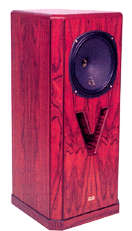 Arranging their arrival wasn't easy. The North American Free Trade Agreement may have been intended to make American-Canadian transactions as friendly and unencumbered as they are between Alabama and Mississippi, but TGI North America's National Sales Manager Ian Gellatly had to jump through some wicked bureaucratic hoops to arrange shipping. We'd been talking intermittently about him getting me a pair of Churchills for review since the Vancouver Hi-Fi show in September 1997, where I thought they sounded excellent in the Hi-Fi Centre's large room and The Inner Ear Report's smaller one. The truck showed up a day early. I came home to a flurry of messages from the driver, who had called every 20 minutes to tell me where he was parked and why he couldn't deliver to the house. (I live at the top of a steep, narrow street.) He waited nearby all afternoon on the shoulder of a busy thoroughfare until I showed up. "Happens all the time," he said with a shrug. "Refused shipment, wrong address, wrong hour..." No wonder freight is so expensive. We strapped them—one at a time—into the back of my Isuzu Trooper. With the rear door open, we backed up the street and rolled them into the garage. The +100kg cases were easy to maneuver on their heavy-duty casters. Getting the speakers out of them was another story, but with a little engineering skill and a heavy-duty handtruck, I accomplished alone what Ian had insisted was a two-man job. (The handtruck is a most underrated invention. With foam-rubber pipe insulation covering its rails, it's an indispensable tool for reviewers and hobbyists alike.)
The massive speakers went first into the downstairs guest quarters, where they endured a few days' break-in with a small NAD receiver. I seemed to remember Gellatly telling me this particular pair was a dealer's floor stock, meaning they were already broken in, but they looked so flawless—factory new, in fact—that I did it anyway. Break-in, while not always strictly necessary, is both a reassuring ritual and an informal introduction—like meeting a new neighbor at a garage sale. Two feet wide and 2' deep, a tad over 4' tall, and weighing in at 177 lbs each, the Churchills were as imposing as a couple of Sumo wrestlers. No human guests availed themselves of my hospitality while the big bruisers were down there, nor would they have been likely to—the loudspeakers and their matching crossovers left only emergency access to the guest bath. A few days later they came upstairs, where they displaced a pair of bird's-eye-maple Montana EPSes—the last item on my list of tardy reviews. Build
Arranging their arrival wasn't easy. The North American Free Trade Agreement may have been intended to make American-Canadian transactions as friendly and unencumbered as they are between Alabama and Mississippi, but TGI North America's National Sales Manager Ian Gellatly had to jump through some wicked bureaucratic hoops to arrange shipping. We'd been talking intermittently about him getting me a pair of Churchills for review since the Vancouver Hi-Fi show in September 1997, where I thought they sounded excellent in the Hi-Fi Centre's large room and The Inner Ear Report's smaller one. The truck showed up a day early. I came home to a flurry of messages from the driver, who had called every 20 minutes to tell me where he was parked and why he couldn't deliver to the house. (I live at the top of a steep, narrow street.) He waited nearby all afternoon on the shoulder of a busy thoroughfare until I showed up. "Happens all the time," he said with a shrug. "Refused shipment, wrong address, wrong hour..." No wonder freight is so expensive. We strapped them—one at a time—into the back of my Isuzu Trooper. With the rear door open, we backed up the street and rolled them into the garage. The +100kg cases were easy to maneuver on their heavy-duty casters. Getting the speakers out of them was another story, but with a little engineering skill and a heavy-duty handtruck, I accomplished alone what Ian had insisted was a two-man job. (The handtruck is a most underrated invention. With foam-rubber pipe insulation covering its rails, it's an indispensable tool for reviewers and hobbyists alike.)
The massive speakers went first into the downstairs guest quarters, where they endured a few days' break-in with a small NAD receiver. I seemed to remember Gellatly telling me this particular pair was a dealer's floor stock, meaning they were already broken in, but they looked so flawless—factory new, in fact—that I did it anyway. Break-in, while not always strictly necessary, is both a reassuring ritual and an informal introduction—like meeting a new neighbor at a garage sale. Two feet wide and 2' deep, a tad over 4' tall, and weighing in at 177 lbs each, the Churchills were as imposing as a couple of Sumo wrestlers. No human guests availed themselves of my hospitality while the big bruisers were down there, nor would they have been likely to—the loudspeakers and their matching crossovers left only emergency access to the guest bath. A few days later they came upstairs, where they displaced a pair of bird's-eye-maple Montana EPSes—the last item on my list of tardy reviews. Build
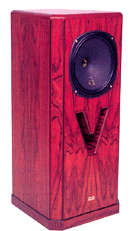
The Churchill's cabinet and crossover are made right here in North America, solely for the North American market. They look like the fine furniture that they are: precision joinery, carefully inlaid hardwood trim, meticulously matched veneers applied over an inch-thick MDF core. The veneer is pair-matched not only on the front panels, but on the tops, sides, backs, and even on the external crossovers, which share the speakers' trapezoidal shape. Crossover components include Solen Hepta-Litz inductors and Dale precision resistors in a magnetic-null orientation. Four high-quality WBT binding posts, for biwiring or bi-amping, are easily accessible on the back of the crossover housings, which attach to the speakers by shielded, extensible Kimber Kable umbilical cords with locking Neutrik Speakon connectors. The result: baby elephants linked trunk-to-tail to their mothers.
A 15" coaxial driver with a stiff pulp cone is mounted top-center, with a gold silhouette of Great Britain's top-hatted, cigar-chomping prime minister Winston Churchill applied to the cone just below the tweeter. A large, V-shaped port, said to minimize wind noise, occupies the center of the front baffle. The port's distinctive shape is widely assumed to be the derivation of the speaker's name, but Gellatly assured me this isn't so. The silhouette can be mistaken for a Chinese pictograph (my initial assumption) or a famous Churchill look-alike, as noted by my buddy Dave Ganapoler, musician and craftsman extraordinaire: "They sound awesome, but why the picture of W.C. Fields?" Near the bottom of the front panel is a small brass plate inscribed "TANNOY." The literature states that there are knit grilles available for the Churchills, but I've never seen any—not at three hi-fi shows, and not on the floor models at San Francisco Tannoy dealer House of Music. Neither are there grille mounts on the speakers; they're obviously intended to be used grille-free. The cabinets are extremely sturdy, and exhibited no detectable resonance when rapped with the knuckles on top, front, or back. A smidgen of resonance can be heard if you rap hard on the large side panels.
Arranging their arrival wasn't easy. The North American Free Trade Agreement may have been intended to make American-Canadian transactions as friendly and unencumbered as they are between Alabama and Mississippi, but TGI North America's National Sales Manager Ian Gellatly had to jump through some wicked bureaucratic hoops to arrange shipping. We'd been talking intermittently about him getting me a pair of Churchills for review since the Vancouver Hi-Fi show in September 1997, where I thought they sounded excellent in the Hi-Fi Centre's large room and The Inner Ear Report's smaller one. The truck showed up a day early. I came home to a flurry of messages from the driver, who had called every 20 minutes to tell me where he was parked and why he couldn't deliver to the house. (I live at the top of a steep, narrow street.) He waited nearby all afternoon on the shoulder of a busy thoroughfare until I showed up. "Happens all the time," he said with a shrug. "Refused shipment, wrong address, wrong hour..." No wonder freight is so expensive. We strapped them—one at a time—into the back of my Isuzu Trooper. With the rear door open, we backed up the street and rolled them into the garage. The +100kg cases were easy to maneuver on their heavy-duty casters. Getting the speakers out of them was another story, but with a little engineering skill and a heavy-duty handtruck, I accomplished alone what Ian had insisted was a two-man job. (The handtruck is a most underrated invention. With foam-rubber pipe insulation covering its rails, it's an indispensable tool for reviewers and hobbyists alike.) The Churchill's cabinet and crossover are made right here in North America, solely for the North American market. They look like the fine furniture that they are: precision joinery, carefully inlaid hardwood trim, meticulously matched veneers applied over an inch-thick MDF core. The veneer is pair-matched not only on the front panels, but on the tops, sides, backs, and even on the external crossovers, which share the speakers' trapezoidal shape. Crossover components include Solen Hepta-Litz inductors and Dale precision resistors in a magnetic-null orientation. Four high-quality WBT binding posts, for biwiring or bi-amping, are easily accessible on the back of the crossover housings, which attach to the speakers by shielded, extensible Kimber Kable umbilical cords with locking Neutrik Speakon connectors. The result: baby elephants linked trunk-to-tail to their mothers.