"And I say panel speakers can't rock'n'roll—"
"Well I say that if rock sounds weird over panel speakers, then something's wrong with the music, not the speakers—"
Dara and I had been out on a Sunday drive when we picked up these two crazy hitchhikers, audiophiles who were bickering about panel speakers in the back seat and driving us both nuts.
"Willya shut up back there?" I yelled. The first 'phile kicked the back of my seat.
 "What's wrong with YOU, mac?! It's a free country! Or used to be, anyway—"
I'd had enough of the two of them; I pulled into a roadside hi-fi dealer and Dara and I went in while the arguing hitchhikers trailed after us, mumbling about ribbon tweeters.
We sat down at a table and a salesman came over to take our order.
"Do you know what you'd like?" he asked me. I looked at the menu, but I didn't see what I wanted.
"Yeah, I'd like a panel loudspeaker that doesn't sound sterile with rock'n'roll, and a black coffee." Then turning back to Dara, "As I was saying, I—"
"That's not on the menu, sir. We have panel speakers, and we have conventional dynamic speakers that can rock'n'roll. Which would you prefer?"
"Look, I just want a panel speaker that—"
"I'm sorry, sir, but there are no substitutions. Maybe you need some more time to decide...," he said, moving away. I grabbed his apron.
"Okay, okay—I'll tell you what; I see on your menu that you have panel speakers that only 'do' certain types of music, and conventional dynamic speakers that can rock'n'roll, so just bring me a panel speaker and substitute the sterility for some balls, and everybody's happy."
"There are NO substitutions! Let go of my apron, you'll muss it!"
I let go and the salesman stood there glaring down at me.
"Do you know what you want or don't you?!" he hissed.
"Yeah, I know what I want. You see this panel speaker? I want you to bring me one. And bring me one of these dynamic speakers, too, the ones that kick booty. Then I want you to take whatever it is that makes it kick booty out of the cone speaker, slap it onto the panel speaker, and throw away the rest of the cone speaker. You haven't made any substitutions, I haven't broken any rules, everyone's happy."
But seriously...
"What's wrong with YOU, mac?! It's a free country! Or used to be, anyway—"
I'd had enough of the two of them; I pulled into a roadside hi-fi dealer and Dara and I went in while the arguing hitchhikers trailed after us, mumbling about ribbon tweeters.
We sat down at a table and a salesman came over to take our order.
"Do you know what you'd like?" he asked me. I looked at the menu, but I didn't see what I wanted.
"Yeah, I'd like a panel loudspeaker that doesn't sound sterile with rock'n'roll, and a black coffee." Then turning back to Dara, "As I was saying, I—"
"That's not on the menu, sir. We have panel speakers, and we have conventional dynamic speakers that can rock'n'roll. Which would you prefer?"
"Look, I just want a panel speaker that—"
"I'm sorry, sir, but there are no substitutions. Maybe you need some more time to decide...," he said, moving away. I grabbed his apron.
"Okay, okay—I'll tell you what; I see on your menu that you have panel speakers that only 'do' certain types of music, and conventional dynamic speakers that can rock'n'roll, so just bring me a panel speaker and substitute the sterility for some balls, and everybody's happy."
"There are NO substitutions! Let go of my apron, you'll muss it!"
I let go and the salesman stood there glaring down at me.
"Do you know what you want or don't you?!" he hissed.
"Yeah, I know what I want. You see this panel speaker? I want you to bring me one. And bring me one of these dynamic speakers, too, the ones that kick booty. Then I want you to take whatever it is that makes it kick booty out of the cone speaker, slap it onto the panel speaker, and throw away the rest of the cone speaker. You haven't made any substitutions, I haven't broken any rules, everyone's happy."
But seriously...
What's the deal with panel speakers, anyway? Why does 99% of my favorite music sound so sterile and lifeless with even the best, most highly respected panel speakers? Take the Quad ESL-63, for example. It's got a Class B ranking in "Recommended Components," and most of our writers really dig it; one even uses it for his main reference. And JA made it his "Editor's Choice" component in 1992. But I have never been able to warm up to the sound of this speaker (footnote 1), or other large-panel jobs like the Magnepans, Martin-Logans, or Sound-Labs either. Every time I've tried to play some Who, Zeppelin, Otis Redding, Meters, Nirvana, or any other kind of high-energy groove music on these large-panel speakers, the sound is always, well, flat. Tame. DEAD. You want solo viola? A string quartet? Comin' right up! rock'n'roll? Next window, please...
So it was with no great sense of anticipation that I stopped in to sample Eminent Technology's new LFT-VIII hybrid planar/dynamic speaker at the Vegas CES. But ten seconds into Bob Brozman's Devil's Slide (an LP I'd brought, not a hand-picked demo disc) convinced me I was hearing something special: clean, lush highs, good bass extension, and midrange purity that belied its $1500 price. What's more, the steel-body National guitars sounded real, not like a panel-speaker version of a steel-body National. The LFT-VIII jazzed me so much I asked Bruce Thigpen to send me a pair for review...and here we are.
Panels is panels—or is they?
At $1500/pair, Eminent Technology's LFT-VIII is the lowest-priced member of ET's stable of "Linear Field Transducer" speakers. What's a "Linear Field Transducer"? You had to ask... In the beginning was the electrostatic speaker. This planar pioneer employs a thin sheet of plastic stretched over a rigid frame, covered with a barely conductive coating, and sandwiched between two perforated steel plates called "stators," which are charged with a constant and very high DC voltage. When a music signal is applied to the diaphragm, it is both pushed and pulled toward the stators to produce sound waves. Examples of electrostatics include the Quads, Martin-Logans, Sound-Labs, and Acoustats.
But electrostatics also employ an input transformer between the input signal and the stators, and this can degrade the sound as well as present a tough capacitive load to the amplifier. So manufacturers like Magnepan developed the planar magnetic speaker, a design that did away with the input transformer. Planar magnetic drivers take that same thin sheet of plastic, but instead of it being coated with conductive material, a coil of weensie wire is glued to one side of the diaphragm, which is then suspended in a rigid frame and positioned behind a single perforated metal sheet covered with magnetic strips. Unlike the classic electrostatic speaker, the music signal is applied directly to the "voice-coil" glued to the plastic diaphragm, and the alternating AC voltage reacts with the field produced by the magnets on the metal sheet, causing the diaphragm to move back and forth and make sound. Without the need for an input transformer, planar magnetics also present a much easier load for an amplifier to drive. Examples of planar magnetic speakers include the Magnepans and the mid/woofer panels in the various Apogee speakers (footnote 2).
However, that's not the end of the story. Because planar magnetics are "single-ended" rather than "push-pull," large excursions of the diaphragm move it further out of the magnetic field of the single metal'n'magnet sheet, and this can result in higher distortion levels and a loss of control of the diaphragm at high levels. So while planar magnetics solve some of the electrostatic's problems, they have their own drawbacks as well. Gee, if only there was a way to get the best of both worlds...wouldn't the world be a much brighter place, Rosita?
Bruuuuuuuuuuce!!!
It was these limitations of electrostatic and planar magnetic designs that drove ET's Bruce Thigpen to develop his patented "Linear Field Transducer" driver. The LFT employs a thin sheet of Mylar stretched between a rigid frame like the earlier two approaches, but instead of a conductive coating or glued-on wire voice-coil, the LFT's diaphragm is similar to the Infinity planar units in that it is first laminated with a very thin sheet of aluminum foil, then silk-screened with ink on the foil side with a spiral voice-coil pattern. After chemically etching away whatever aluminum isn't covered with the ink, the result is a low-mass diaphragm/voice-coil less than 1 mil thick.
As with a planar magnetic, this etched voice-coil is driven directly by the amplifier, without the need of a transformer. But unlike a planar magnetic's single-ended operation, the LFT's diaphragm is suspended between two sheets of magnets, for true push-pull drive just like an electrostatic. As the LFT is always suspended in the magnetic field created by the two sides of opposing magnets, its diaphragm is said to operate in a much more linear fashion than typical single-ended planar magnetic designs; Bruce claims that the LFT design combines the best attributes of electrostatics and planar magnetics with none of their drawbacks (footnote 3).
I LFT my VIII in San Franciscoooo
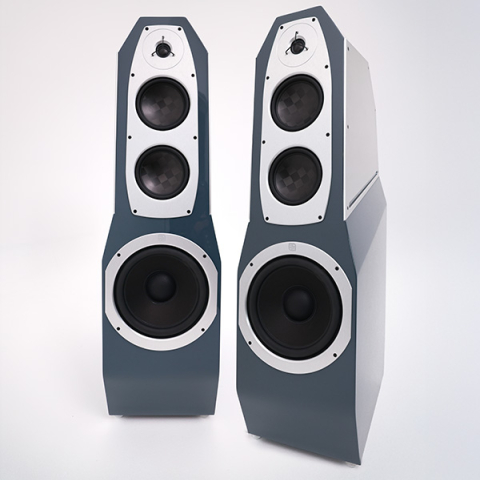
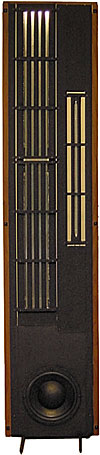
The 5'-tall, floorstanding LFT-VIII is similar in appearance to Acoustat's electrostatic/dynamic hybrids: a steel upper frame sided with two strips of nicely finished oak houses the side-by-side LFT midrange and LFT tweeter drivers, and is bolted atop a sealed box containing the 8" dynamic woofer. Since the frame and woofer enclosure are only 13" wide, the LFT-VIII is what we here in the Southern regions call a "tall, slim drink a' water." Located on the rear of the woofer enclosure are two sets of copper Edison Price Music Posts to allow bi-wiring, as well as a terminal block to allow the tweeter to be hooked up for flat response, –6dB at 20kHz, or –12dB at 20kHz.
Footnote 1: I do love the original Quad, though, and far prefer it to the ESL-63. When I grow up, I'm going to set up a room in my house with a pair of old Quads and some VTL Tiny Triodes, and I'm going to forget about hi-fi forever.
Footnote 2: While the Apogees' tweeters are true ribbon transducers, their mid/woofer panels are more akin to planar magnetics like the Magnepans.
Footnote 3: Bruce Thigpen's first speaker, the Eminent Technology LFT-III, was a full-range design using two versions (HF and LF/MF) of his LFT driver. It was favorably reviewed in Stereophile by Anthony H. Cordesman back in Vol.10 No.3, April/May 1987.—John Atkinson
"What's wrong with YOU, mac?! It's a free country! Or used to be, anyway—"
I'd had enough of the two of them; I pulled into a roadside hi-fi dealer and Dara and I went in while the arguing hitchhikers trailed after us, mumbling about ribbon tweeters.
We sat down at a table and a salesman came over to take our order.
"Do you know what you'd like?" he asked me. I looked at the menu, but I didn't see what I wanted.
"Yeah, I'd like a panel loudspeaker that doesn't sound sterile with rock'n'roll, and a black coffee." Then turning back to Dara, "As I was saying, I—"
What's the deal with panel speakers, anyway? Why does 99% of my favorite music sound so sterile and lifeless with even the best, most highly respected panel speakers? Take the Quad ESL-63, for example. It's got a Class B ranking in "Recommended Components," and most of our writers really dig it; one even uses it for his main reference. And JA made it his "Editor's Choice" component in 1992. But I have never been able to warm up to the sound of this speaker (footnote 1), or other large-panel jobs like the Magnepans, Martin-Logans, or Sound-Labs either. Every time I've tried to play some Who, Zeppelin, Otis Redding, Meters, Nirvana, or any other kind of high-energy groove music on these large-panel speakers, the sound is always, well, flat. Tame. DEAD. You want solo viola? A string quartet? Comin' right up! rock'n'roll? Next window, please...
At $1500/pair, Eminent Technology's LFT-VIII is the lowest-priced member of ET's stable of "Linear Field Transducer" speakers. What's a "Linear Field Transducer"? You had to ask... In the beginning was the electrostatic speaker. This planar pioneer employs a thin sheet of plastic stretched over a rigid frame, covered with a barely conductive coating, and sandwiched between two perforated steel plates called "stators," which are charged with a constant and very high DC voltage. When a music signal is applied to the diaphragm, it is both pushed and pulled toward the stators to produce sound waves. Examples of electrostatics include the Quads, Martin-Logans, Sound-Labs, and Acoustats.
It was these limitations of electrostatic and planar magnetic designs that drove ET's Bruce Thigpen to develop his patented "Linear Field Transducer" driver. The LFT employs a thin sheet of Mylar stretched between a rigid frame like the earlier two approaches, but instead of a conductive coating or glued-on wire voice-coil, the LFT's diaphragm is similar to the Infinity planar units in that it is first laminated with a very thin sheet of aluminum foil, then silk-screened with ink on the foil side with a spiral voice-coil pattern. After chemically etching away whatever aluminum isn't covered with the ink, the result is a low-mass diaphragm/voice-coil less than 1 mil thick.
The 5'-tall, floorstanding LFT-VIII is similar in appearance to Acoustat's electrostatic/dynamic hybrids: a steel upper frame sided with two strips of nicely finished oak houses the side-by-side LFT midrange and LFT tweeter drivers, and is bolted atop a sealed box containing the 8" dynamic woofer. Since the frame and woofer enclosure are only 13" wide, the LFT-VIII is what we here in the Southern regions call a "tall, slim drink a' water." Located on the rear of the woofer enclosure are two sets of copper Edison Price Music Posts to allow bi-wiring, as well as a terminal block to allow the tweeter to be hooked up for flat response, –6dB at 20kHz, or –12dB at 20kHz.
Footnote 1: I do love the original Quad, though, and far prefer it to the ESL-63. When I grow up, I'm going to set up a room in my house with a pair of old Quads and some VTL Tiny Triodes, and I'm going to forget about hi-fi forever.