Danish Audiophile Loudspeaker Industries (DALI), a relatively large maker of loudspeakers, was founded in 1982 by the peripatetic Peter Lyngdorf, who has worked with or founded Steinway/Lyngdorf, Lyngdorf Audio, TacT, NAD, etc. Audionord International, another company founded by Lyngdorf, owns DALI as well as American subsidiary DALI USA, along with yet another Lyngdorf creation: the 60 Hi-Fi Klubben stores, said to be the world's largest chain of high-end audio retail shops. Whew! The guy keeps busy.
 DALI began as a Hi-Fi Klubben house brand in 1982, and grew to become a much-sought independent speaker line. Older readers whose eardrums still ache from the speakers bearing such mediocre house brands as XAM (E.J. Korvette) and Studiocraft (Tech Hi-Fi) needn't worry: DALI is the real deal.
While DALI has maintained a relatively low profile in the US, it now distributes its extensive line of two- and 5.1-channel products in 56 countries, and reliably earns high marks from reviewers and consumers around the world for both performance and appearance. Like many speaker makers, DALI outsources the production of its drivers and cabinets. All research and design work is done in-house, as are final assembly and testing, which are accomplished by two-person teams instead of on an assembly line.
On a visit to Denmark a few years ago I spied DALI-bound cabinets at the world-renowned Hornslet factory and, at Vifa-ScanSpeak, long-grain wood and paper-fiber–coned woofers similar to those used in many DALI speakers. With premier resources such as those available in-country, why not take advantage of them?
Upgrade to Success
DALI began as a Hi-Fi Klubben house brand in 1982, and grew to become a much-sought independent speaker line. Older readers whose eardrums still ache from the speakers bearing such mediocre house brands as XAM (E.J. Korvette) and Studiocraft (Tech Hi-Fi) needn't worry: DALI is the real deal.
While DALI has maintained a relatively low profile in the US, it now distributes its extensive line of two- and 5.1-channel products in 56 countries, and reliably earns high marks from reviewers and consumers around the world for both performance and appearance. Like many speaker makers, DALI outsources the production of its drivers and cabinets. All research and design work is done in-house, as are final assembly and testing, which are accomplished by two-person teams instead of on an assembly line.
On a visit to Denmark a few years ago I spied DALI-bound cabinets at the world-renowned Hornslet factory and, at Vifa-ScanSpeak, long-grain wood and paper-fiber–coned woofers similar to those used in many DALI speakers. With premier resources such as those available in-country, why not take advantage of them?
Upgrade to Success
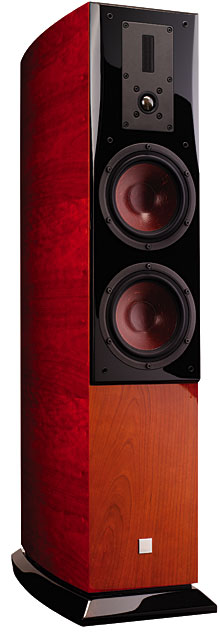
The Helicon speakers, the company's midpriced line, have been the biggest earners throughout DALI's history. The new Helicon 400 Mk.2 ($6300/pair) is an extensive reworking of the original Helicon 400. Like the original, the Mk.2 is a moderately sized (40.4" high by 10.6" wide by 19.8" deep), bass-reflex floorstander with two rear ports. Its lower-frequency drive-units are two 6.5"-cone woofers, with diaphragms made from coated wood pulp. These units are custom-made by Vifa-ScanSpeak and fitted with low-loss rubber surrounds. The new woofers used in the Mk.2 include double inverse magnet systems designed to improve magnetic flux density in the gap to better control cone excursion and thus reduce the original 400's excessive midbass bloom, as well as provide shielding for the speaker's use in video systems. DALI claims that the woofer cones' stiffness, light weight, and relatively shallow concavity help provide wideband response as well as good off-axis dispersion, and made it possible to simplify the design of the hardwired crossover. High frequencies are covered by a tweeter module comprising a 1" silk-dome tweeter and a 2" ribbon, variations of which are used throughout the DALI line. While the online spec sheet lists crossover points of 700Hz, 3kHz, and 13kHz, clearly only one woofer's response is limited to 700Hz. The other crosses over to the tweeter at 3kHz, thus providing double-woofered low-end heft while allowing one of them to extend throughout the midrange. In addition, the 1" tweeter extends from 3kHz to its upper limit (not specified but obviously beyond 20kHz), while the ribbon tweeter is high-pass filtered at 13kHz and extends to beyond 30kHz. So whether the Helicon 400 Mk.2 is a 2½-way or a 3-way design—or perhaps a 2½+½+½-way—is a matter of semantics and/or nomenclature. I call it a 3½-way.
The Mk.2 version also includes a biwirable set of double binding posts, and upgrades to the finish and crossover. DALI claims that the 88dB-sensitive 400 Mk.2 is amplifier-friendly, with a 4 ohm nominal impedance and a linear impedance curve said to not dip below 3 ohms. They also say that all their speakers exhibit "time coherence"—something many manufacturers claim but few speakers actually produce.
The extensively braced cabinet is made (though not by Hornslet) of laminated MDF. With its curvaceous, well-proportioned cabinet, real-wood veneer (Rosenut or Cherry) in high-gloss lacquer, and gloss-black front baffle plate and plinth, the Helicon 400 Mk.2 is a graceful, living-room–friendly loudspeaker that looks as if it costs far more than it does. In fact, during the entire listening period, for some reason I thought it cost not $6300, but $9000/pair.
Setup
DALI prides itself on producing wide-dispersion loudspeakers, thanks to both the woofer/midrange cone's contour and the hybrid tweeter module, whose ribbon's wide horizontal dispersion fills in at the upper frequencies, where the dome begins to "beam." Therefore, toe-in is neither necessary nor recommended unless the listening position is well off axis.
DALI recommends placing the Helicon 400 Mk.2s a minimum of 25" from the front wall and the same minimum distance from the sidewalls, and that the speakers and listening position should describe an equilateral triangle. That put them farther out into my room and somewhat closer together than I usually have speakers here, though by only a few inches. The 400 Mk.2s proved extremely room-friendly, with satisfactory imaging and tonal balance over a wide range of placement positions, though pushing them too close to the front wall did indeed produce a slight overabundance of lower midbass.
Once I'd got the Helicons properly positioned, I installed the supplied spikes. DALI recommends a break-in period (of unspecified length) before taking the speaker's full measure. I felt that two weeks of seven-hour listening days were sufficient, though the speakers sounded pleasing right out of the box, and even more so with their grilles on.
A Dazzling Experience
The Helicon 400 Mk.2s were every bit as open, airy, and spacious as DALI claims them to be, creating an unusually wide, wall-to-wall soundstage that also managed to produce generous depth. Height was not quite as expansive, though it was extremely well delineated within what the speaker did produce. Its subjectively smooth, wide dispersion helped the 400 Mk.2 convincingly "disappear" with ease, without creating concentrated hot spots at the speaker baffles.
With the lights out, the Helicon 400 Mk.2 produced a sensation of limitless space—as if my room's walls had been totally obliterated. If you like airy, 3D sonic rides, this speaker delivers them. It was easy to "see" well into the corners of well-recorded soundstages, and the speakers' ability to delineate events across that stage with great specificity of imaging was impressive.
The 400 Mk.2's spatial performance inspired me to spin many LPs that had been recorded at outdoor concerts, including the stupendous Ann Arbor Blues and Jazz Festival 1972 (45rpm, Atlantic/Classic SD-2 502), as well as a 1964 Japanese pressing of The Newport Folk Festival 1963, Vol.2 (Vanguard SH114), which includes Bob Dylan singing "Blowin' in the Wind" with a huge chorus that included Joan Baez, Peter, Paul and Mary, and many others, all arrayed across the stage. Man, what a spread—it sounded as big as all outdoors.
In fact, the Helicons believably reproduced the great outdoors over a wide lateral range of listening positions, placing each voice distinctly and cleanly on the stage. I've heard more body and solidity, but never a cleaner, more open array. If you think space is the final frontier, you'll like what DALI's tweeter combo of ribbon and soft dome does. Still, its wide dispersive abilities mean that you should be sure to tame the first reflection from the side walls in order to maintain focus and spatial coherence. When I stood up and moved around the room, the dome tweeter's generous vertical dispersion offset the HF beaming and extreme vertical rolloff typical of ribbon tweeters—but even so, the tweeter combo definitely sounded smoother, more extended, and better integrated with the woofers when I listened while sitting down.
The Helicon Mk.2's overall tonal balance was impressively smooth and free of glistening peaks, hollow-sounding suckouts, or obvious colorations. But either the upper-midrange presence region was slightly accentuated, or the midrange itself was slightly suppressed—this speaker was more about transient attack than harmonic richness and supple textures, and its overall balance was clearly on the slightly hot side in my well-damped room.
The low-frequency response was surprisingly robust and cleanly rendered down to around 30Hz. Bass notes were deep, tactile, well-controlled, and definitely did not sound mechanical. If there was any sort of deliberate midbass bump, it has been deftly applied and wasn't audible as such—double basses were nimble and well proportioned while still sounding generous and satisfying.
DALI began as a Hi-Fi Klubben house brand in 1982, and grew to become a much-sought independent speaker line. Older readers whose eardrums still ache from the speakers bearing such mediocre house brands as XAM (E.J. Korvette) and Studiocraft (Tech Hi-Fi) needn't worry: DALI is the real deal.
While DALI has maintained a relatively low profile in the US, it now distributes its extensive line of two- and 5.1-channel products in 56 countries, and reliably earns high marks from reviewers and consumers around the world for both performance and appearance. Like many speaker makers, DALI outsources the production of its drivers and cabinets. All research and design work is done in-house, as are final assembly and testing, which are accomplished by two-person teams instead of on an assembly line.
On a visit to Denmark a few years ago I spied DALI-bound cabinets at the world-renowned Hornslet factory and, at Vifa-ScanSpeak, long-grain wood and paper-fiber–coned woofers similar to those used in many DALI speakers. With premier resources such as those available in-country, why not take advantage of them?
The Helicon speakers, the company's midpriced line, have been the biggest earners throughout DALI's history. The new Helicon 400 Mk.2 ($6300/pair) is an extensive reworking of the original Helicon 400. Like the original, the Mk.2 is a moderately sized (40.4" high by 10.6" wide by 19.8" deep), bass-reflex floorstander with two rear ports. Its lower-frequency drive-units are two 6.5"-cone woofers, with diaphragms made from coated wood pulp. These units are custom-made by Vifa-ScanSpeak and fitted with low-loss rubber surrounds. The new woofers used in the Mk.2 include double inverse magnet systems designed to improve magnetic flux density in the gap to better control cone excursion and thus reduce the original 400's excessive midbass bloom, as well as provide shielding for the speaker's use in video systems. DALI claims that the woofer cones' stiffness, light weight, and relatively shallow concavity help provide wideband response as well as good off-axis dispersion, and made it possible to simplify the design of the hardwired crossover. High frequencies are covered by a tweeter module comprising a 1" silk-dome tweeter and a 2" ribbon, variations of which are used throughout the DALI line. While the online spec sheet lists crossover points of 700Hz, 3kHz, and 13kHz, clearly only one woofer's response is limited to 700Hz. The other crosses over to the tweeter at 3kHz, thus providing double-woofered low-end heft while allowing one of them to extend throughout the midrange. In addition, the 1" tweeter extends from 3kHz to its upper limit (not specified but obviously beyond 20kHz), while the ribbon tweeter is high-pass filtered at 13kHz and extends to beyond 30kHz. So whether the Helicon 400 Mk.2 is a 2½-way or a 3-way design—or perhaps a 2½+½+½-way—is a matter of semantics and/or nomenclature. I call it a 3½-way.
DALI prides itself on producing wide-dispersion loudspeakers, thanks to both the woofer/midrange cone's contour and the hybrid tweeter module, whose ribbon's wide horizontal dispersion fills in at the upper frequencies, where the dome begins to "beam." Therefore, toe-in is neither necessary nor recommended unless the listening position is well off axis.
The Helicon 400 Mk.2s were every bit as open, airy, and spacious as DALI claims them to be, creating an unusually wide, wall-to-wall soundstage that also managed to produce generous depth. Height was not quite as expansive, though it was extremely well delineated within what the speaker did produce. Its subjectively smooth, wide dispersion helped the 400 Mk.2 convincingly "disappear" with ease, without creating concentrated hot spots at the speaker baffles.