It must be difficult for makers of audio equipment to decide how to best exhibit their products at events such as the annual Consumer Electronics Show. If you're doing a demo, you want it to impress audio journalists and potential dealers, and sometimes just playing music is not enough: you need something extra. A few years ago, Joseph Audio put on a demo, supposedly of their top-of-the-line floorstanding speaker, during which Jeff Joseph removed a cloth that had been draped over what was assumed to be hotel-room furniture. Under that cloth were the speakers that were actually playing: Joseph's new in-wall model, mounted on flat baffles. Wilson Audio Specialties demonstrated their speakers with purportedly ultra-high-end electronics and digital source, then revealed that they were actually using a modestly priced preamp and power amp, and that the source was an Apple iPod.
 Such demos can be effective in convincing listeners that the speakers are better than their price would suggest, or that expensive speakers don't necessarily require correspondingly expensive electronics to make them sound good. However, they can also backfire: people, especially reviewers, don't like to be fooled, and their wrath is likely to be directed at the manufacturer. (I, of course, could instantly tell that there was something amiss.)
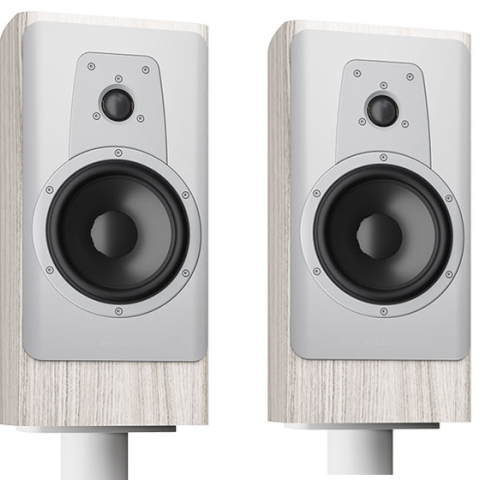
At the 2006 CES, Silverline Audio Technology demonstrated their diminutive, floorstanding Prelude loudspeaker in a manner designed to prove that their performance is well above what their size and price would indicate, but this demo involved no deception. The Preludes were set up in a system that used 600Wpc Pass amplifiers, and the demo featured a recording of a percussion ensemble played at a blow-the-man-down level. I expected to see the mid/woofer cones fly across the room. Instead, I heard clean, dynamic music. Impressed, I requested a pair for review.
Which Prelude?
Such demos can be effective in convincing listeners that the speakers are better than their price would suggest, or that expensive speakers don't necessarily require correspondingly expensive electronics to make them sound good. However, they can also backfire: people, especially reviewers, don't like to be fooled, and their wrath is likely to be directed at the manufacturer. (I, of course, could instantly tell that there was something amiss.)
At the 2006 CES, Silverline Audio Technology demonstrated their diminutive, floorstanding Prelude loudspeaker in a manner designed to prove that their performance is well above what their size and price would indicate, but this demo involved no deception. The Preludes were set up in a system that used 600Wpc Pass amplifiers, and the demo featured a recording of a percussion ensemble played at a blow-the-man-down level. I expected to see the mid/woofer cones fly across the room. Instead, I heard clean, dynamic music. Impressed, I requested a pair for review.
Which Prelude?
My auditioning of the Silverline Prelude proceeded in a routine way, with no problems such as drivers being wired out of phase or binding posts breaking when tightened. I set up the speakers in positions that I thought would work for them, listened, tweaked the setup, listened again, experimented with various associated components, listened some more, then wrote up the review and submitted it to John Atkinson. I was done with the Preludes.
Or so I thought. A few weeks later, before the review manuscript had gone through the normal editing process, I received an e-mail from Silverline's Alan Yun, designer of the Prelude. He informed me that some changes had been made in the speaker. The cabinet walls were now thicker; the two small rear ports had been replaced with a single larger one; the crossover was now mounted directly on the binding-post board, resulting in a shorter signal path; the plinth was made bigger to improve stability; and there were new, heavier-duty floor spikes. Such changes can have a substantial effect on a speaker's sound—it was clear that I'd have to listen to the revised model.
As it turned out, the Prelude had undergone other changes potentially even more important. These included a new tweeter (bigger magnet motor and coil, more refined protection grille), a new woofer (with double magnets, for greater sensitivity and power handling), and a redesign of the crossover to accommodate the driver and port changes. Now, you might think that so many changes would easily justify naming the revised model the "Mk.II" or "Series 2" or "Special Edition." Not so. (Apparently, very few pairs of the original Prelude were sold.) In this and the "Listening, Take 2" sections I refer to the first and second sets of review samples as "Original" and "Revised," respectively. "Listening, Take 1" is, nearly verbatim, the review's original "Listening" section.
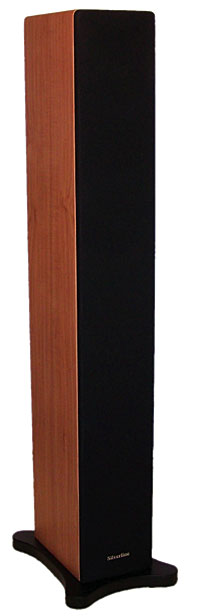
One thing the Original and Revised Preludes have in common is that they're small. If you place a paperback book atop one, borders of the speaker's top surface of only about ½" wide (Original) or ¾" wide (Revised) would still be visible. Although the Revised has thicker walls, the Original's interior dimensions have been retained (though for some reason the Revised is about ¾" shorter). The Original had brass binding posts, the Revised the familiar plastic ones; I first thought this was to comply with European safety rules, but an e-mail from Alan Yun informed me that the plastic posts were used only for the review samples; the production Reviseds will have brass posts. The wooden plinth (8¼" by 9" on the Original, 8¾" by 11½" on the Revised) attaches to the body of the speaker with heavy-duty bolts. Screw-in spikes are provided (the Revised's are thicker), but the user is warned not to install these until he or she is sure that the speaker positions are optimal. The Revised's cabinet has a "wraparound" construction, and while neither version will challenge the appearance of a Sonus Faber loudspeaker, the Revised gives a more upscale impression.
According to Alan Yun, design of the Prelude began in 2003, the aim being to produce a full-range, mini-floorstanding speaker that would satisfy "the most demanding audiophiles and music lovers where budget and space are of the most concern." The key to this was the design of a midrange/woofer with a lightweight but extremely rigid cone of aluminum-magnesium alloy. Two of these drive-units are used, with a 1" tweeter mounted in a woofer-tweeter-woofer arrangement. This type of design is often referred to as a D'Appolito array, but, unlike the classic D'Appolito design, which uses third-order crossovers, the Prelude uses a second-order crossover with the tweeter wired in inverted phase.
As noted earlier, the Revised's mid/woofer has a double magnet; examining the two versions side by side revealed that this driver's diameter is also a bit greater—about 3¾" vs 3½"—and that its mounting is more flared. The drivers, made in Taiwan to Silverline's specifications, are magnetically shielded. (Given the growing popularity of flat-panel displays, which, unlike CRTs, are immune to magnetic interference, I wonder if speaker manufacturers will phase out the magnetic shielding of drivers.) The Original's cabinet had two 1 3/8"-wide rear ports: these are replaced in the Revised with a single 1¾" port. The cabinet is constructed of high-density fiberboard: the side and rear panels are ½" thick in the Original, ¾" in the Revised; the baffle ¾" thick in the Original, 1" in the Revised. The cabinet is braced at critical points, and covered with Dacron over 50% of its internal surfaces. The internal wiring is pure-copper Silverline Audio Conductor, designed by Alan Yun. In a bow to "perceived value," biwire terminals are provided, though Yun says he prefers single wiring for its coherence. I used single wiring for all my listening.
Although Silverline tests its prototypes in an anechoic chamber, Yun's approach to loudspeaker design is based on listening rather than on measurements. "Anechoic chamber measurement tells you how the equipment measures in that environment, but it cannot tell you how sweet the sound is, how smooth, and how deep and wide the soundstage."
Setup
One advantage of having a speaker as small and light as the Prelude is that it's easy to move around—quite different from the likes of the Dunlavy SC-IVs and Avantgarde Unos that I'm used to. In the end, however, the Preludes sounded best when placed in pretty much the positions I've found to be optimal with other speakers: forming an approximately equilateral triangle with my listening seat, the speakers set up along the longer dimension of my 14' by 16' room, with dissimilar distances between the speakers and the front and sidewalls. The Preludes were toed-in, though not so much as to point directly at me. After I was satisfied with their positions, I installed the supplied screw-in spikes. The Prelude comes equipped with a grille, and the best thing I can say about it is that it's easily removed. The grille frame is made of ½"-thick MDF, with cutouts for the drivers, and the hard surface of the cutout right next to the tweeter looks like a recipe for producing diffraction. Indeed, with their grilles installed, the Preludes sounded much less open, almost muffled on top. I left the grilles off for all of my listening.
Such demos can be effective in convincing listeners that the speakers are better than their price would suggest, or that expensive speakers don't necessarily require correspondingly expensive electronics to make them sound good. However, they can also backfire: people, especially reviewers, don't like to be fooled, and their wrath is likely to be directed at the manufacturer. (I, of course, could instantly tell that there was something amiss.)
At the 2006 CES, Silverline Audio Technology demonstrated their diminutive, floorstanding Prelude loudspeaker in a manner designed to prove that their performance is well above what their size and price would indicate, but this demo involved no deception. The Preludes were set up in a system that used 600Wpc Pass amplifiers, and the demo featured a recording of a percussion ensemble played at a blow-the-man-down level. I expected to see the mid/woofer cones fly across the room. Instead, I heard clean, dynamic music. Impressed, I requested a pair for review.
Which Prelude?
My auditioning of the Silverline Prelude proceeded in a routine way, with no problems such as drivers being wired out of phase or binding posts breaking when tightened. I set up the speakers in positions that I thought would work for them, listened, tweaked the setup, listened again, experimented with various associated components, listened some more, then wrote up the review and submitted it to John Atkinson. I was done with the Preludes.
One advantage of having a speaker as small and light as the Prelude is that it's easy to move around—quite different from the likes of the Dunlavy SC-IVs and Avantgarde Unos that I'm used to. In the end, however, the Preludes sounded best when placed in pretty much the positions I've found to be optimal with other speakers: forming an approximately equilateral triangle with my listening seat, the speakers set up along the longer dimension of my 14' by 16' room, with dissimilar distances between the speakers and the front and sidewalls. The Preludes were toed-in, though not so much as to point directly at me. After I was satisfied with their positions, I installed the supplied screw-in spikes. The Prelude comes equipped with a grille, and the best thing I can say about it is that it's easily removed. The grille frame is made of ½"-thick MDF, with cutouts for the drivers, and the hard surface of the cutout right next to the tweeter looks like a recipe for producing diffraction. Indeed, with their grilles installed, the Preludes sounded much less open, almost muffled on top. I left the grilles off for all of my listening.