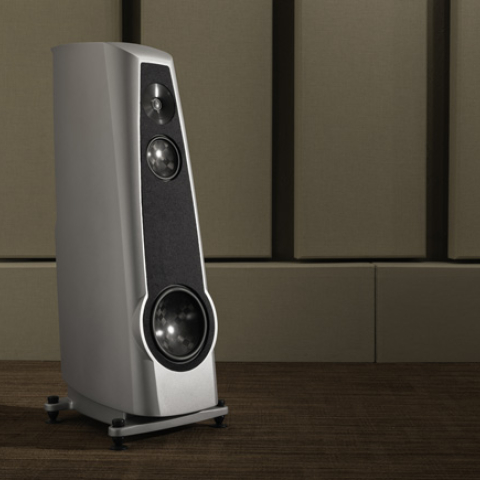
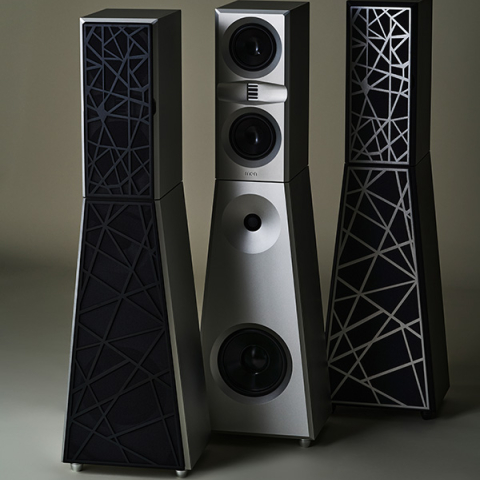
One of the highlights of such annual events as the Consumer Electronics and Primedia Home Entertainment shows has been the demonstrations of loudspeakers from TAD, the professional division of Pioneer Electronics. Designer Andrew Jones is always generous in using recordings brought by visitors, and enthusiastic in explaining the technology behind these beautiful behemoths. Among these speakers' unique features are a beryllium dome tweeter mounted concentrically inside a beryllium midrange cone, and a cabinet built of stacked, carved horizontal sections, for incredible rigidity without using exotic materials or excessive mass. The concentric upper-range driver is a reminder that, some time back, Jones worked for KEF, where the coaxial UniQ driver was developed, but the materials and details of the TAD drivers are all new. While the TAD Model 1s are always good for musical and audiophile thrills, their price is in the upper five figures, which put them out of serious purchase consideration.
 However, at the 2006 CES, I found Jones in the Pioneer room, just downstairs from the TAD room, demonstrating Pioneer's new EX speaker line, which is derived directly from the technology developed for the TAD products. That demo, of the stand-mounted S-2EX ($6000/pair), was very encouraging; the demo at HE2006 last May of the larger S-1EX ($9000/pair) convinced me that I had to get a pair for review.
Description
However, at the 2006 CES, I found Jones in the Pioneer room, just downstairs from the TAD room, demonstrating Pioneer's new EX speaker line, which is derived directly from the technology developed for the TAD products. That demo, of the stand-mounted S-2EX ($6000/pair), was very encouraging; the demo at HE2006 last May of the larger S-1EX ($9000/pair) convinced me that I had to get a pair for review.
Description
Some months later, two large transit cases, each the size of an armoire, appeared at my back door—along with Andrew Jones, who assisted in unloading them. That task was quite easy, and shortly I was alone with the S-1EXes.
Why they don't bear the TAD badge and its attendant cachet rather than the Pioneer logo with a fancified EX modifier is a long story that involves Pioneer's worldwide marketing decisions rather than any effort to distance themselves from the TAD name. Nonetheless, we've seen many mass marketers try to invade the High End with worthy products, only to fail because the typical audiophile couldn't bear to have a Sony or a Samsung nameplate. Heck, even the Japanese big three auto makers, Honda, Toyota, and Nissan, invented new names and distribution channels in recognition of the need to differentiate their high-end models from their regular lines. Let's hope that the S-1EX will be the exception to the rule; it will be sold through "selected" Pioneer EX dealers and is not simply a gussied-up mass-market box. It's a genuine effort to offer cutting-edge speaker technology at an affordable price. Of course, affordable is highly subjective, but an order-of-magnitude reduction in price from the TAD-1 is significant on anyone's scale.
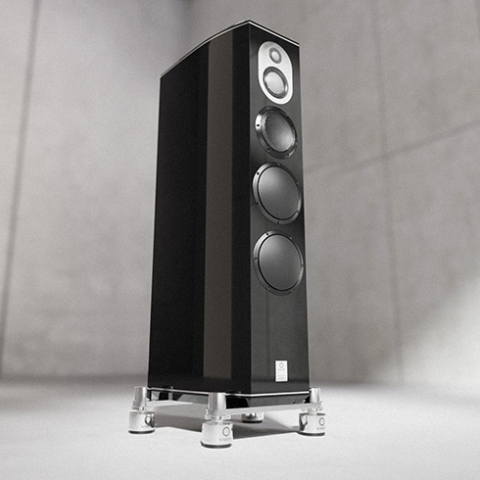
The S-1EX is a handsome black column with a subtly complex shape. Its cross section is almost trochoid—that is, its curve is generated by a point on the radius of a circle or the radius extended as the circle rolls on a fixed straight line—and the front and sides are gently convex. Jones maintains that the use of curved construction results in greater stiffness than would result from flat panels of the same thickness. The thickness of the panels ranges from 3" on parts of the front to 1.25" on the sides, which are built up from 1/8"-thick layers that are curved before being laminated together. The S-1EX comes mounted on a heavy base plate whose adjustable feet give the speaker a wide stance. With its feet flat on the ground, the cabinet leans slightly back and is absolutely stable. In addition, almost the entire front of the cabinet is deeply scooped out from top to bottom, with the drivers mounted in a vertical arc. This is done so that each driver is equidistant from and aimed directly at the listener.
And what special drivers these are! The coaxial tweeter-midrange—or, as Pioneer calls it, the Coherent Source Transducer (CST)—consists of a beryllium-dome tweeter that shares a dual-gapped neodymium magnet with a magnesium-coned midrange unit. (The TAD drivers use beryllium, with its high ratio of stiffness to mass, for both the tweeter and midrange.) The coaxial arrangement means that these two drivers essentially act as a single driver that provides controlled and symmetrical radiation for all frequencies from the low hundreds up to 100kHz. The S-1EX also has two 7" woofers with cones made of layers of aramid, carbon fiber, and polypropylene, with neodymium magnets and diecast aluminum chassis—all features of the TAD system as well. The complex, composite crossover uses series and parallel elements to divide the frequencies among the drivers, control their in-band frequency responses, and ensure that the overall system presents a sensible load to the amplifier.
To sum up: The S-1EX has four drivers in three chassis, vertically arranged on the front panel, below them an artfully sculpted 5" port. At the bottom of the rear panel are nice biamp terminals. There are no tone controls or doohickeys.
Sound
My first impression of the S-1EX was of clean, balanced sound, with the exception of some lumpiness in the bass that demanded that I experiment with the speakers' positions. Andrew Jones assisted with this, and before he left, the S-1Exs were positioned to his liking. However, I now thought they lacked a little in the bass. Over the next week or so, I moved them a bit farther from the sidewalls and toed them in a bit more to reach what sounded to me like smooth neutrality. I listened to them this way for quite a while before realizing that, when listening, I was always sitting much more erectly than mere alertness required. I placed a 5/8"-thick board under the rear feet of each speaker base so that the speakers themselves sat a bit straighter. (I could have adjusted the feet and gotten the same effect, but I'd already packed the provided tool away with the shipping cartons.) At my listening distance of about 14', this placed the axes of the CST drivers exactly at the level of my ears. That was it! At every musical task I set it, the S-1EX was simply outstanding. Most important, it was devoid of any identifiable tonal coloration through the mid to high frequencies. That, coupled with its great transparency and crisp transients, made it sound more like a full-range planar than a conventional box speaker. Like planars, it seemed to be able to throw the music into the room rather than let it expand backward behind the speaker plane. Unlike most planars, it was as good with the precision imaging of a single instrument—a solo violin, say—as with a full orchestra or choir. Whether the violin was off to the side, as in the opening solo in Fritz Reiner and the Chicago Symphony's recording of Rimsky-Korsakov's Scheherazade (SACD/CD, RCA Living Stereo 66377-2), or dead center, as in Julia Fischer's spectacular new performance of Tchaikovsky's Violin Concerto with Yakov Kreizberg and the Russian National Orchestra (SACD/CD, Pentatone PTC 5186 095), it was both dead stable in position and full-bodied in tone.
However, at the 2006 CES, I found Jones in the Pioneer room, just downstairs from the TAD room, demonstrating Pioneer's new EX speaker line, which is derived directly from the technology developed for the TAD products. That demo, of the stand-mounted S-2EX ($6000/pair), was very encouraging; the demo at HE2006 last May of the larger S-1EX ($9000/pair) convinced me that I had to get a pair for review.
Description
Some months later, two large transit cases, each the size of an armoire, appeared at my back door—along with Andrew Jones, who assisted in unloading them. That task was quite easy, and shortly I was alone with the S-1EXes.
My first impression of the S-1EX was of clean, balanced sound, with the exception of some lumpiness in the bass that demanded that I experiment with the speakers' positions. Andrew Jones assisted with this, and before he left, the S-1Exs were positioned to his liking. However, I now thought they lacked a little in the bass. Over the next week or so, I moved them a bit farther from the sidewalls and toed them in a bit more to reach what sounded to me like smooth neutrality. I listened to them this way for quite a while before realizing that, when listening, I was always sitting much more erectly than mere alertness required. I placed a 5/8"-thick board under the rear feet of each speaker base so that the speakers themselves sat a bit straighter. (I could have adjusted the feet and gotten the same effect, but I'd already packed the provided tool away with the shipping cartons.) At my listening distance of about 14', this placed the axes of the CST drivers exactly at the level of my ears. That was it! At every musical task I set it, the S-1EX was simply outstanding. Most important, it was devoid of any identifiable tonal coloration through the mid to high frequencies. That, coupled with its great transparency and crisp transients, made it sound more like a full-range planar than a conventional box speaker. Like planars, it seemed to be able to throw the music into the room rather than let it expand backward behind the speaker plane. Unlike most planars, it was as good with the precision imaging of a single instrument—a solo violin, say—as with a full orchestra or choir. Whether the violin was off to the side, as in the opening solo in Fritz Reiner and the Chicago Symphony's recording of Rimsky-Korsakov's Scheherazade (SACD/CD, RCA Living Stereo 66377-2), or dead center, as in Julia Fischer's spectacular new performance of Tchaikovsky's Violin Concerto with Yakov Kreizberg and the Russian National Orchestra (SACD/CD, Pentatone PTC 5186 095), it was both dead stable in position and full-bodied in tone.