Bonnie and I decided to avoid the crowds last weekend, and instead settled in at home to watch the recent remake of Great Expectations, with Ethan Hawke and Gwyneth Paltrow. It seemed like a pretty good movie, but before long I found my thoughts drifting to the review I had in progress: my audition and analysis of the Magnepan Magneplanar MG3.6/R. True, Great Expectations is a little slow, and a few explosions or car chases might have better held my attention, but if ever there was an audio product to which the phrase "great expectations" applied, it's the Magnepan 3.6/R. 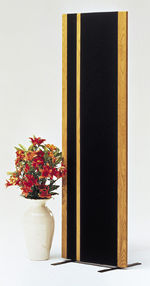 The MG3.6/R's immediate predecessor, the MG3.5/R, was a breakthrough product for Magnepan. It was a huge commercial success, and established a spectacular new level of performance for Magnepan in terms of dynamics and transparency. As if that weren't enough, the 3.6/R comes right on the heels of the MG1.6/QR, another huge success, and an industry-wide benchmark for performance in a $1500 loudspeaker. I reviewed the 1.6/QR in January 1999; it is the least expensive speaker in Class B of Stereophile's "Recommended Components," and one of the least expensive to ever appear there. Months before the MG3.6/R was even introduced at the 1999 WCES, a buzz permeated the Internet about "the new Magnepan," and I received a steady stream of e-mail messages asking about it. "Is the 3.6 as good as I've heard? Is it really all of the updates developed for the 1.6, now applied to the 3.5?" Nowhere were expectations greater than at Casa McKenzie-Damkroger. I've been listening to Magnepans evolve for two decades. I've admired their coherence and loved the uncanny way they could capture the sense of real instruments playing in a real space. Conversely, their lack of dynamics and slight opacity were always barriers between the music and me, barriers diminished in each succeeding generation, and nearly eliminated in the MG3.5/R and 1.6/R. Now comes the MG3.6/R, so maybe...?
Great expectations, indeed. Basic Technology: What is an MG3.6/R?
The MG3.6/R's immediate predecessor, the MG3.5/R, was a breakthrough product for Magnepan. It was a huge commercial success, and established a spectacular new level of performance for Magnepan in terms of dynamics and transparency. As if that weren't enough, the 3.6/R comes right on the heels of the MG1.6/QR, another huge success, and an industry-wide benchmark for performance in a $1500 loudspeaker. I reviewed the 1.6/QR in January 1999; it is the least expensive speaker in Class B of Stereophile's "Recommended Components," and one of the least expensive to ever appear there. Months before the MG3.6/R was even introduced at the 1999 WCES, a buzz permeated the Internet about "the new Magnepan," and I received a steady stream of e-mail messages asking about it. "Is the 3.6 as good as I've heard? Is it really all of the updates developed for the 1.6, now applied to the 3.5?" Nowhere were expectations greater than at Casa McKenzie-Damkroger. I've been listening to Magnepans evolve for two decades. I've admired their coherence and loved the uncanny way they could capture the sense of real instruments playing in a real space. Conversely, their lack of dynamics and slight opacity were always barriers between the music and me, barriers diminished in each succeeding generation, and nearly eliminated in the MG3.5/R and 1.6/R. Now comes the MG3.6/R, so maybe...?
Great expectations, indeed. Basic Technology: What is an MG3.6/R?
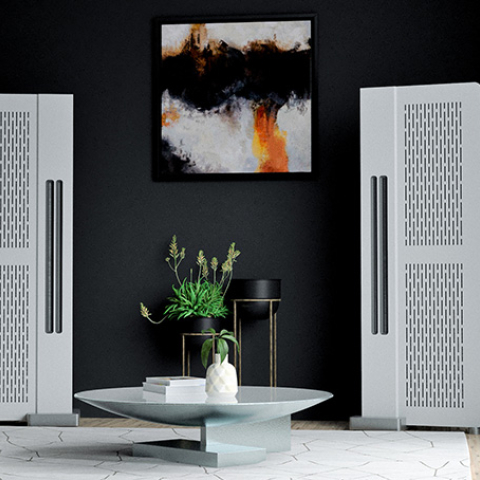
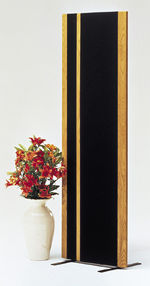
Several Magnepan loudspeakers have been covered in these pages, including two of the MG3.6/R's predecessors, the III and IIIA. The 3.6/R carries forward the same configuration, layout, and driver technology. It's a three-way design with crossover points of 200Hz and 1700Hz. The planar-magnetic driver is a 0.5-mil-thick Mylar diaphragm, onto different areas of which have been fastened separate, current-carrying wire grids for the bass and midrange. The top end is handled by Magnepan's unique, 55"-long ribbon—a true, free-standing ribbon in which the current-carrying aluminum ribbon is also the driving element. The 3.6/R is cosmetically identical to the 3.5/R: a slim, elegant tower approximately 6' tall by 2' wide by 1.5" deep. My pair was covered with an oatmeal-colored, open-weave fabric, with dark cherry strips flanking the panels and separating the tweeter and midrange-bass sections. The panels are mirror-imaged, with the planar-magnetic driver located to the inside in the recommended setup, and the ribbon tweeter to the outside (footnote 1). Connections (single or biwire) are made via banana plugs to an external crossover box that plugs into the panel's rear. Magnepan also makes an optional crossover for bi-amping, but I did all of my listening with the standard unit. Although it retains the 3.5/R's basic configuration, appearance, and driver technology, the 3.6/R differs slightly in some system parameters. The changes reflect both a response to perceived shortfalls in the 3.5/R and lessons learned in the successful transformation of the 1.5/QR into the giant-killer 1.6. The goals for the 3.6/R were to improve low bass power and articulation, smooth the in-room midbass smoothness, and better integrate the drivers. The first was accomplished by increasing the midrange panel's area from 170 to 199 in2, allowing the bass/midrange crossover point to be lowered, and the bass panel's tuning to be optimized for a narrower frequency range. Better integration and smoother in-room response were achieved primarily by careful optimization of the tensioning, damping, and partitioning of the diaphragm—the "black art" responsible for much of the transformation of the 1.5 into the 1.6.
Footnote 1: The tweeters should be slightly farther from the listener than the bass-midrange panel, so will be placed inboard or outboard, depending on distance and toe-in.
The MG3.6/R's immediate predecessor, the MG3.5/R, was a breakthrough product for Magnepan. It was a huge commercial success, and established a spectacular new level of performance for Magnepan in terms of dynamics and transparency. As if that weren't enough, the 3.6/R comes right on the heels of the MG1.6/QR, another huge success, and an industry-wide benchmark for performance in a $1500 loudspeaker. I reviewed the 1.6/QR in January 1999; it is the least expensive speaker in Class B of Stereophile's "Recommended Components," and one of the least expensive to ever appear there. Months before the MG3.6/R was even introduced at the 1999 WCES, a buzz permeated the Internet about "the new Magnepan," and I received a steady stream of e-mail messages asking about it. "Is the 3.6 as good as I've heard? Is it really all of the updates developed for the 1.6, now applied to the 3.5?" Nowhere were expectations greater than at Casa McKenzie-Damkroger. I've been listening to Magnepans evolve for two decades. I've admired their coherence and loved the uncanny way they could capture the sense of real instruments playing in a real space. Conversely, their lack of dynamics and slight opacity were always barriers between the music and me, barriers diminished in each succeeding generation, and nearly eliminated in the MG3.5/R and 1.6/R. Now comes the MG3.6/R, so maybe...? Several Magnepan loudspeakers have been covered in these pages, including two of the MG3.6/R's predecessors, the III and IIIA. The 3.6/R carries forward the same configuration, layout, and driver technology. It's a three-way design with crossover points of 200Hz and 1700Hz. The planar-magnetic driver is a 0.5-mil-thick Mylar diaphragm, onto different areas of which have been fastened separate, current-carrying wire grids for the bass and midrange. The top end is handled by Magnepan's unique, 55"-long ribbon—a true, free-standing ribbon in which the current-carrying aluminum ribbon is also the driving element. The 3.6/R is cosmetically identical to the 3.5/R: a slim, elegant tower approximately 6' tall by 2' wide by 1.5" deep. My pair was covered with an oatmeal-colored, open-weave fabric, with dark cherry strips flanking the panels and separating the tweeter and midrange-bass sections. The panels are mirror-imaged, with the planar-magnetic driver located to the inside in the recommended setup, and the ribbon tweeter to the outside (footnote 1). Connections (single or biwire) are made via banana plugs to an external crossover box that plugs into the panel's rear. Magnepan also makes an optional crossover for bi-amping, but I did all of my listening with the standard unit. Although it retains the 3.5/R's basic configuration, appearance, and driver technology, the 3.6/R differs slightly in some system parameters. The changes reflect both a response to perceived shortfalls in the 3.5/R and lessons learned in the successful transformation of the 1.5/QR into the giant-killer 1.6. The goals for the 3.6/R were to improve low bass power and articulation, smooth the in-room midbass smoothness, and better integrate the drivers. The first was accomplished by increasing the midrange panel's area from 170 to 199 in2, allowing the bass/midrange crossover point to be lowered, and the bass panel's tuning to be optimized for a narrower frequency range. Better integration and smoother in-room response were achieved primarily by careful optimization of the tensioning, damping, and partitioning of the diaphragm—the "black art" responsible for much of the transformation of the 1.5 into the 1.6.
Footnote 1: The tweeters should be slightly farther from the listener than the bass-midrange panel, so will be placed inboard or outboard, depending on distance and toe-in.