The Revel Ultima Studios came to me by chance. I'd wanted to review Revel's high-value Performa F-30—see my May 2000 report—but the Studio was offered instead. By the time a pair of Studios had arrived, however, the F-30s were also on their way, and the Studios were put on the back burner. Because of the mix-up, I thought the Studios would be freebies—just listen for a while and send 'em back. I am now obliged to do the honest thing and fess up in public: Many months have passed and the Studios are still here. 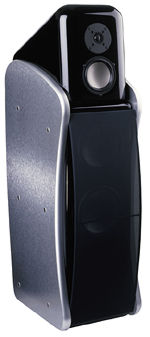 Theory
The Ultima Studio is Revel's second-largest speaker. Like the still larger Ultima Salon and the smaller Ultima Gem, it embodies all of the Revel philosophy while not costing as much as the other Ultima series. The observable and impressive components, including the cutting-edge driver construction, the sophisticated cabinetry, and the scrupulously accurate crossover networks, have been discussed before in this magazine, and more extensively on Revel's website, but the performance priorities that determine the design still demand adequate mention. Some months ago, but well after the Studios had been set up, I visited the Revel factory and learned of the psychoacoustic investigations that precede the design of their speakers. Harman International, of which Revel is a part, is a big enough company to support a lab dedicated to investigating loudspeaker performance through the study—in controlled experimental environments—of how trained listeners perceive the various parameters of sound reproduction. The Harman facility includes workstations where employees practice the identification and description of sounds, as well as a most impressive controlled-listening lab, all under the supervision of Floyd Toole and Sean Olive. Panels of trained listeners can compare prototype and production speakers and help determine the relative audibilities of distortions, frequency deviations, phase shifts, and variations in polar response. With these data it becomes possible to construct a hierarchy of parameters in terms of their acoustic importance, and to correlate variations of parameter magnitude with audibility. Thus, when Kevin Voecks, Revel's Director of Research and Technology, and head of engineering Domenic Buonincontri began to build actual speakers, they had a cost/benefit worksheet for the audibility of many of the performance criteria. They knew that, despite common intuition, narrowband (high Q) frequency deviations of relatively high amplitude color the sound less than broadband (low Q) deviations of lower amplitude. They knew that, in a real listening room, perfect on-axis frequency response is of little value if the off-axis response is loading the room (and the listener) with a highly irregular spectrum. They knew how the subjective satisfaction of reducing harmonic and intermodulation distortion to sub-threshold values was related to improvements in the phase response. They knew, too, at what point one important parameter had been made sufficiently good that it was time to concentrate on another. Because the consumer has to be able to afford the results, it's significant that Revel knew which priorities were meaningful, and where to focus its efforts (and Harman's money) when it came time to actually build something.
Reality
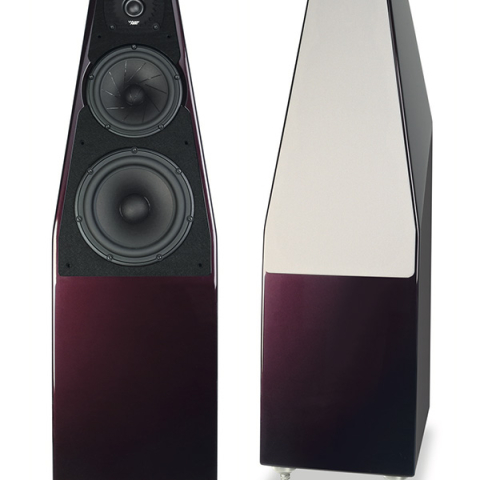
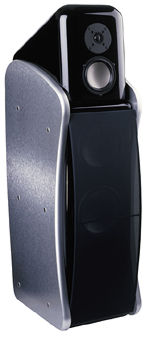
Despite all the cost/benefit analysis, no effort or expense seems to have been spared in the design and construction of the Revel Ultima Studio. Though each speaker is shipped in a large, heavy carton and the manual advises two strong men perform the task, unpacking and positioning a pair of Studios was an easy one-man job. Sonic Frontiers' unpacking procedure for their hefty Power-2 and Power-3 amps is exemplary, but Revel's is even better. Instructions on the outside of each carton indicate how to orient it and open the first flap. Relevant instructions were then revealed at each subsequent step until, lo and behold, I was able to walk and slide each 150-lb Studio into place all by myself. Revel's attention to such details was a harbinger of great things. My Studios, in gloss black with rosewood side panels, blend just fine with our mix of period and modern furniture. At least, that's what my wife says, and I'm happy to accept her opinion. The general quality of fit and finish is outstanding. Without spikes, the Studios were as solidly stable as some other spiked speakers; with spikes, they seemed welded to the floor.
Theory The Ultima Studio is Revel's second-largest speaker. Like the still larger Ultima Salon and the smaller Ultima Gem, it embodies all of the Revel philosophy while not costing as much as the other Ultima series. The observable and impressive components, including the cutting-edge driver construction, the sophisticated cabinetry, and the scrupulously accurate crossover networks, have been discussed before in this magazine, and more extensively on Revel's website, but the performance priorities that determine the design still demand adequate mention. Some months ago, but well after the Studios had been set up, I visited the Revel factory and learned of the psychoacoustic investigations that precede the design of their speakers. Harman International, of which Revel is a part, is a big enough company to support a lab dedicated to investigating loudspeaker performance through the study—in controlled experimental environments—of how trained listeners perceive the various parameters of sound reproduction. The Harman facility includes workstations where employees practice the identification and description of sounds, as well as a most impressive controlled-listening lab, all under the supervision of Floyd Toole and Sean Olive. Panels of trained listeners can compare prototype and production speakers and help determine the relative audibilities of distortions, frequency deviations, phase shifts, and variations in polar response. With these data it becomes possible to construct a hierarchy of parameters in terms of their acoustic importance, and to correlate variations of parameter magnitude with audibility. Thus, when Kevin Voecks, Revel's Director of Research and Technology, and head of engineering Domenic Buonincontri began to build actual speakers, they had a cost/benefit worksheet for the audibility of many of the performance criteria. They knew that, despite common intuition, narrowband (high Q) frequency deviations of relatively high amplitude color the sound less than broadband (low Q) deviations of lower amplitude. They knew that, in a real listening room, perfect on-axis frequency response is of little value if the off-axis response is loading the room (and the listener) with a highly irregular spectrum. They knew how the subjective satisfaction of reducing harmonic and intermodulation distortion to sub-threshold values was related to improvements in the phase response. They knew, too, at what point one important parameter had been made sufficiently good that it was time to concentrate on another. Because the consumer has to be able to afford the results, it's significant that Revel knew which priorities were meaningful, and where to focus its efforts (and Harman's money) when it came time to actually build something.
Despite all the cost/benefit analysis, no effort or expense seems to have been spared in the design and construction of the Revel Ultima Studio. Though each speaker is shipped in a large, heavy carton and the manual advises two strong men perform the task, unpacking and positioning a pair of Studios was an easy one-man job. Sonic Frontiers' unpacking procedure for their hefty Power-2 and Power-3 amps is exemplary, but Revel's is even better. Instructions on the outside of each carton indicate how to orient it and open the first flap. Relevant instructions were then revealed at each subsequent step until, lo and behold, I was able to walk and slide each 150-lb Studio into place all by myself. Revel's attention to such details was a harbinger of great things. My Studios, in gloss black with rosewood side panels, blend just fine with our mix of period and modern furniture. At least, that's what my wife says, and I'm happy to accept her opinion. The general quality of fit and finish is outstanding. Without spikes, the Studios were as solidly stable as some other spiked speakers; with spikes, they seemed welded to the floor.