You've probably seen the ad in Stereophile: a very personal account by Avantgarde-USA president Jim Smith, describing how, during a 30-year career in high-end audio, he had become increasingly disappointed with conventional loudspeakers' ability to communicate the emotional impact of live music, and how he found the answer with the Avantgarde horn loudspeakers. It's advertising copy in the best I-liked-it-so-much-I-bought-the-company tradition—with the exception that Smith did not actually buy Avantgarde Acoustic, but did become their North American distributor. 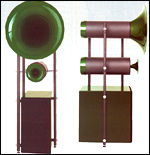 Stereophile's policy is to have total separation (a "Chinese wall," in publishing parlance) between the advertising and editorial departments: a manufacturer's status as an advertiser does not determine whether its products are reviewed, and has no influence on a review's content. However, all advertising is intended to draw the reader's attention to the product, and, in this reader's case, the Avantgarde ad certainly fulfilled its function. I was intrigued. The ad reminded me that I had spent a fair amount of time listening to some Avantgarde speakers (I'm not sure if they were the Unos or the Duos) at HI-FI '97 in San Francisco, and had thought then that if I were ever to review a horn speaker—a product category for which I previously felt little affinity—it would have to be an Avantgarde. Should I give an Avantgarde review more serious consideration now? Checking Avantgarde's website, I noted that the Uno and Duo had been revised within the past year, and that a new, higher-performance subwoofer was now standard with the Duo and optional with the Uno. It was looking more and more as if this might be a good time to review these speakers. All that remained was the phone call to reviewmeister Jonathan Scull (who promptly gave approval to the project) and to decide whether to go for the Uno or the Duo. The Duo (although not the latest version) had already been reviewed by Martin Colloms in Vol.21 No.6, and the Uno is said to be more suited to smaller listening rooms, like mine. After a discussion with Jim Smith, I decided to go with the Uno, but with the upgraded SUB225 CTRL PRO subwoofer. My adventure in the world of horns was about to begin.
Description and Design
Stereophile's policy is to have total separation (a "Chinese wall," in publishing parlance) between the advertising and editorial departments: a manufacturer's status as an advertiser does not determine whether its products are reviewed, and has no influence on a review's content. However, all advertising is intended to draw the reader's attention to the product, and, in this reader's case, the Avantgarde ad certainly fulfilled its function. I was intrigued. The ad reminded me that I had spent a fair amount of time listening to some Avantgarde speakers (I'm not sure if they were the Unos or the Duos) at HI-FI '97 in San Francisco, and had thought then that if I were ever to review a horn speaker—a product category for which I previously felt little affinity—it would have to be an Avantgarde. Should I give an Avantgarde review more serious consideration now? Checking Avantgarde's website, I noted that the Uno and Duo had been revised within the past year, and that a new, higher-performance subwoofer was now standard with the Duo and optional with the Uno. It was looking more and more as if this might be a good time to review these speakers. All that remained was the phone call to reviewmeister Jonathan Scull (who promptly gave approval to the project) and to decide whether to go for the Uno or the Duo. The Duo (although not the latest version) had already been reviewed by Martin Colloms in Vol.21 No.6, and the Uno is said to be more suited to smaller listening rooms, like mine. After a discussion with Jim Smith, I decided to go with the Uno, but with the upgraded SUB225 CTRL PRO subwoofer. My adventure in the world of horns was about to begin.
Description and Design
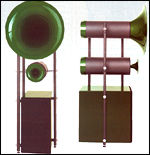
As horn fans are wont to point out, the first loudspeaker (Emile Berliner's) was a horn, and horns have an inherent advantage over any other type of loudspeaker in their ability to produce the most sound with the least electrical input. Horn critics counter that while efficiency was important when amplifier outputs were restricted to the 2-5W range, high efficiency is no longer required now that much more powerful amplifiers are available, and that horns' high efficiency comes at the price of colorations (frequency-response and phase anomalies) that detract from the accuracy of reproduction. Avantgarde's response to these criticisms is that, regardless of available power, horns' high efficiency confers benefits in dynamics and low distortion, and that careful design can reduce horn colorations to a negligible level. The Avantgarde speakers feature a spherical horn construction, which is said to yield exceptional uniformity and integration of the response in the vertical and horizontal planes. The horn is made of ABS, a material chosen for its neutral resonance behavior, resistance to temperature- and humidity-induced changes, and because it can be manufactured to close tolerances—all factors that are critical to performance. The only downside is that the manufacturing process is quite expensive.
Stereophile's policy is to have total separation (a "Chinese wall," in publishing parlance) between the advertising and editorial departments: a manufacturer's status as an advertiser does not determine whether its products are reviewed, and has no influence on a review's content. However, all advertising is intended to draw the reader's attention to the product, and, in this reader's case, the Avantgarde ad certainly fulfilled its function. I was intrigued. The ad reminded me that I had spent a fair amount of time listening to some Avantgarde speakers (I'm not sure if they were the Unos or the Duos) at HI-FI '97 in San Francisco, and had thought then that if I were ever to review a horn speaker—a product category for which I previously felt little affinity—it would have to be an Avantgarde. Should I give an Avantgarde review more serious consideration now? Checking Avantgarde's website, I noted that the Uno and Duo had been revised within the past year, and that a new, higher-performance subwoofer was now standard with the Duo and optional with the Uno. It was looking more and more as if this might be a good time to review these speakers. All that remained was the phone call to reviewmeister Jonathan Scull (who promptly gave approval to the project) and to decide whether to go for the Uno or the Duo. The Duo (although not the latest version) had already been reviewed by Martin Colloms in Vol.21 No.6, and the Uno is said to be more suited to smaller listening rooms, like mine. After a discussion with Jim Smith, I decided to go with the Uno, but with the upgraded SUB225 CTRL PRO subwoofer. My adventure in the world of horns was about to begin. As horn fans are wont to point out, the first loudspeaker (Emile Berliner's) was a horn, and horns have an inherent advantage over any other type of loudspeaker in their ability to produce the most sound with the least electrical input. Horn critics counter that while efficiency was important when amplifier outputs were restricted to the 2-5W range, high efficiency is no longer required now that much more powerful amplifiers are available, and that horns' high efficiency comes at the price of colorations (frequency-response and phase anomalies) that detract from the accuracy of reproduction. Avantgarde's response to these criticisms is that, regardless of available power, horns' high efficiency confers benefits in dynamics and low distortion, and that careful design can reduce horn colorations to a negligible level. The Avantgarde speakers feature a spherical horn construction, which is said to yield exceptional uniformity and integration of the response in the vertical and horizontal planes. The horn is made of ABS, a material chosen for its neutral resonance behavior, resistance to temperature- and humidity-induced changes, and because it can be manufactured to close tolerances—all factors that are critical to performance. The only downside is that the manufacturing process is quite expensive.