I can't resist reading about a company's flagship loudspeaker—the price-no-object product that embodies the most advanced ideas from a company's research and design department. Flagship loudspeakers tend to be large, heavy, and complex, and are designed to perform best in large rooms; often, each part of each driver is hand-built to the highest level of quality, with precisely tight tolerances. The cost? Don't ask. Some two-channel, audio-only flagships cost more than a BMW M5 sports sedan or a Porsche 911.  But the cutting-edge technology, extraordinary craftsmanship, and price-no-object performance make a flagship loudspeaker the stuff audiophile dreams are made on. So when the opportunity arose to review the Evidence, the flagship speaker from Danish company Dynaudio, I eagerly agreed. The Evidence
Dynaudio took six years to develop of the Evidence, and, unlike some "statement" designs, the Evidence is a real product: Dynaudio's president, Wilfried Ehrenholz, reports that the company has sold 75 pairs of Evidences in the speaker's first year of existence. From the beginning, Ehrenholz and Mark Allan Thorup, manager of R&D, sought to design a very large dynamic loudspeaker system for large listening rooms. Although there were a number of specific design goals—high power handling, no coloration, precise bass response, damping of resonances, excellent transient response, large dynamic range, and low distortion—one of the most important was the control of vertical dispersion. Large listening environments are vulnerable to detail-obscuring room reflections. Dynaudio's design team knew that the proportion of these secondary reflections to side-wall reflections contributed from the floor increases the farther back the listener moves from the loudspeaker. They found that a tall, narrow column provided better control of vertical dispersion, with minimal floor reflections when listen to from 7m to 14m (23' to 46') away. They determined that with such an enclosure shape, standing and sitting listeners should hear exactly the same musical qualities.
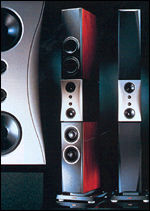
The resulting design, the Evidence, is a three-way, floorstanding tower system with eight transducers: two tweeters and two 6" midrange drivers in an MTTM configuration, surrounded by four 8" woofers—two above, two below—in separate cabinets that lock together. The top and bottom bass cabinets are each 30" high, while the central tweeter/midrange block is only 18" high. Assembled on the matching pedestal, they form a tall, thin column 82" tall, 9½" wide, and 22" deep—a big loudspeaker weighing 297 lbs and with a bass-cabinet volume of 106 liters. But its very narrow profile, stabilized by a low but massive, 17.5"-square baseplate, prevents a pair of Evidences from visually dominating a large room. The tweeter/midbass center section is sealed, while the upper and lower bass units are reflex-aligned, each with a port opening to the rear. Besides the ports, the bottom section's rear panel features two finely machined, very substantial WBT gold-plated binding posts for speaker cables, complete with special spades. The Evidence's drivers were all designed in-house to Mark Allan Thorup's exacting specifications. "It's like the engine in Formula 1 cars," said Wilfried Ehrenholz. "Every dynamic driver in the Evidence is brought to the limits of its design." The 28mm dome tweeters use a 40mm aluminum-alloy front panel, integrated into the mid-section's aluminum block front baffle. Each tweeter employs a long, pure-aluminum wire voice-coil with magnetic-fluid cooling and a vented pole-piece. A 72mm-long neodymium magnet is used in the tweeter to give it high sensitivity. The 6" midranges employ a one-piece molded polypropylene cone and a pure aluminum voice-coil. Each of the four woofers features an 8", one-piece, molded-polypropylene cone, a 75mm pure-aluminum wire voice-coil, and large amounts of neodymium magnet material for high sensitivity.
Much attention has been paid to cabinet and driver construction and crossover tuning. The removable crossover module slides on tracks into a ventilated chamber within the tweeter-midrange housing, and can be easily removed for factory modification or upgrade. It uses large-gauge, multiwire inductors hand-wound to tolerances of less than 1%. Resistors are low-inductance, low-capacitance, wire-wound types with high heat stability. The fast-pulse, metal-film polypropylene capacitors are wired into double-thickness, multi-layered, Fiberglas-reinforced printed circuit boards with extra-thick copper traces. All internal cables are made of high-purity, silver-coated, matched-crystal, oxygen-free copper. Mark Thorup's crossover design employs first-order slopes but uses eight different crossover frequencies so that the Evidence's multiple drive-units don't all see the same signal. Only one of the tweeters, for example, handles the full range of high frequencies. As a result, the vertical dispersion is uniform across the speaker's frequency range.
But the cutting-edge technology, extraordinary craftsmanship, and price-no-object performance make a flagship loudspeaker the stuff audiophile dreams are made on. So when the opportunity arose to review the Evidence, the flagship speaker from Danish company Dynaudio, I eagerly agreed. The Evidence Dynaudio took six years to develop of the Evidence, and, unlike some "statement" designs, the Evidence is a real product: Dynaudio's president, Wilfried Ehrenholz, reports that the company has sold 75 pairs of Evidences in the speaker's first year of existence. From the beginning, Ehrenholz and Mark Allan Thorup, manager of R&D, sought to design a very large dynamic loudspeaker system for large listening rooms. Although there were a number of specific design goals—high power handling, no coloration, precise bass response, damping of resonances, excellent transient response, large dynamic range, and low distortion—one of the most important was the control of vertical dispersion. Large listening environments are vulnerable to detail-obscuring room reflections. Dynaudio's design team knew that the proportion of these secondary reflections to side-wall reflections contributed from the floor increases the farther back the listener moves from the loudspeaker. They found that a tall, narrow column provided better control of vertical dispersion, with minimal floor reflections when listen to from 7m to 14m (23' to 46') away. They determined that with such an enclosure shape, standing and sitting listeners should hear exactly the same musical qualities.