In the Beginning Was the Word...
At first blush, the sound of the Vandersteen Model 2Ce Signature transported me to a bucolic nature trail in the Berkshires on one of those high, dry August days when the amber stillness of late afternoon imparts a sense of otherness against the endless vistas of green and brown and blue. In my Wordsworthian reverie, as I made my way up the mountainside, remembrances of venerable loudspeakers past called out to me from the sturdy stands of New England foliage. Mark you the lofty maple and the supple white birch; the noble pine, the mighty oak and humble larch; there, on the crest, an Acoustic Research AR3a; farther up the ridge, a copse of Advent, KLH, and Allison—and finally, high on yonder peak, beckoning like God's own flip-top, crush-proof box, the Vandersteen 2Ce Signature.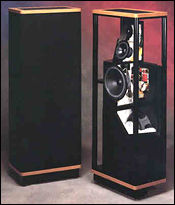 There is something enduring and reassuring in the classic audio verities. Consider the pleasure we continue to derive from our venerable analog technologies, evolving and prospering as they continue to do in the teeth of the long digital gale. Journeying back in time to the 1960s, one might readily identify such abiding paradigms of loudspeaker performance as the remarkably open, detailed Quad ESL-57 and the eminently euphonic, musical Acoustic Research AR3a. I cut my teeth on the soft highs, mellow midrange, and plump bass of the acoustic suspension AR3a—the quintessence of the New England sound. And though the Vandersteen 2Ce Signature is as distinct from the AR3a in execution and design as night is from day, I suspect that if you plotted the family tree forward a decade or two, you could make a case for the 2Ce as the AR's literal descendant—but with a more extended frequency response, a more focused low end, and more refined performance. But that's just one man's opinion. Richard the Lion Roars
In conversation with Richard Vandersteen, one is inevitably moved by his charismatic self-confidence and his earnest sense of mission—an audio maverick paddling furiously upstream against the prevailing currents of the high-end aesthetic. I asked him to delineate the philosophy underlying the design of the 2Ce: "We're actually time machines more than we are amplitude machines," Richard explains. "So I decided—and I didn't know whether time or phase mattered—that the waveform was darn important, and that I had better be prudent and preserve that waveform in space."
Taking Richard Vandersteen back some 30 years down memory lane in the search for the aural antecedents to his sound, I was surprised to discover that, during a stretch in the military just before he developed the fundamental design of his Model 2, he'd actually purchased a pair of Quad ESLs. "The New England sound was basically sweet, more natural than what the JBLs were doing at the time—as were the Quads, of course. The AR3a's were nice and full and correct in the bass; they had a midrange that tended to be level with the woofer, and if you measure the tweeters, they were not rolled off—they were actually pretty flat in energy response. They just didn't get the leading edge because the cone was in controlled breakup, and they had no way to make them flat out to 20kHz; whereas the JBLs took the midrange and the tweeter and literally shoved it in your face—they were anywhere from 3dB to 10dB louder than the woofer.
At first blush, the sound of the Vandersteen Model 2Ce Signature transported me to a bucolic nature trail in the Berkshires on one of those high, dry August days when the amber stillness of late afternoon imparts a sense of otherness against the endless vistas of green and brown and blue. In my Wordsworthian reverie, as I made my way up the mountainside, remembrances of venerable loudspeakers past called out to me from the sturdy stands of New England foliage. Mark you the lofty maple and the supple white birch; the noble pine, the mighty oak and humble larch; there, on the crest, an Acoustic Research AR3a; farther up the ridge, a copse of Advent, KLH, and Allison—and finally, high on yonder peak, beckoning like God's own flip-top, crush-proof box, the Vandersteen 2Ce Signature.
There is something enduring and reassuring in the classic audio verities. Consider the pleasure we continue to derive from our venerable analog technologies, evolving and prospering as they continue to do in the teeth of the long digital gale. Journeying back in time to the 1960s, one might readily identify such abiding paradigms of loudspeaker performance as the remarkably open, detailed Quad ESL-57 and the eminently euphonic, musical Acoustic Research AR3a. I cut my teeth on the soft highs, mellow midrange, and plump bass of the acoustic suspension AR3a—the quintessence of the New England sound. And though the Vandersteen 2Ce Signature is as distinct from the AR3a in execution and design as night is from day, I suspect that if you plotted the family tree forward a decade or two, you could make a case for the 2Ce as the AR's literal descendant—but with a more extended frequency response, a more focused low end, and more refined performance. But that's just one man's opinion. Richard the Lion Roars In conversation with Richard Vandersteen, one is inevitably moved by his charismatic self-confidence and his earnest sense of mission—an audio maverick paddling furiously upstream against the prevailing currents of the high-end aesthetic. I asked him to delineate the philosophy underlying the design of the 2Ce: "We're actually time machines more than we are amplitude machines," Richard explains. "So I decided—and I didn't know whether time or phase mattered—that the waveform was darn important, and that I had better be prudent and preserve that waveform in space."