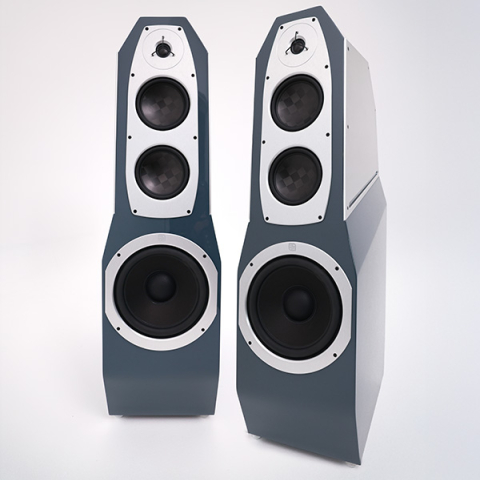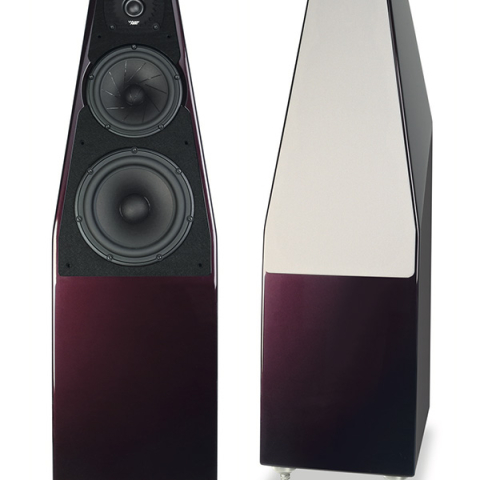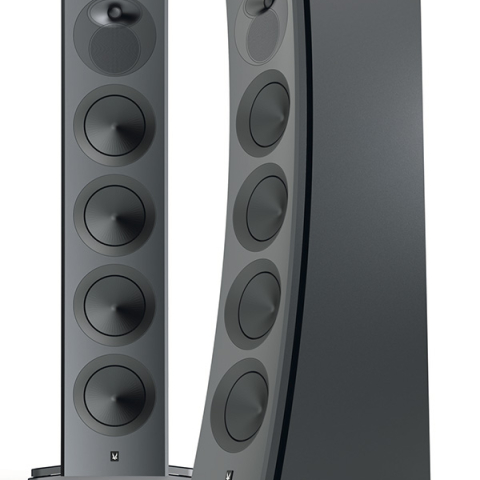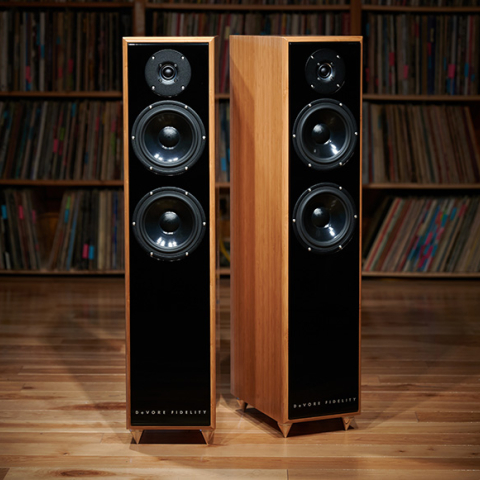
I first met Jacques Mahul (the JM in JMlab/Focal) when my wife Kathleen and I traveled to Paris to cover HiFi (Hee-Fee) '96. The sound produced by the JMlab Grand Utopias—on a collection of many-chassis'd YBA electronics—got my enthusiastic vote for best of show (footnote 1). JMlab's large demo room was always packed to the rafters with avid listeners. (As a group, melomanes, as audiophiles are called in France, exactly mirror their stateside brethren in appearance and general demeanor. Yes, they're a raucous and demanding bunch!)  As I gleefully accepted a bottle of JMlab Sauternes from Jacques Mahul, he casually mentioned plans for a smaller version of the Grand Utopia, to be known "merely" as the Utopia. Well, they say bigger isn't always better... The new Utopia made its debut at Stereophile's Hee-Fee '97 in San Francisco. I was impressed with their sound, and we made arrangements for the Grand Utopia's yonger "sister" (footnote 2) to be delivered to our listening room in New York. The Utopia is undeniably elegant and sculptural, despite its weight of 275 lbs per side. The cabinetry and finish are truly extraordinary. The central enclosure is finished in Porsche "911 Carrera" lacquer, with side panels fashioned of anigre, an exotic African wood. The mid/high-range enclosure is encased in solid tauri, another exotic, from the South American forests. The drivers are designed to run uncovered and are supplied without conventional grillecovers. However, each speaker comes with a pair of snap-on wooden panels to protect the drivers when not in use. This is sure to keep the lucky owner in touch with the sensual delights of using such a finely crafted device. (It's hard to say which was more pleasurable: adjusting the Nagra PL-P preamplifier's modulometer and flicking its sexy buttons, or embracing the Utopias when snapping on their covers!) Although striking in appearance, the Utopia didn't shout "high tech" at me. Nevertheless, its design embodies a myriad of bleeding-edge technical achievements. At first glance, the speaker appears to be one large unit, and a fairly wide one at that. Closer examination reveals that each speaker actually comprises four separate enclosures joined at the rear. From the literature: "The search for the greatest neutrality and least mechanical interaction between the drivers has given rise to an original concept based on totally self-contained enclosures. In the Utopia, each driver has its own load volume. This creates total immunity from the cross-modulation problems that inevitably arise from single-volume designs."
As you might imagine, these aren't ordinary enclosures. They're built up of 1"-thick MDF, then clad with another 1.2" thickness of anigre. In addition to "numerous reinforcements," the inner walls of the bass and midrange enclosures are further damped with lead strips 6" wide and 0.1" thick. Two huge WBT binding posts sit at tweeter height on the rear of the cabinet—no bi-wire option is available. The crossover is positioned just behind the binding posts in an isolated chamber, its cover held in place by a vast array of screws. (The tweeter is battened-down from the inside of this chamber; no screwheads mar the lovely tauri-wood frontage. The crossover is also the result of meticulous attention to detail and implementation. This includes polypropylene capacitors, close-tolerance resistors, and large-diameter air-core inductors with low series resistance to minimize insertion loss. The slopes are third-order. Mahul: "The crossover networks are classic, fairly simple designs. It's important to understand that we don't try to compensate for the defects of the driver in the crossover—they must always work together in concert." Wiring is entirely point-to-point, and components are soldered directly to one another; no printed circuit boards are employed. (The same technique is used chez YBA.) Mahul: "Long sessions of critical listening revealed that circuit boards induce capacitive and inductive artifacts that disturbed the high definition and coherence of the sound." All internal connections are made with JMlab's own 6mm-square-section LCOFC pure copper cable.
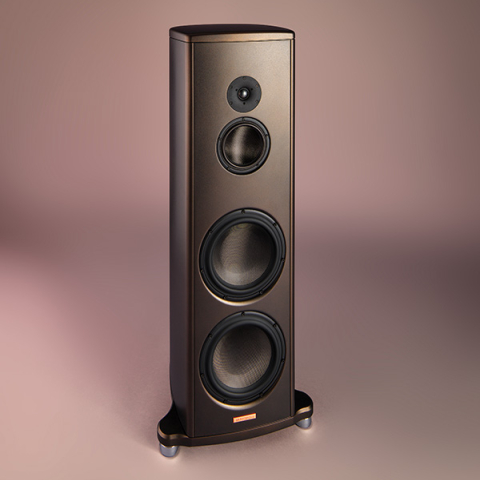
As I gleefully accepted a bottle of JMlab Sauternes from Jacques Mahul, he casually mentioned plans for a smaller version of the Grand Utopia, to be known "merely" as the Utopia. Well, they say bigger isn't always better... The new Utopia made its debut at Stereophile's Hee-Fee '97 in San Francisco. I was impressed with their sound, and we made arrangements for the Grand Utopia's yonger "sister" (footnote 2) to be delivered to our listening room in New York. The Utopia is undeniably elegant and sculptural, despite its weight of 275 lbs per side. The cabinetry and finish are truly extraordinary. The central enclosure is finished in Porsche "911 Carrera" lacquer, with side panels fashioned of anigre, an exotic African wood. The mid/high-range enclosure is encased in solid tauri, another exotic, from the South American forests. The drivers are designed to run uncovered and are supplied without conventional grillecovers. However, each speaker comes with a pair of snap-on wooden panels to protect the drivers when not in use. This is sure to keep the lucky owner in touch with the sensual delights of using such a finely crafted device. (It's hard to say which was more pleasurable: adjusting the Nagra PL-P preamplifier's modulometer and flicking its sexy buttons, or embracing the Utopias when snapping on their covers!) Although striking in appearance, the Utopia didn't shout "high tech" at me. Nevertheless, its design embodies a myriad of bleeding-edge technical achievements. At first glance, the speaker appears to be one large unit, and a fairly wide one at that. Closer examination reveals that each speaker actually comprises four separate enclosures joined at the rear. From the literature: "The search for the greatest neutrality and least mechanical interaction between the drivers has given rise to an original concept based on totally self-contained enclosures. In the Utopia, each driver has its own load volume. This creates total immunity from the cross-modulation problems that inevitably arise from single-volume designs."
As you might imagine, these aren't ordinary enclosures. They're built up of 1"-thick MDF, then clad with another 1.2" thickness of anigre. In addition to "numerous reinforcements," the inner walls of the bass and midrange enclosures are further damped with lead strips 6" wide and 0.1" thick. Two huge WBT binding posts sit at tweeter height on the rear of the cabinet—no bi-wire option is available. The crossover is positioned just behind the binding posts in an isolated chamber, its cover held in place by a vast array of screws. (The tweeter is battened-down from the inside of this chamber; no screwheads mar the lovely tauri-wood frontage. The crossover is also the result of meticulous attention to detail and implementation. This includes polypropylene capacitors, close-tolerance resistors, and large-diameter air-core inductors with low series resistance to minimize insertion loss. The slopes are third-order. Mahul: "The crossover networks are classic, fairly simple designs. It's important to understand that we don't try to compensate for the defects of the driver in the crossover—they must always work together in concert." Wiring is entirely point-to-point, and components are soldered directly to one another; no printed circuit boards are employed. (The same technique is used chez YBA.) Mahul: "Long sessions of critical listening revealed that circuit boards induce capacitive and inductive artifacts that disturbed the high definition and coherence of the sound." All internal connections are made with JMlab's own 6mm-square-section LCOFC pure copper cable.
Footnote 1: The Grand Utopia was very favorably reviewed in Stereophile by Jack English in May 1996 (Vol.19 No.5).—JA
Footnote 2: As JMlab refers to it, C'est toujours "cherchez la femme" avec les Français!
As I gleefully accepted a bottle of JMlab Sauternes from Jacques Mahul, he casually mentioned plans for a smaller version of the Grand Utopia, to be known "merely" as the Utopia. Well, they say bigger isn't always better... The new Utopia made its debut at Stereophile's Hee-Fee '97 in San Francisco. I was impressed with their sound, and we made arrangements for the Grand Utopia's yonger "sister" (footnote 2) to be delivered to our listening room in New York. The Utopia is undeniably elegant and sculptural, despite its weight of 275 lbs per side. The cabinetry and finish are truly extraordinary. The central enclosure is finished in Porsche "911 Carrera" lacquer, with side panels fashioned of anigre, an exotic African wood. The mid/high-range enclosure is encased in solid tauri, another exotic, from the South American forests. The drivers are designed to run uncovered and are supplied without conventional grillecovers. However, each speaker comes with a pair of snap-on wooden panels to protect the drivers when not in use. This is sure to keep the lucky owner in touch with the sensual delights of using such a finely crafted device. (It's hard to say which was more pleasurable: adjusting the Nagra PL-P preamplifier's modulometer and flicking its sexy buttons, or embracing the Utopias when snapping on their covers!) Although striking in appearance, the Utopia didn't shout "high tech" at me. Nevertheless, its design embodies a myriad of bleeding-edge technical achievements. At first glance, the speaker appears to be one large unit, and a fairly wide one at that. Closer examination reveals that each speaker actually comprises four separate enclosures joined at the rear. From the literature: "The search for the greatest neutrality and least mechanical interaction between the drivers has given rise to an original concept based on totally self-contained enclosures. In the Utopia, each driver has its own load volume. This creates total immunity from the cross-modulation problems that inevitably arise from single-volume designs." Footnote 1: The Grand Utopia was very favorably reviewed in Stereophile by Jack English in May 1996 (Vol.19 No.5).—JA