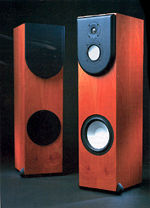
I visited the Revel room on the last day of the January 1999 CES, expecting another dynamic demo of their Ultima line. Instead, I found a pair of floorstanding Performa F30s connected to a rack full of the best Mark Levinson electronics. Deeply impressed by the dynamics and clarity of this first model in the new Performa line, I called Revel's Kevin Voecks as soon as I got back to New York City, but was told that another Stereophile reviewer had already got first dibs on the F30. Would I be interested in one of the other Revels? Well, yes, sure, but... 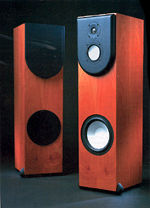 A pair of Revel's Ultima Studios were already on their way to my house when I bumped into Jonathan Scull at a concert. He casually mentioned that the other reviewer had had to cancel on the F30. What? Turn back the truck! (Too late.) Sign me up for the F30, please! So this review is about a year late, and F30s are already flying out of local audio emporia as fast as they come in. It's not hard to see why. The F30 is a floorstanding, three-way speaker of generous but not imposing size. It carries over from the Ultima line Revel's ideas about radiation characteristics, low distortion, and driver design. The latter is immediately apparent in the F30's 5.25" inverted magnesium-cone midrange, a direct descendant of the Ultima's darker-colored titanium cone. In addition, the 1" aluminum-dome tweeter is a machine-made relative of the Ultima's handmade tweeters. The bottom end is served by a potent 10" inverted aluminum cone. The crossovers are, as in the F30's Ultima brothers, 24dB/octave types to optimize the on- and off-axis responses in the vertical and horizontal planes. The three drivers are mounted in a vertical row on the front panel. The F30 is a clean-edged rectangular prism scrupulously finished on all sides in rosewood veneer, but with little of the Ultimas' expensive shaping and forming. The F30 sits on four little black aluminum feet with plastic inserts that provide non-scratch support during the placement ritual. When the speaker's final resting place is determined, spikes can be inserted: points down for carpeted floors, points up for hard floors. Four hefty, gold-plated binding posts on the back panel make biwiring possible, and a tweeter-level control with ±1dB adjustment in 0.5dB steps accompanies the terminals on the rear escutcheon. The middle of the back panel has a large flared fitting at the opening of the tuned port. A careful internal physical examination revealed that the inner end of the port is similarly flared. Very nice.
The results of all these efforts are depicted in the F30's specs (see "Description"), which Revel maintains are more predictive of real-world performance than simple on-axis measurements. What I find interesting is the "tightness" of all the specs—from ±0.75dB to ±1.5dB—across the bandwidth, and the great similarity between the in-room response (which integrates all the sound arriving at the listening position in a typical room) and the first-reflections response (a measure of the early-arriving but indirect sound from the side walls, floor, and ceiling). This says that the direct sound from the speakers and the sound bounced off room surfaces before reaching the listener's ears have similar tonal balances. Thus, the F30's wide radiation pattern across the spectrum should provide balanced sound over a wide area of the room, and not restrict the listener to a small "sweet spot." However, the tonal balance of the indirect sounds is influenced by the acoustic properties of the surrounding surfaces, and this is more significant than for a speaker like the F30 than one with a narrow dispersion pattern, such as a dipole. The predicted tradeoff is more relaxed listening in return for careful speaker positioning. Sounds like a good deal to me.
A pair of Revel's Ultima Studios were already on their way to my house when I bumped into Jonathan Scull at a concert. He casually mentioned that the other reviewer had had to cancel on the F30. What? Turn back the truck! (Too late.) Sign me up for the F30, please! So this review is about a year late, and F30s are already flying out of local audio emporia as fast as they come in. It's not hard to see why. The F30 is a floorstanding, three-way speaker of generous but not imposing size. It carries over from the Ultima line Revel's ideas about radiation characteristics, low distortion, and driver design. The latter is immediately apparent in the F30's 5.25" inverted magnesium-cone midrange, a direct descendant of the Ultima's darker-colored titanium cone. In addition, the 1" aluminum-dome tweeter is a machine-made relative of the Ultima's handmade tweeters. The bottom end is served by a potent 10" inverted aluminum cone. The crossovers are, as in the F30's Ultima brothers, 24dB/octave types to optimize the on- and off-axis responses in the vertical and horizontal planes. The three drivers are mounted in a vertical row on the front panel. The F30 is a clean-edged rectangular prism scrupulously finished on all sides in rosewood veneer, but with little of the Ultimas' expensive shaping and forming. The F30 sits on four little black aluminum feet with plastic inserts that provide non-scratch support during the placement ritual. When the speaker's final resting place is determined, spikes can be inserted: points down for carpeted floors, points up for hard floors. Four hefty, gold-plated binding posts on the back panel make biwiring possible, and a tweeter-level control with ±1dB adjustment in 0.5dB steps accompanies the terminals on the rear escutcheon. The middle of the back panel has a large flared fitting at the opening of the tuned port. A careful internal physical examination revealed that the inner end of the port is similarly flared. Very nice.
The results of all these efforts are depicted in the F30's specs (see "Description"), which Revel maintains are more predictive of real-world performance than simple on-axis measurements. What I find interesting is the "tightness" of all the specs—from ±0.75dB to ±1.5dB—across the bandwidth, and the great similarity between the in-room response (which integrates all the sound arriving at the listening position in a typical room) and the first-reflections response (a measure of the early-arriving but indirect sound from the side walls, floor, and ceiling). This says that the direct sound from the speakers and the sound bounced off room surfaces before reaching the listener's ears have similar tonal balances. Thus, the F30's wide radiation pattern across the spectrum should provide balanced sound over a wide area of the room, and not restrict the listener to a small "sweet spot." However, the tonal balance of the indirect sounds is influenced by the acoustic properties of the surrounding surfaces, and this is more significant than for a speaker like the F30 than one with a narrow dispersion pattern, such as a dipole. The predicted tradeoff is more relaxed listening in return for careful speaker positioning. Sounds like a good deal to me.
A pair of Revel's Ultima Studios were already on their way to my house when I bumped into Jonathan Scull at a concert. He casually mentioned that the other reviewer had had to cancel on the F30. What? Turn back the truck! (Too late.) Sign me up for the F30, please! So this review is about a year late, and F30s are already flying out of local audio emporia as fast as they come in. It's not hard to see why. The F30 is a floorstanding, three-way speaker of generous but not imposing size. It carries over from the Ultima line Revel's ideas about radiation characteristics, low distortion, and driver design. The latter is immediately apparent in the F30's 5.25" inverted magnesium-cone midrange, a direct descendant of the Ultima's darker-colored titanium cone. In addition, the 1" aluminum-dome tweeter is a machine-made relative of the Ultima's handmade tweeters. The bottom end is served by a potent 10" inverted aluminum cone. The crossovers are, as in the F30's Ultima brothers, 24dB/octave types to optimize the on- and off-axis responses in the vertical and horizontal planes. The three drivers are mounted in a vertical row on the front panel. The F30 is a clean-edged rectangular prism scrupulously finished on all sides in rosewood veneer, but with little of the Ultimas' expensive shaping and forming. The F30 sits on four little black aluminum feet with plastic inserts that provide non-scratch support during the placement ritual. When the speaker's final resting place is determined, spikes can be inserted: points down for carpeted floors, points up for hard floors. Four hefty, gold-plated binding posts on the back panel make biwiring possible, and a tweeter-level control with ±1dB adjustment in 0.5dB steps accompanies the terminals on the rear escutcheon. The middle of the back panel has a large flared fitting at the opening of the tuned port. A careful internal physical examination revealed that the inner end of the port is similarly flared. Very nice.