In this age of $70,000-plus "flagship" designs, perhaps $25k is no longer an obscene amount to pay for a pair of loudspeakers. Still, it's mucho dinero. What makes a speaker worth this kind of bread? Does the product's intrinsic value really warrant such a lofty cost, or is it merely a matter of pricing at what the market will bear? The answers to these questions requires careful examination of not only the speaker, but also of the buyer's own soul, priorities, and pocketbook.  Signature SC-VI
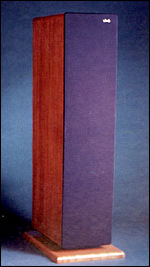
The Signature SC-VI is probably the most "anti-tweak" flagship high-end speaker ever made. Its design methodology flies in the face of some of the most cherished audiophile principles: the more expensive the part, the better the sound; voicing is critical to true high-end results; and only human ears can determine if a product is good. Its designer, John Dunlavy, believes that if you comprehensively test the proper sonic parameters, you can scientifically design a speaker that is superior to any speaker designed by only intuitive methods. Like almost all of John Dunlavy's designs, the Signature SC-VI speaker features a sealed enclosure. Rather than figuring out a way around Hoffman's iron law (footnote 1) by using a vent, duct, port, transmission line, or some other kludge, a Dunlavy speaker's bass extension is determined by the size of its enclosure and its internal damping material. Dunlavy believes that if you want deep bass, the only phase-correct way to achieve this is with a large box. The SC-VI's huge enclosure is made of laminated layers of veneered MDF varying in thickness from 3/4" to 3". Weighing 530 lbs, it might be thought to be a big box filled with sand, but it's actually a series of boxes connected by internal braces. Each set of drivers is housed in its own separate subenclosure. The weight of the Signature VI is the result of copious amounts of MDF used for both bracing and internal enclosures. There isn't a single grain of sand in the box!
Rather than try to shape the Signature VI's cabinet to minimize the effects of early reflections, John Dunlavy chose to damp the cabinet's front surfaces with soft material. Using various thicknesses of felt cloth—a process for which, on 9/18/79, he was granted US patent #4,167,985—he aimed to achieve virtually inaudible cabinet diffraction effects. The Dunlavy SC-VI drive-units aren't merely arranged in a symmetrical array, but in a "time-/path-aligned" array. Not only are the drivers vertically mirror-arranged—tweeter in the center, woofers at top and bottom—but the physically shallower drive-units are set back so that the sound from all the drivers will arrive at a particular distance at the same time. The setbacks are what makes this symmetrical array into a true point-source. The drive-unit array is focused for a minimum listening and testing distance of 10'. While there are many speakers on the market with symmetrical arrays and others with "time-aligned" drive-unit setbacks, none are quite like the Dunlavy designs.
Footnote 1: Devised by one of the founders of KLH, this mathematical formula spells out just how much bass can be generated by a speaker of a specific cabinet size.
Signature SC-VI The Signature SC-VI is probably the most "anti-tweak" flagship high-end speaker ever made. Its design methodology flies in the face of some of the most cherished audiophile principles: the more expensive the part, the better the sound; voicing is critical to true high-end results; and only human ears can determine if a product is good. Its designer, John Dunlavy, believes that if you comprehensively test the proper sonic parameters, you can scientifically design a speaker that is superior to any speaker designed by only intuitive methods. Like almost all of John Dunlavy's designs, the Signature SC-VI speaker features a sealed enclosure. Rather than figuring out a way around Hoffman's iron law (footnote 1) by using a vent, duct, port, transmission line, or some other kludge, a Dunlavy speaker's bass extension is determined by the size of its enclosure and its internal damping material. Dunlavy believes that if you want deep bass, the only phase-correct way to achieve this is with a large box. The SC-VI's huge enclosure is made of laminated layers of veneered MDF varying in thickness from 3/4" to 3". Weighing 530 lbs, it might be thought to be a big box filled with sand, but it's actually a series of boxes connected by internal braces. Each set of drivers is housed in its own separate subenclosure. The weight of the Signature VI is the result of copious amounts of MDF used for both bracing and internal enclosures. There isn't a single grain of sand in the box!
Footnote 1: Devised by one of the founders of KLH, this mathematical formula spells out just how much bass can be generated by a speaker of a specific cabinet size.