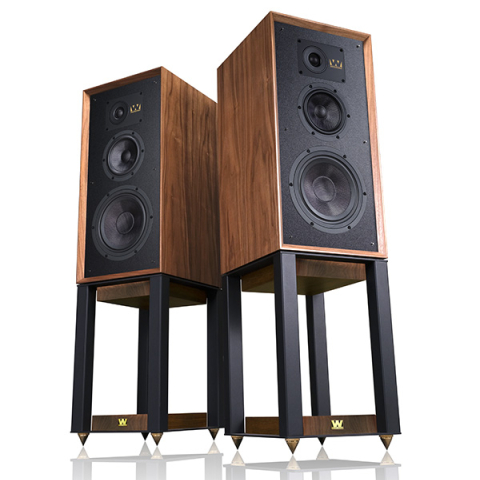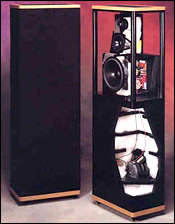
The Vandersteen 3A is a higher-end variation on the theme established by the company's first loudspeaker, the 2C. The latter is still available, though much updated into the current, highly popular 2Ce. A four-way design, the 3A has separate sub-enclosures for each drive unit; the whole affair is covered with a knit grille-cloth "sock" with wood trim end pieces. A rear-mounted metal brace allows the user to vary the tiltback—an important consideration for best performance with this loudspeaker. 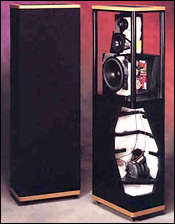 Both the VCC-1 center channel and the thinner VSM-1 surrounds (non-dipole) use a similar coaxial, two-way driver. Such a design will, in theory, result in a more uniform dispersion pattern-particularly important in a center channel. The VCC-1 also incorporates a switch that will modify the frequency response to compensate for the effects of nearby walls. I left it off in my listening.
  Vandersteen uses an unusual hook-up method for its 2W subwoofer. A passive high-pass filter is placed at the input to the main loudspeaker amplifiers; the woofer signal is tapped from the output of these amplifiers, and the bass of the 2W is boosted in the latter's own amplifier to make up for the high-pass bass rolloff at the main amps. Since this is the only recommended method of connection, the 2W is probably best used to supplement Vandersteen's own loudspeakers. The 2W has a level control but no other user adjustments. The 3As in Stereo
When I reviewed the Vandersteen 3As for Stereophile (Vol.18 No.4, April 1995), I commented on their smooth, sweet sound—a sound more forgiving than analytical. Nonetheless, they revealed plenty about associated equipment. As with all loudspeakers, especially high-end designs, careful system matching with the 3As paid real dividends. Properly set up, the sound of the Vandersteens had genuine openness and detail to go with their fundamental, natural warmth. It combined a pristinely clean top end and a clean, clear, yet subtly shaded midrange. Soundstaging was precise, though better focused with a slight toe-in to the left and right loudspeakers rather than the straight-ahead setup recommended by Vandersteen.
Moreover, the 3As had real weight in the bass, handling virtually everything I could throw at them with aplomb. Only an occasional challenge caused them difficulty—the opening drumstrokes on the CD soundtrack from Jurassic Park (MCA), for example. On video-based material, in fact, Vandersteen recommends a subwoofer (or two), and I concur. Vandersteen's own 2W subwoofers only extend slightly deeper into the bottom octave than the 3As by themselves, but significantly increase the overall dynamic range capability of the system.
Both the VCC-1 center channel and the thinner VSM-1 surrounds (non-dipole) use a similar coaxial, two-way driver. Such a design will, in theory, result in a more uniform dispersion pattern-particularly important in a center channel. The VCC-1 also incorporates a switch that will modify the frequency response to compensate for the effects of nearby walls. I left it off in my listening. Vandersteen uses an unusual hook-up method for its 2W subwoofer. A passive high-pass filter is placed at the input to the main loudspeaker amplifiers; the woofer signal is tapped from the output of these amplifiers, and the bass of the 2W is boosted in the latter's own amplifier to make up for the high-pass bass rolloff at the main amps. Since this is the only recommended method of connection, the 2W is probably best used to supplement Vandersteen's own loudspeakers. The 2W has a level control but no other user adjustments. The 3As in Stereo When I reviewed the Vandersteen 3As for Stereophile (Vol.18 No.4, April 1995), I commented on their smooth, sweet sound—a sound more forgiving than analytical. Nonetheless, they revealed plenty about associated equipment. As with all loudspeakers, especially high-end designs, careful system matching with the 3As paid real dividends. Properly set up, the sound of the Vandersteens had genuine openness and detail to go with their fundamental, natural warmth. It combined a pristinely clean top end and a clean, clear, yet subtly shaded midrange. Soundstaging was precise, though better focused with a slight toe-in to the left and right loudspeakers rather than the straight-ahead setup recommended by Vandersteen.