It is the audio writer's nightmare that the combination of the large number of exhibitors at a Consumer Electronics Show and the very limited amount of time the Show's doors are open will lead him to miss the event's biggest story. I came close to living that nightmare last January, at the 2007 CES, when I realized that I had missed an entire floor of Las Vegas's Venetian Hotel. And it was, of course, the floor where, among other high-profile high-end companies, Sumiko was debuting the Cremona Elipsa from Italian speaker manufacturer Sonus Faber.
 I rushed up to the Venetian's penthouse floor, where I was just in time to get a demo of the speaker before the Show closed for the evening. Of course, my camera's memory card turned out to be full, so I couldn't include a photo with our live coverage, but, as I reported then, the sound of the new speaker was extremely impressive. I asked for a pair of Elipsas for review once the speaker was in production, and they arrived at the end of May. I settled down for a summer of serious listening.
Cremona Elipsa
I rushed up to the Venetian's penthouse floor, where I was just in time to get a demo of the speaker before the Show closed for the evening. Of course, my camera's memory card turned out to be full, so I couldn't include a photo with our live coverage, but, as I reported then, the sound of the new speaker was extremely impressive. I asked for a pair of Elipsas for review once the speaker was in production, and they arrived at the end of May. I settled down for a summer of serious listening.
Cremona Elipsa
Sonus Faber's Cremona line of speakers comes in at lower prices than their top Homage and Anniversario models; the latters' stunning, hand-lacquered, seven-layer, deep-gloss finishes are replaced in the Cremonas with a semi-matte finish. Even so, these are still handsome speakers; when I reviewed the original Cremona in March 2004, I was very much taken by the combination of well-balanced sound and excellent fit'n'finish at a very affordable price of $7495/pair (back in those far-off days of a strong US dollar and a weak euro). I very much agreed with Sam Tellig that the Cremona's sound was "sweet, smooth, completely free from grain" (January 2003).
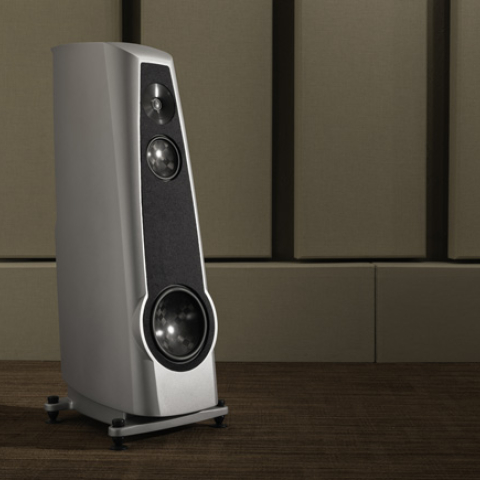
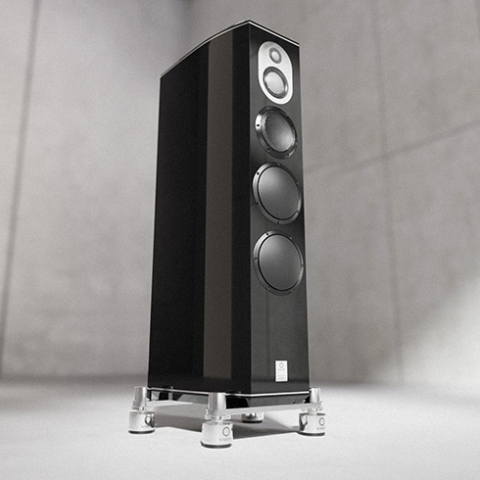
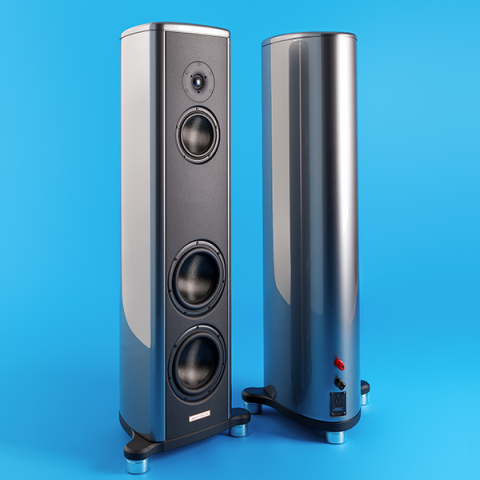
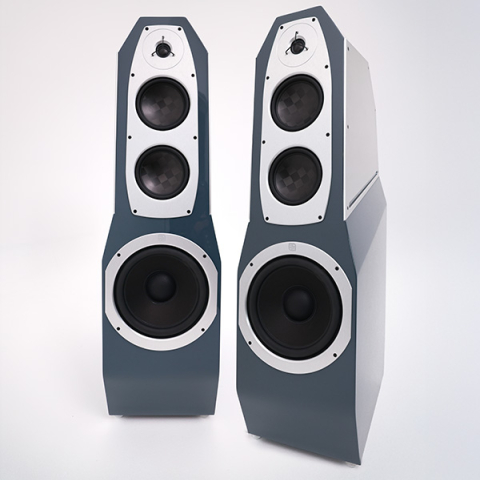
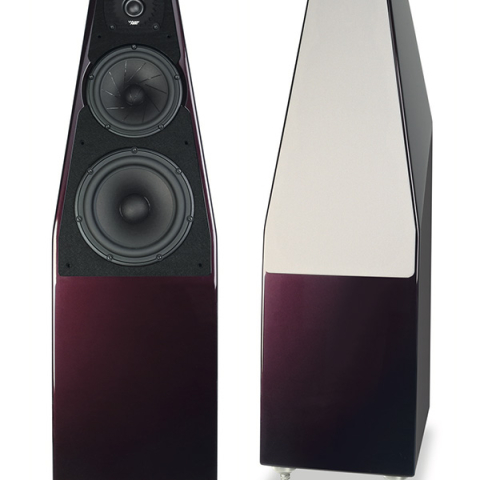
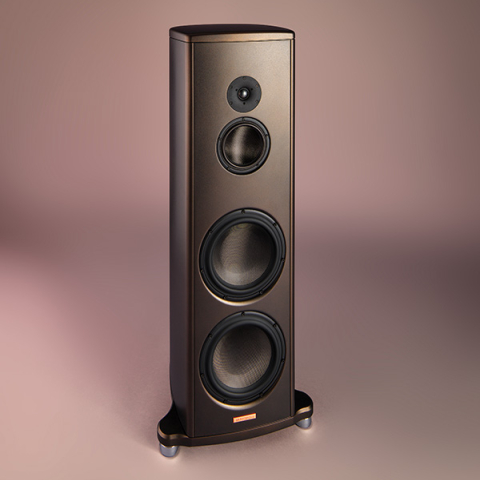
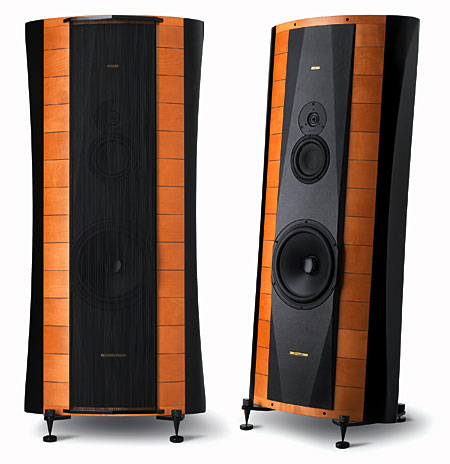
At $20,800/pair, the Cremona Elipsa is significantly more expensive than the original Cremona. While similarly finished, it is a much larger loudspeaker, its shape echoing the top-of-the-line Stradivari Homage, which Michael Fremer reviewed in the January 2005 issue. Rather than the Cremona's lute-shaped, narrow but deep cabinet, the Elipsa's enclosure is wide and shallow, its plan section (from above) being, naturally enough, an ellipse. The cabinet is constructed from layers of wood joined with a polymer glue that provides internal damping and is reinforced with internal ribs. The center of the front baffle is covered from base to top with black leather, and flanked with panels of naturally polished maple. The side panels are finished in semigloss black with concave cutaways that lend an elegant edge to the speaker's appearance. As with all Sonus Faber speakers, the grille consists of silicone-rubber cords covered in black silk and vertically strung from top to bottom of the baffle at low tension, to ensure that any vibrations are well below the audioband.
The Elipsa is a three-way design. A 1" ring-radiator tweeter sits 36" from the floor, mounted very close above a 6" pulp-cone midrange driver, the diaphragm of which has a concave dustcap to continue the smooth profile. The midrange driver handles a wide range, 250Hz –2.3kHz, and is acoustically loaded within its own elliptically shaped subenclosure, this vented to the speaker's rear with a 2.25"-diameter port. Whereas the Cremona has twin 6" woofers, the Elipsa uses a single 10" woofer, the cone of which is formed from an alloy of magnesium and aluminum. This driver is acoustically loaded by two 3"-diameter flared ports on the cabinet rear and, rather than a dustcap, has a stationary metal phase plug on the front of its central pole piece.
The crossover is specified as using second-order slopes. Electrical connection is via a single pair of high-quality binding posts at the base of the cabinet rear, beneath the lowest of the three ports and set, like them, on a leather-covered panel. The black metal bottom plate can be fitted with spikes of differing lengths front and back to allow the speaker to be raked back.
Sonus Sonics
The Elipsas were set up in my room by Sumiko principal John Hunter. As he had when setting up the Cremonas and the Amati anniversarios (which I reviewed in May 2006), Hunter used the duet between bassist Rob Wasserman and singer Jennifer Warnes on Leonard Cohen's "Ballad of the Runaway Horse," from Wasserman's Duets (CD, MCA MCAD 42131), to get positions that resulted in the optimal balance through the upper bass and lower midrange. He then experimented with the speakers' rakeback to bring the image into focus. Compared with the Amatis, it took him a lot less time to get a sound that he felt was representative of what the Elipsas were capable of in my approximately 24' by 16' room. After several months of living with minimonitors, several of them very worthy in their way, it was instructive to go back to a pair of high-quality, full-range loudspeakers. I had forgotten how much music's dynamic contrasts need to be diminished to fit within the loudness window of a pair of small speakers. Without my really being aware of the change in my listening habits, with the smaller speakers the frequency of my playing of the larger-scale orchestral music that Stereophile founder J. Gordon Holt continues to insist high-end audio gear was created to play (see the November issue's "As We See It") had diminished in favor of recordings of chamber and vocal music. But with the Cremona Elipsas, there was an ease to the sound even at high volumes that had me reaching not just for Mozart but for Mahler as well. On the recording I produced of Antony Michaelson performing the Mozart Clarinet Concerto (SACD, Musical Fidelity MFSACD017), the strings' high frequencies sounded smooth without being rolled off, the solo clarinet was completely believable in its natural tonal quality, and the cellos and double-basses sounded rich and warm. Perhaps a bit too warm? A touch gruff-sounding? The Elipsa's mid-upper bass could be warm or even a bit lumpy, depending on the music played. Listening to the half-step –spaced tonebursts on Editor's Choice (CD, Stereophile STPH016-2), the Elipsa didn't speak quite as clearly between 80 and 100Hz as it did above and below that range. The low-frequency, 1/3-octave warble tones on the same CD sounded very clean, however, and were reproduced without audible distortion or port wind noises, even at high sound-pressure levels. Bass extension was excellent, with usable output down to 25Hz, though the 20Hz warble tone was inaudible at normal listening levels.
I rushed up to the Venetian's penthouse floor, where I was just in time to get a demo of the speaker before the Show closed for the evening. Of course, my camera's memory card turned out to be full, so I couldn't include a photo with our live coverage, but, as I reported then, the sound of the new speaker was extremely impressive. I asked for a pair of Elipsas for review once the speaker was in production, and they arrived at the end of May. I settled down for a summer of serious listening.
Cremona Elipsa
Sonus Faber's Cremona line of speakers comes in at lower prices than their top Homage and Anniversario models; the latters' stunning, hand-lacquered, seven-layer, deep-gloss finishes are replaced in the Cremonas with a semi-matte finish. Even so, these are still handsome speakers; when I reviewed the original Cremona in March 2004, I was very much taken by the combination of well-balanced sound and excellent fit'n'finish at a very affordable price of $7495/pair (back in those far-off days of a strong US dollar and a weak euro). I very much agreed with Sam Tellig that the Cremona's sound was "sweet, smooth, completely free from grain" (January 2003).
The Elipsas were set up in my room by Sumiko principal John Hunter. As he had when setting up the Cremonas and the Amati anniversarios (which I reviewed in May 2006), Hunter used the duet between bassist Rob Wasserman and singer Jennifer Warnes on Leonard Cohen's "Ballad of the Runaway Horse," from Wasserman's Duets (CD, MCA MCAD 42131), to get positions that resulted in the optimal balance through the upper bass and lower midrange. He then experimented with the speakers' rakeback to bring the image into focus. Compared with the Amatis, it took him a lot less time to get a sound that he felt was representative of what the Elipsas were capable of in my approximately 24' by 16' room. After several months of living with minimonitors, several of them very worthy in their way, it was instructive to go back to a pair of high-quality, full-range loudspeakers. I had forgotten how much music's dynamic contrasts need to be diminished to fit within the loudness window of a pair of small speakers. Without my really being aware of the change in my listening habits, with the smaller speakers the frequency of my playing of the larger-scale orchestral music that Stereophile founder J. Gordon Holt continues to insist high-end audio gear was created to play (see the November issue's "As We See It") had diminished in favor of recordings of chamber and vocal music. But with the Cremona Elipsas, there was an ease to the sound even at high volumes that had me reaching not just for Mozart but for Mahler as well. On the recording I produced of Antony Michaelson performing the Mozart Clarinet Concerto (SACD, Musical Fidelity MFSACD017), the strings' high frequencies sounded smooth without being rolled off, the solo clarinet was completely believable in its natural tonal quality, and the cellos and double-basses sounded rich and warm. Perhaps a bit too warm? A touch gruff-sounding? The Elipsa's mid-upper bass could be warm or even a bit lumpy, depending on the music played. Listening to the half-step –spaced tonebursts on Editor's Choice (CD, Stereophile STPH016-2), the Elipsa didn't speak quite as clearly between 80 and 100Hz as it did above and below that range. The low-frequency, 1/3-octave warble tones on the same CD sounded very clean, however, and were reproduced without audible distortion or port wind noises, even at high sound-pressure levels. Bass extension was excellent, with usable output down to 25Hz, though the 20Hz warble tone was inaudible at normal listening levels.