New experiences are some of the most pleasurable parts of being an audio reviewer. Despite being involved with the High End for longer than I care to think about, I had never had the experience of owning, living with, or reviewing a pair of electrostatic speakers, be they full-range or hybrid. I'd heard various Quads plenty of times at shows and in the homes of audio buddies, but in my own listening cave? Never.
 Last May, I suspected that my lifelong electrostatic drought had come to an end when I heard the Innersound Kaya Reference system ($20,000/pair) at Home Entertainment 2004 East, in New York. I was instantly taken by their striking looks and their ability to hold up to even my loudest, most bass-heavy J-pop CDs with no strain. Both John Atkinson and I were impressed, and arrangements were promptly made for review samples to be sent along.
The Kayas arrived in early August, with Innersound's Wes Bender in tow to assist in moving, unpacking, and setup. Compared to some of the mammoth speakers I've had in-house over the last few years, moving and unpacking the relatively svelte Kayas was a piece of cake—the two of us were able to manage it in less than an hour. And you don't even need to charge them up—just plug them into the wall and you're ready to go.
Family values
Last May, I suspected that my lifelong electrostatic drought had come to an end when I heard the Innersound Kaya Reference system ($20,000/pair) at Home Entertainment 2004 East, in New York. I was instantly taken by their striking looks and their ability to hold up to even my loudest, most bass-heavy J-pop CDs with no strain. Both John Atkinson and I were impressed, and arrangements were promptly made for review samples to be sent along.
The Kayas arrived in early August, with Innersound's Wes Bender in tow to assist in moving, unpacking, and setup. Compared to some of the mammoth speakers I've had in-house over the last few years, moving and unpacking the relatively svelte Kayas was a piece of cake—the two of us were able to manage it in less than an hour. And you don't even need to charge them up—just plug them into the wall and you're ready to go.
Family values
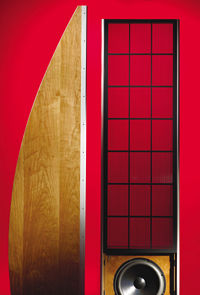
Anyone familiar with Innersound's speakers (the Eros Mk.III was reviewed by Larry Greenhill in April 2003) will notice that, from the front, the Kaya looks like nothing so much as the Eros on steroids. The Kaya's second-generation Ultra Stat panel is nearly 4' tall, and this accounts in part for its ability to take huge momentary power inputs. Wes Bender explained that the panel is virtually impossible to blow up or damage in real-world listening circumstances. Unlike classic electrostatic drivers, the stators that carry the high voltages necessary to create the electrostatic field are embedded in a proprietary constrained-layer material that provides perfect insulation. This means that the tiny irregularities present on coated drivers cannot act as potential "arc-over" points (think of minuscule lightning rods). Innersound's white paper asserts that the Ultra Stat is entirely impervious to variations in temperature and humidity.
Admittedly, an elecrostatic loudpeaker that doesn't have to reproduce bass is capable of much higher SPLs than one that has to act over the full audioband. But hybrids have their own set of issues. It's no easy thing to successfully mate a necessarily massy dynamic woofer with an almost massless 'stat panel and get the two to sing with one voice.
The Kaya echoes the Eros in its use of a 10" woofer in a transmission-line cabinet to handle frequencies below 350Hz. Innersound's Compact Transmission Line is tapered so that it has an "infinite number of very tiny resonances that are then completely absorbed by special damping material contained within the line." The Kaya's cabinet is larger and more sophisticated than the Eros's, featuring a "unique four-layer laminated back [for] minimal internal reflections and virtually no resonance." A "specially developed 10" low-mass paper bass driver" is used; Innersound says that the driver features a patented magnetic damping system. Said woofer is driven by an external 600Wpc crossover-amplifier that is supplied as a part of the system, so an extra set of interconnects from the crossover amp to the main amp is required, as is biamping of the speaker proper.
The amplifier is remote-controllable for overall volume, as well as low-bass output below 100Hz over a 12dB range; a Midrange control adjusts the woofer's output in the crossover range in 1dB increments. The Kaya amplifier also has one very irritating ergonomic feature—its WBT binding posts (footnote 1) are arranged with their slots at 180 degrees to each other. The tails of my current reference speaker cables, the Cardas Golden References, were not long enough to both cross and reach the slots, so I was forced to use Monster X-Terminator banana plugs with the Cardases. (The X-Terminators had a tendency to pop out of the banana jacks in the center of the amp's binding posts.)
The Kaya's appearance is Scandinavian-modern elegant—tall and slim, with lovely maple veneers and brushed-aluminum facing combining to capture a graceful, light feeling. It's the antithesis of a big, dark, Darth Vaderish box. Side "wings" flow down from the panel's top to the top of the woofer cabinet, and though I could hear a resonance when I tapped the wings' surfaces, that resonance appears to be below the point at which the panel crosses over. John Atkinson's measurements will doubtless ferret out the truth.
Setup was not overly difficult. Innersound designer Roger Sanders has not tried to counteract the natural beaminess of electrostatics at high frequencies, so the Kayas required a considerable amount of toe-in and, for nearfield listening, some back-to-front downtilt. After Wes Bender left, I played around with the Kayas' positions, eventually toeing them in a bit less, so that I could see the merest sliver of the woofer cabinet's side from my listening position. They also liked being placed a bit closer to the front wall than I'm used to. Their final positions were 33" from the sidewalls to the speakers' centers, and 45" from the front wall; this provided a good combination of bass reinforcement and soundstage dimensions.
You're the top
I've listened to a good many excellent dynamic speakers, and have described a few as sounding "electrostatic-like." And some of them did have electrostatic-like qualities—there's no question that, in its phenomenal extension and remarkable (once broken in) sweetness, the beryllium tweeter in Focal-JMlab's latest, Be series of Utopias is the finest dome tweeter I've ever heard.
The Kaya's Ultra Stat panel was also very much the real deal, but as only a great electrostat can be. The Kaya resolved spatial information and instrumental and vocal details with stunning acuity. The more elaborate the music—be it the performance of Liszt's Piano Concerto 2 by Sviatoslav Richter, Kiril Kondrashin, and the London Symphony (LP, Philips 6880 046, footnote 2), or the complex layers of deliciously addictive techno-pop in Sugar's "Heart and Soul" (Japanese CD single, Toys Factory TFCC-89110)—the more the Kaya showed. The Kaya could split hairs to as fine a degree as I have heard from any speaker, and delivered extraordinary and, quite possibly, standard-setting transparency, regardless of the type of music I played through them.
Footnote 1: While they sound perfectly fine, I abominate these plastic-covered, slotted, Euro-nanny terminals more than earaches and watered booze combined. They don't fit a Postman terminal wrench, and I'm always in fear that using an adjustable wrench on them will crack the slick plastic that resists so well any attempt with the fingers to tighten them down firmly.—Paul Bolin Footnote 2: This gem was recorded by the famous Mercury Living Presence team of Wilma Cozart Fine, C. Robert Fine, and Robert Eberenz.—Paul Bolin
Last May, I suspected that my lifelong electrostatic drought had come to an end when I heard the Innersound Kaya Reference system ($20,000/pair) at Home Entertainment 2004 East, in New York. I was instantly taken by their striking looks and their ability to hold up to even my loudest, most bass-heavy J-pop CDs with no strain. Both John Atkinson and I were impressed, and arrangements were promptly made for review samples to be sent along.
The Kayas arrived in early August, with Innersound's Wes Bender in tow to assist in moving, unpacking, and setup. Compared to some of the mammoth speakers I've had in-house over the last few years, moving and unpacking the relatively svelte Kayas was a piece of cake—the two of us were able to manage it in less than an hour. And you don't even need to charge them up—just plug them into the wall and you're ready to go.
Family values
Anyone familiar with Innersound's speakers (the Eros Mk.III was reviewed by Larry Greenhill in April 2003) will notice that, from the front, the Kaya looks like nothing so much as the Eros on steroids. The Kaya's second-generation Ultra Stat panel is nearly 4' tall, and this accounts in part for its ability to take huge momentary power inputs. Wes Bender explained that the panel is virtually impossible to blow up or damage in real-world listening circumstances. Unlike classic electrostatic drivers, the stators that carry the high voltages necessary to create the electrostatic field are embedded in a proprietary constrained-layer material that provides perfect insulation. This means that the tiny irregularities present on coated drivers cannot act as potential "arc-over" points (think of minuscule lightning rods). Innersound's white paper asserts that the Ultra Stat is entirely impervious to variations in temperature and humidity.
I've listened to a good many excellent dynamic speakers, and have described a few as sounding "electrostatic-like." And some of them did have electrostatic-like qualities—there's no question that, in its phenomenal extension and remarkable (once broken in) sweetness, the beryllium tweeter in Focal-JMlab's latest, Be series of Utopias is the finest dome tweeter I've ever heard.
Footnote 1: While they sound perfectly fine, I abominate these plastic-covered, slotted, Euro-nanny terminals more than earaches and watered booze combined. They don't fit a Postman terminal wrench, and I'm always in fear that using an adjustable wrench on them will crack the slick plastic that resists so well any attempt with the fingers to tighten them down firmly.—Paul Bolin Footnote 2: This gem was recorded by the famous Mercury Living Presence team of Wilma Cozart Fine, C. Robert Fine, and Robert Eberenz.—Paul Bolin