What's in a name? One of my favorite Rodrigues cartoons (footnote 1) shows a meeting of a loudspeaker manufacturer's marketing people, trying to come up with a name for the company's latest product: "Why don't we call it 'XTL-3340'?" "How about 'GA-75V'?" "I've got it! The TXT-9'!"  Another approach to naming a speaker is to use a term that suggests something positive about its performance. "Revelation" implies that listening to the speaker will reveal previously hidden or obscure truths. There's also a religious association—Hales Design Group may be implying that listening to the speaker will be a kind of spiritual experience (footnote 2). Not bad for $2195—but can they deliver on the promise? And what about the claim that "what we made will forever change the world of dynamic loudspeakers...an instant classic, a benchmark against which others of its type are measured"? I had some serious claim-checking to do. Design and setup
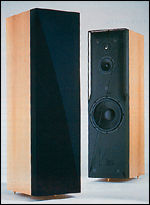
At first glance there's nothing startling or technologically innovative here—just your typical sealed-box three-way with fourth-order crossovers. No exotic drivers, either: 1" Vifa aluminum-dome tweeter, 4.5" Vifa cone midrange driver, and a 10" woofer.
A closer look reveals some departures from the routine. The woofer is not an off-the-shelf item, but was specifically designed by Paul Hales for the Revelation Three. The crossover uses OFC air-core inductors and polypropylene capacitors. The binding posts (single-wire only) and internal wiring are by Cardas—unusual at this price level. And then there's the cabinet: 1"-thick MDF walls, 4"-thick MDF baffle with rounded edges, heavily braced, and weighing substantially more than similar-looking models from other manufacturers. The enclosure's wood veneer is finished with a clear satin lacquer.
Footnote 1: Charles Rodrigues, Total Harmonic Distortion. New York: Perfectbound Press, 1988.Footnote 2: There's no truth to the rumor that Hales was going to title the owner's manual The Book of Revelation.
Another approach to naming a speaker is to use a term that suggests something positive about its performance. "Revelation" implies that listening to the speaker will reveal previously hidden or obscure truths. There's also a religious association—Hales Design Group may be implying that listening to the speaker will be a kind of spiritual experience (footnote 2). Not bad for $2195—but can they deliver on the promise? And what about the claim that "what we made will forever change the world of dynamic loudspeakers...an instant classic, a benchmark against which others of its type are measured"? I had some serious claim-checking to do. Design and setupAt first glance there's nothing startling or technologically innovative here—just your typical sealed-box three-way with fourth-order crossovers. No exotic drivers, either: 1" Vifa aluminum-dome tweeter, 4.5" Vifa cone midrange driver, and a 10" woofer.
Footnote 1: Charles Rodrigues, Total Harmonic Distortion. New York: Perfectbound Press, 1988.Footnote 2: There's no truth to the rumor that Hales was going to title the owner's manual The Book of Revelation.